
Lusha is popular for its speed. If you’re on LinkedIn and need a phone number right now, their extension usually works. It’s a go-to for many SDRs because it doesn't disrupt their daily workflow.
But speed doesn't matter if the data is wrong. The main reason people look for an alternative is the "no data found" message or, worse, dialing a number that’s been out of service for a year. Since Lusha only checks its own database, you're stuck with whatever they have on file. Adding to that is its seat-based pricing structure, which may feel like a tax as your team grows.
Then comes the Lusha’s complex credit system. A direct phone number reveal can cost up to 5 credits, while an email only costs 1. This makes 'match rates' a dual concern: if the tool fails to find a number, you are not charged any credit, but if it finds a wrong number, those 5 credits are lost forever, as Lusha does not refund for invalid data.
On Which Parameters is Lusha Compared to Other Alternative Data Tools?
When comparing these tools, we look at what actually helps a sales rep book a meeting. It’s not just about the Lusha pricing; it's about the effort wasted on bad leads. So your focus should be on:
- Match Rates: How often does the tool actually find a working mobile number?
- Verification: Is the email checked immediately when you click "find," or is it using old data?
- Pricing Model: Are you required to sign a per-user contract, or can your entire team share credits? Will you still be charged for invalid leads?
- International Data: Does the coverage hold up outside of the US?
Best Alternatives to Lusha
Tools | Best For | Starting Price | Free Trial | Data Accuracy | G2 Rating |
|---|---|---|---|---|---|
FullEnrich | Teams needing waterfall enrichment from 20+ sources | $29/month | Yes (First 50 Leads) | 99% Deliverability (with an 80%+ Match Rate) | 4.8/5 |
Lead411 | Teams needing intent triggers, like funding or hiring | $49/month | Yes (Limited Credits) | 90-95% | 4.5/5 |
Kaspr | Individual SDRs focused on European LinkedIn data | €59 /month | Yes (5 Credits) | 90-92% | 4.4/5 |
Dealfront (Now Leadfeeder) | Targeting the DACH region with GDPR compliance | €99/month | Yes (Limited) | 90-95% | 4.3/5 |
People Data Labs | Developers needing raw data via API for bulk enrichment | $98/month | Yes (Free Tier) | 90%+ | 4.3/5 |
LeadFuze | Automated list building using AI (Fuzebot) | $147/month | Yes (25 Credits) | 92-95% | 4.6/5 |
Instantly | High-volume email outreach with built-in leads | $37/month | No (Paid Credits) | 85-90% | 4.8/5 |
RocketReach | Finding C-suite and personal email addresses | $49/month | Yes (5 Credits) | 90-95% | 4.4/5 |
Cognism | Enterprise teams needing phone-verified EMEA data | ~$15k/year | No Free Trial | 98% (Diamond Data) | 4.5/5 |
Apollo | All-in-one platform for database and sequences | $59/month | Yes (Free Tier) | 85-88% | 4.7/5 |
ZoomInfo | Deep enterprise intelligence and org charts | ~$15k/year (Quote based) | No Free Trial | 90-92% | 4.5/5 |
Swordfish | Finding direct cell phone numbers for recruitment | $99/month | Yes (Limited) | 95%+ for emails, ~80% for direct cell phones. | 4.5/5 |
1. FullEnrich
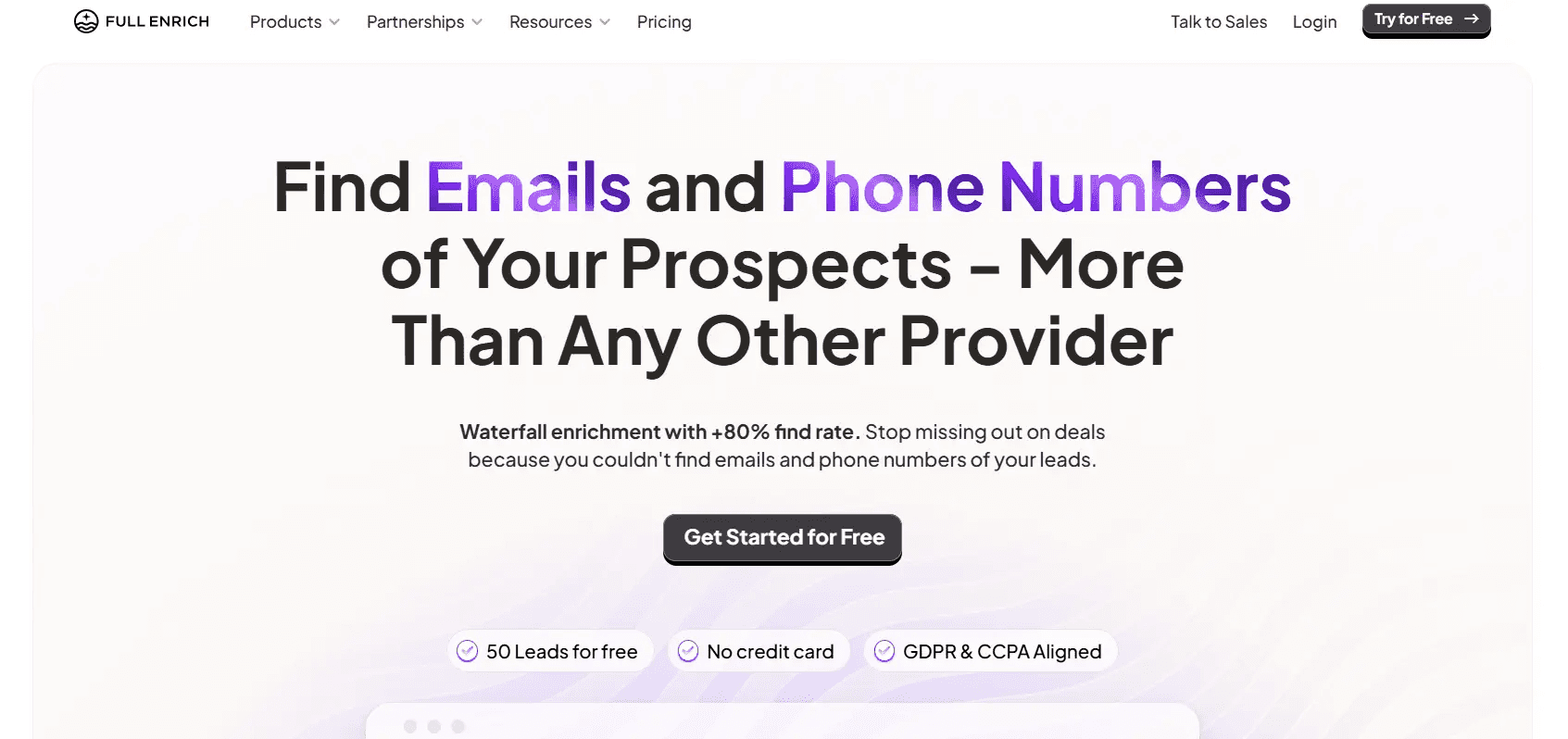
Best For: Sales teams that need to find the phone numbers that single-source databases miss.”
Best Capabilities: 20+ Source Waterfall Enrichment, Triple-Verification & Unlimited Seats.
Pricing: Starts at $29/month.
Ease of Use: Beginner to Intermediate.
FullEnrich solves the biggest problem with Lusha: hitting a data-coverage wall. Lusha is one database, which means it has limits. FullEnrich is a Waterfall Enrichment platform. Instead of checking a single list, it automatically pings more than 20 data providers in a row until it finds a verified mobile number or email address.
Fullenrich works best for teams that are tired of jumping between three different tools to find a single person's contact information. It handles the heavy lifting in the background, especially for international leads where a single US-based database usually fails. You aren't paying for "seats"; you pay only for the data you actually find, and your whole team can jump in on one plan.
How does FullEnrich handle team scaling differently from Lusha?
Lusha becomes expensive quickly because it charges for each user you add. FullEnrich gives you unlimited seats with every plan. This makes the platform easier on your budget as you grow. More importantly, you will no longer receive "data not found" errors. Because it draws from 20+ sources, it finds the right information far more often than a single-source tool ever could.
Best Capabilities
These features are designed to ensure your sales team spends more time talking to prospects and less time cleaning lists or dealing with dead ends.
- Waterfall Enrichment: It checks 20+ different sources for every lead you search.
- Verified Phone Ownership: Confirms that the mobile number belongs to your prospect.
- Credit Rollover: Your unused credits stay active for 3 months.
- LinkedIn Scraper: You can turn a whole Sales Navigator search into a clean list in one go.
- Reverse Email Lookup: Find any B2B contact from an email.
Pricing Plans
Pricing is designed to be flexible, so you pay only for verified data, without hidden user fees or platform taxes.
- Starter ($29/mo): 500 credits, unlimited users.
- Growth ($55/mo): 1,000 credits, unlimited users.
- Scale (Starts at $500 /mo): custom credits
Here is how the credit logic works:
- 1 Work Email = 1 Credit
- 1 Mobile Phone = 10 Credits
- 1 Personal Email = 3 Credits
Pros:
- There is a much higher chance of finding a number than in any single database.
- No additional cost to add more team members.
- Triple-verification keeps your bounce rate under 1%.
Cons:
- Phone data enrichment is expensive.
- It doesn't track "Intent Data" (who is visiting your site).
2. Lead411
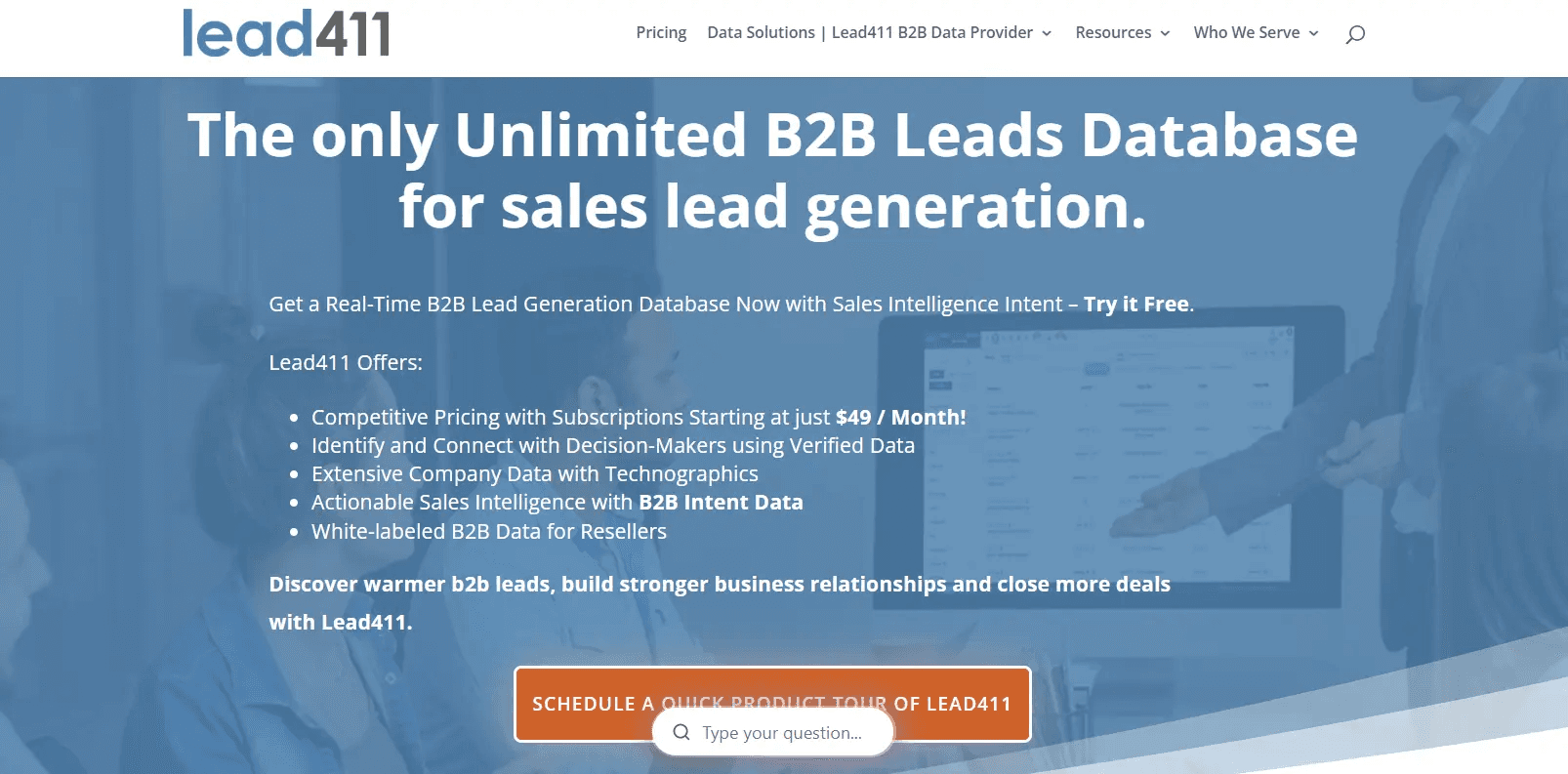
Best For: Sales teams who want to combine highly accurate contact data with real-time 'buying triggers' like funding news or job changes.
Best Capabilities: Growth Intent Data, Sales Automation, Global Contact Database, and CRM Data Refresh.
Pricing: Starts at $49/month.
Ease of Use: Beginner.
Lead411 is built for reps who don't want to call people out of the blue. While Lusha just gives you a number, Lead411 tells you why you should call. It tracks "Growth Intent" signals, such as a company receiving new funding or hiring a new VP, so you can reach out when they have a reason to buy.
One of the biggest wins here is their focus on data accuracy. They don’t just scrape the web; they use a mix of technology and human verification to keep their lists clean. If you're tired of dialing into "ghost" companies that went out of business six months ago, Lead411 is a much more reliable partner for your outbound efforts.
Is Lead411 more reliable for outreach than Lusha?
Lusha is great for a quick LinkedIn lookup, but Lead411 is built for building entire lists around specific news. If you need to know which companies in your territory have just launched a new product, Lead411 will provide that context, along with verified mobile numbers.
Also read: Lead411 vs Lusha
Best Capabilities
Beyond simple contact lookups, these tools allow you to prioritize your outreach based on what is actually happening at your target accounts.
- Growth Intent Triggers: Get alerts on funding, hiring, and office moves.
- Unlimited Business Emails: High-tier plans enable large-scale list building without credit caps.
- Reach Outreach: Built-in tools to send emails and SMS directly from the platform.
- CRM Sync: Strong automated integrations with Salesforce, HubSpot, and Zoho.
Pricing Plans
Lead411 plans are structured around the depth of intelligence you need, moving from basic lookups to full intent-based tracking.
- Free Trial ($0): 7 days of access with 50 free leads/exports to test accuracy.
- Spark ($49/mo): 1,000 exports per month, verified emails, direct dials, and the Chrome extension.
- Ignite ($150/mo): 1,000+ exports per month plus API access and advanced CRM customizations.
- Blaze (Custom Quote): Unlimited exports per year and full data-governance features.
Pros:
- Very accurate data with fewer "dead" numbers than volume-heavy tools.
- The "Sales Intelligence" features help you time your outreach perfectly.
- Includes a built-in tool for sending basic outbound sequences.
Cons:
- The interface may feel somewhat dated compared to Lusha’s clean extension.
- Pricing is higher if you need only a few lookups per month.
3. Kaspr
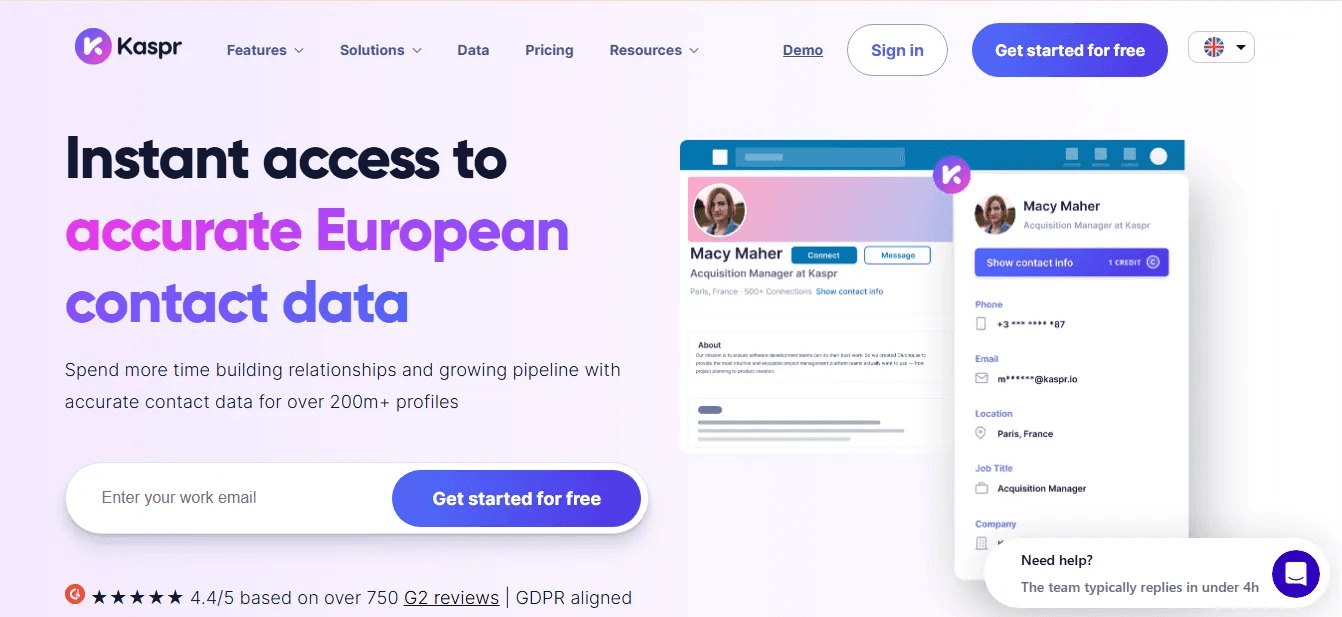
Best For:Individual SDRs and recruiters who want a cheaper, more flexible version of Lusha’s LinkedIn extension and for teams for teams looking for accurate, real-time verified data in Europe.”
Best Capabilities:Automated LinkedIn Workflows, Real-time Lead Capture, CRM Integration, and Lead Management.
Pricing:Free plan; Paid plans start at €59 /month (or €45/month billed annually).
Ease of Use:Beginner.
Kaspr is often seen as the "European Lusha." It works in almost the same way, a simple Chrome extension that pops up when you're on a LinkedIn profile. It’s designed to be fast and easy, but it often has better match rates for leads in Europe and the UK. If you like the Lusha workflow but find data quality lacking in international markets, Kaspr is an immediate alternative to test.
They also offer more automation than Lusha. You can set up "workflows" that automatically find the contact info for anyone who likes a specific post or comments on a thread. It’s a great way to turn social activity into a verified list of leads without manually clicking every profile.
Why do individual reps often move from Lusha to Kaspr?
Kaspr is generally more generous with its credits and has a much better "Free" tier for testing. For a solo rep or a small startup, it offers a more affordable entry point. Data in Europe is also notably stronger, so if your territory isn't strictly North American, you'll likely see higher success rates with Kaspr.
Also read: Kaspr vs Lusha
Best Capabilities
These features focus on automating the "social" side of selling, making it easier to pull leads from LinkedIn engagements.
- LinkedIn Automation: Automatically enrich leads from posts, groups, or searches.
- Lead Dashboard: A clean place to manage and export your saved contacts.
- Bulk Enrichment: Enrich hundreds of LinkedIn profiles at once with a single click.
- API Access: Connect your data flow directly to your custom apps or internal tools.
Pricing Plans
The pricing is geared toward individuals and small teams, offering a low-barrier entry to premium contact data.
- Free: 5 phone credits and 5 direct email credits.
- Starter (€59 /mo): Unlimited B2B email credits, 100 Phone credits, 5 Direct email credits
- Enterprise (€99 /mo): Unlimited B2B email credits, 200 Phone credits, 200 Direct email credits
- Enterprise (Contact Sales): Everything custom
Pros:
- Excellent match rates for European and UK-based prospects.
- More "social" automation features than Lusha.
- Very easy to set up.
Cons:
- The database is smaller than the enterprise-grade tools.
- Can occasionally pull old contact information instead of work addresses.
4. Dealfront (Now Leadfeeder)
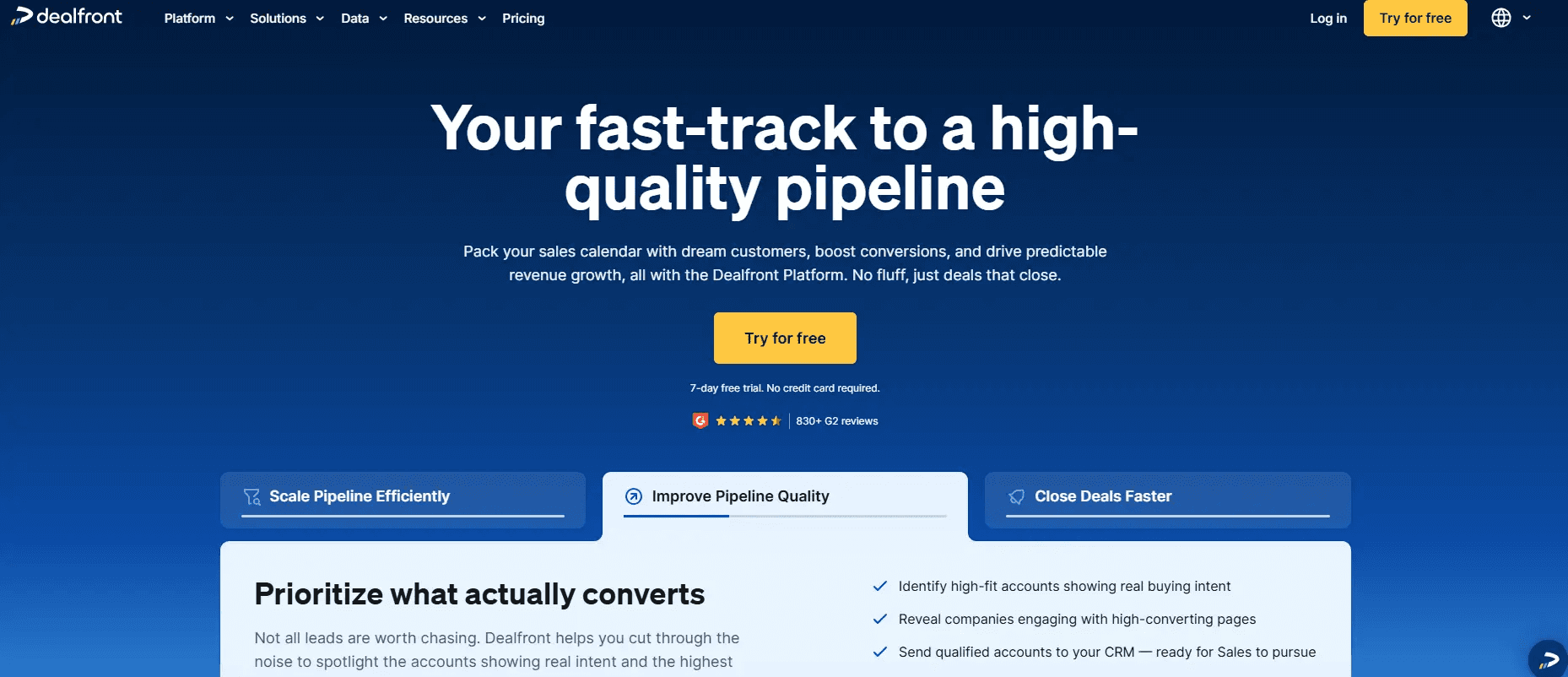
Best For: Teams targeting the DACH region (Germany, Austria, Switzerland) who need deep, compliant data and local market insights.
Best Capabilities: Web Visitor Identification, Sales Triggers, and B2B Intent Data.
Pricing: Starts at €0 (Lite plan) or €99/month (billed annually) for Website Visitor Identification
Ease of Use: Intermediate.
Dealfront is the result of a merger between Echobot and Leadfeeder, creating a powerhouse specifically for the European market. While Lusha is often the first choice for US-based prospecting, Dealfront (which has recently rebranded under the Leadfeeder name) specializes in the complexities of European data. It doesn't just provide a phone number; it offers a 360-degree view of European companies, including local-language data and financial records that US-centric tools often miss.
For teams operating under strict GDPR, Dealfront is a safer bet. They prioritize "privacy-first" data sourcing, ensuring your outreach remains compliant with local laws in countries such as Germany and Austria. If you've ever struggled with limited coverage or the legal risks of using U.S. databases in the EU, Dealfront provides the depth and security required for international expansion.
How does Dealfront’s focus on Europe provide an edge over Lusha?
Lusha’s coverage in Europe is often overlooked, leading to many "no data found" results. Dealfront makes Europe its entire focus. By using local crawlers and sourcing data from national trade registers, they identify leads and phone numbers that don't exist in broader global databases.
Best Capabilities
These features turn raw European company data into actionable sales triggers that help you time your outreach perfectly.
- Visitor Identification: Unmasks the companies visiting your website so you can reach out while interest is high.
- Sales Triggers: Alerts you to management changes, funding, or office moves within the DACH region.
- Custom Filtering: Search by industry-specific European codes and local financial performance metrics.
- Compliance Suite: Built-in tools to ensure every lead meets the highest GDPR standards.
Pricing Plans
Pricing is transparent and based on whether you need simple web tracking or a full sales intelligence platform.
- Lite (€0/mo): Free forever, revealing up to 100 companies per month with basic visit details.
- Website Visitor Identification (Starts €99/mo): Unlimited identified companies, full visitor history, and CRM integrations.
- Platform (Starts €399/mo): Adds the global database, advanced prospecting filters, and AI enrichment.
Pros:
- The undisputed leader for DACH and the broader European market data.
- Combines web visitor tracking with outbound prospecting in one tool.
- Deeply compliant with the strictest European privacy laws.
Cons:
- More expensive than basic lookup tools like Lusha.
- Not as effective for teams prospecting exclusively in North America.
5. People Data Labs (PDL)
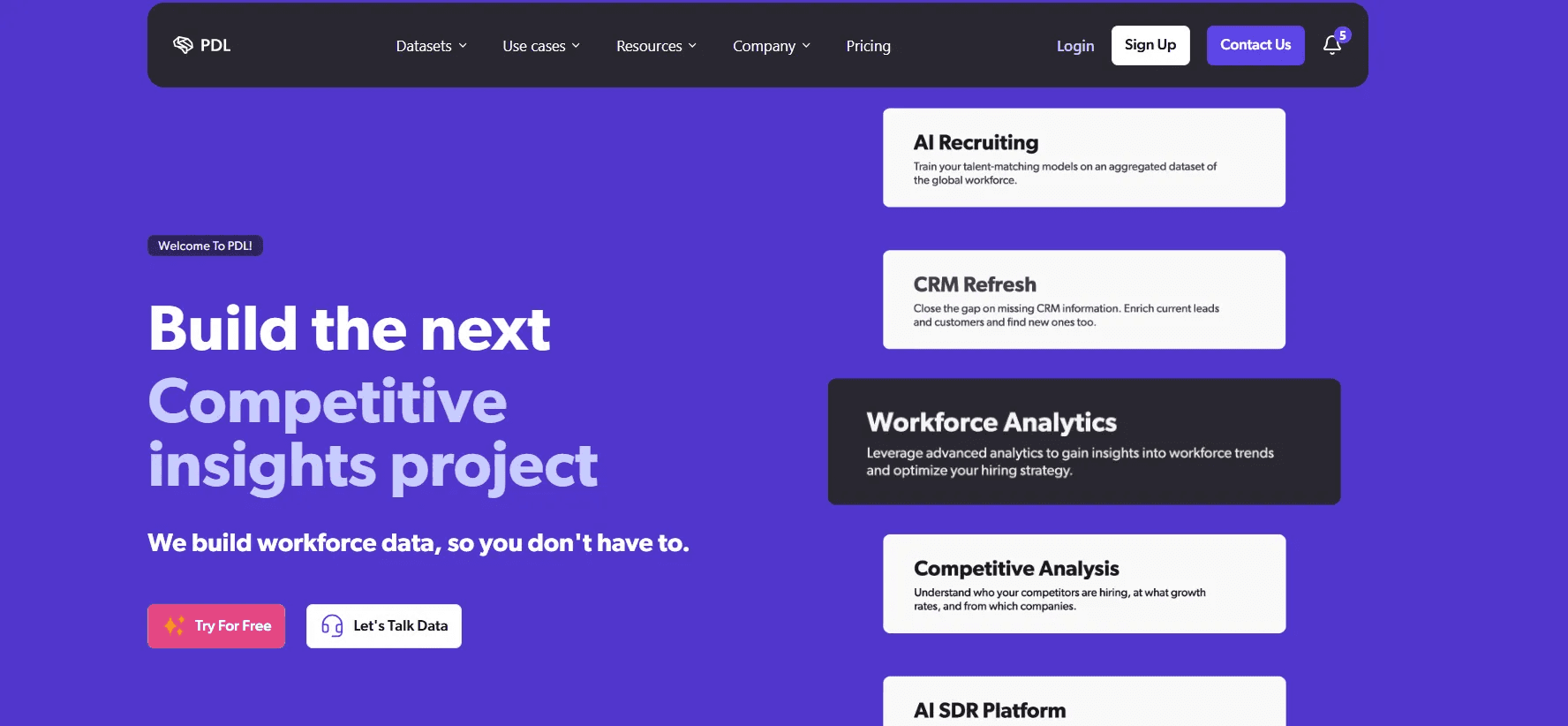
Best For: Engineering teams and data-driven companies that want to build their own internal tools using massive raw data feeds.
Best Capabilities:3 Billion+ records, Flexible Enrichment APIs, Data License Feeds, and Identity Resolution.
Pricing: Starts at $98/month (350 records).
Ease of Use: Advanced (Technical knowledge required).
People Data Labs (PDL) is not your typical browser extension. While Lusha is built for individual SDRs, PDL is built for developers. It is a massive source of raw data containing over 3 billion profiles. Instead of a "point-and-click" interface, you access this data via API. This allows companies to build their own internal prospecting tools, enrich their databases at a massive scale, or power their own software products with B2B intelligence.
This is the "pro-level" alternative. If your team is tired of being limited by a tool's specific interface or "per-seat" model, PDL gives you the raw ingredients to build whatever you want. It is less about "quick lookups" and more about "mass enrichment." For teams with technical resources, PDL offers a level of customization and volume that Lusha can't possibly match.
Is People Data Labs a more powerful solution than Lusha?
For a single sales rep, Lusha is easier to use. But for a company that needs to enrich millions of records or build a custom internal engine, PDL is far more powerful. It removes the "interface" barrier and provides direct access to the underlying data at a much lower cost per record when purchasing in bulk.
Also read: People Data Labs vs Lusha
Best Capabilities
This tool is designed for technical users who need to integrate high-quality B2B data directly into their own code or cloud environment.
- Person & Company APIs: Retrieve deep profiles on individuals and organizations with simple code.
- Identity Resolution: Links disparate data points (like a LinkedIn URL and a personal email) into one clean profile.
- Data License: Purchase entire segments of the database to host locally on your own servers.
- Enrichment on the Fly: Automate the process of cleaning and updating your CRM data in real-time.
Pricing Plans
The pricing model is developer-friendly: you pay for the data you use, making it highly scalable for apps and internal tools.
- Testing APIs: 100 monthly records
- Full APIs ($98/mo): Includes API access with 350 monthly records.
- Bulk Data (Custom): Scaled pricing for high-volume API calls and bulk data exports.
Pros:
- Access to one of the largest professional databases in existence.
- Completely customizable; you build the tool the way you want it.
- Extremely cost-effective for high-volume data needs.
Cons:
- Requires a developer or technical knowledge to set up and use.
- No Chrome extension or user interface for daily sales prospecting.
6. LeadFuze
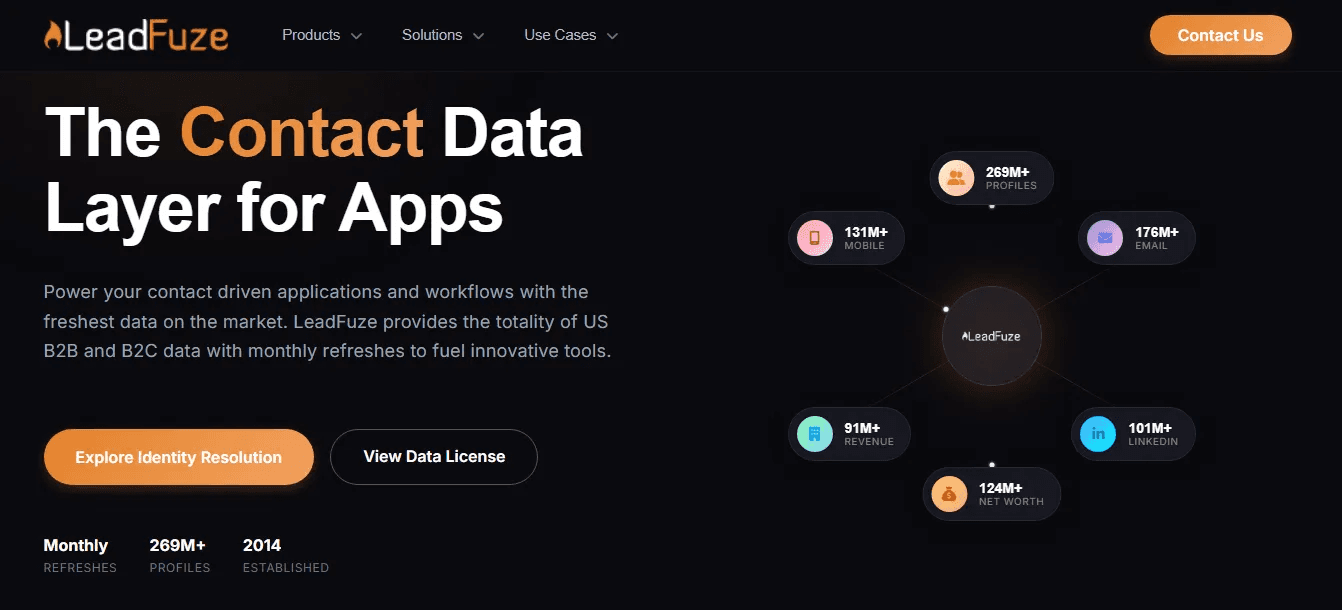
Best For:Small sales teams and agencies that want an automated "AI assistant" to build their lead lists in the background.
Best Capabilities: Fuzebot Automation, Market Insights, and Lead Governance.
Pricing: Starts at $397/month.
Ease of Use: Beginner.
LeadFuze is built around the idea of "Automated Prospecting." While Lusha requires you to search for a LinkedIn profile to retrieve data manually, LeadFuze uses an AI assistant, "Fuzebot," to do the work for you. You simply tell Fuzebot your target criteria, such as "Marketing VPs in the SaaS industry." It then searches for leads, verifies their contact information, and adds them to your list while you focus on other tasks.
It is a "set it and forget it" tool. For small teams that don't have time to spend hours every day on LinkedIn, LeadFuze acts like a junior SDR. It focuses on finding "third-party verified" data, meaning it cross-references multiple sources to ensure the email and phone number are correct before handing them to you.
Why use LeadFuze over Lusha for building lists?
Lusha is a manual lookup tool; LeadFuze is a list-building engine. If you want to wake up every morning to a fresh list of 100 new prospects without doing any manual searching, LeadFuze’s automation handles the heavy lifting that Lusha requires you to do yourself.
Best Capabilities
These features automate the most repetitive parts of prospecting so you can spend more time actually talking to prospects.
- Fuzebot: The AI engine that finds leads and builds your lists automatically based on your ICP.
- Market Insights: Deep data that helps you identify industry trends and hiring patterns before you reach out.
- Lead Governance: Prevents you from accidentally adding the same lead twice or contacting people already in your CRM.
- Hyper-Targeting: Filters leads by specific technical skills, years of experience, and even specific software they use.
Pricing Plans
Pricing is based on the number of "leads" you want to find per month, with no hidden seat fees for small teams.
- Free Trial ($0): Gives you access to the system to run searches and identify your total addressable market.
- Unlimited ($397/mo): Provides unlimited lead credits per month. This plan requires an annual commitment and is billed monthly.
- Scaling ($497/mo): Includes 2,500 lead credits per month for individuals or teams looking to scale their efforts without an annual commitment.
- Custom (Quote-based): Tailored for teams needing more than 2,500 credits or those with 5+ users, with options to customize feature access and permissions.
Pros:
- "Set it and forget it" automation saves hours of manual work every week.
- Very high accuracy due to their third-party verification process.
- Great for finding niche leads that require very specific filtering.
Cons:
- More expensive entry price than a simple lookup tool like Lusha.
- The interface can be overwhelming for absolute beginners.
7. Instantly
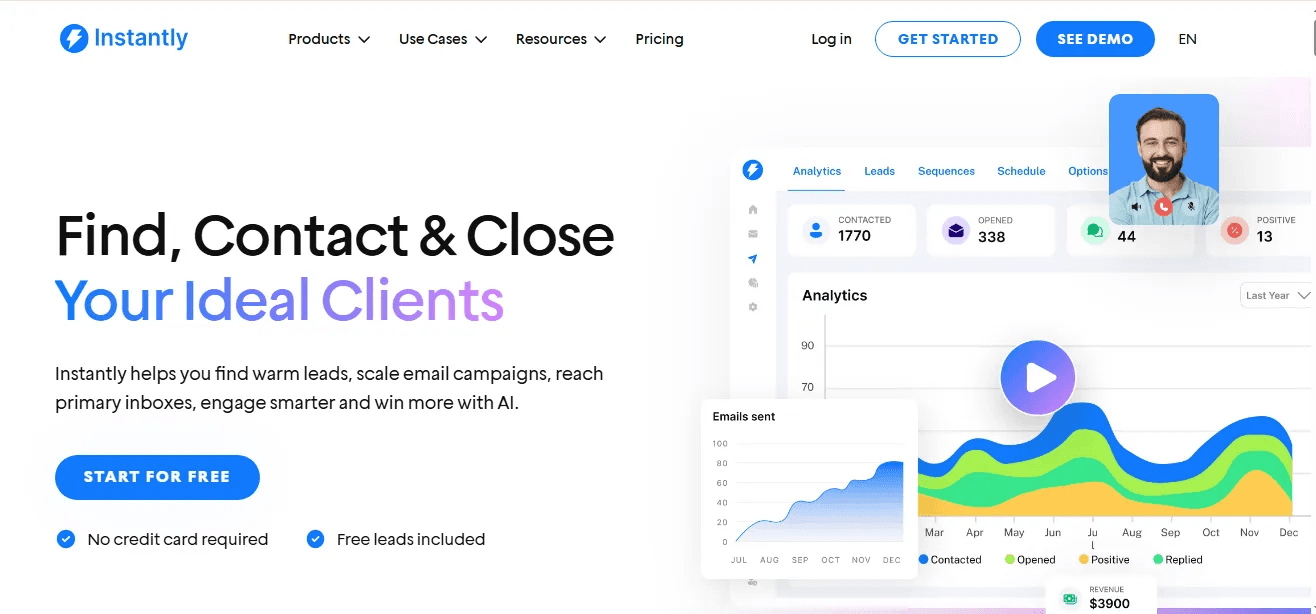
Best For: Cold emailers who want to find leads and launch outreach sequences from a single, unified dashboard.
Best Capabilities: SuperSearch, Unlimited Email Warmup, & Built-in Deliverability Network.
Pricing: Starts at $47 /month (Outreach).
Ease of Use:Beginner.
It has become a favorite for teams that focus heavily on email. Unlike Lusha, which is mostly a lookup tool, Instantly is a full outreach engine. Their "SuperSearch" database provides access to 450 million leads you can push directly into a sequence. It’s designed to remove friction when moving data between platforms, enabling you to go from "searching" to "sending" in a few minutes.
The real draw here is the deliverability. Instantly includes unlimited email warmup and a private network of millions of accounts to help your messages actually land in the primary inbox. If you’re doing high-volume email prospecting and find Lusha’s per-credit cost too high for simple list building, Instantly offers a much more affordable path to scaling your sending volume.
How does Instantly’s outreach focus compare to Lusha’s data-only model?
Lusha is better for finding a specific phone number, but Instantly is better for running a business. If you need to send 1,000 emails a day, having the database and the sending tool in one dashboard is far more efficient than the manual "find-then-export" workflow Lusha requires.
Best Capabilities
These features are designed to keep your outreach automated and your sender reputation healthy.
- SuperSearch: A massive database of 450M+ B2B contacts with built-in filtering.
- Unlimited Warmup: Automatically interacts with your emails to help them avoid spam folders.
- AI Reply Agent: Categorizes responses and can even draft replies to interested prospects.
- Unibox: A centralized inbox that lets you manage replies from dozens of sending accounts in one place.
Pricing Plans
Instantly uses a flat fee for the sending platform, while lead credits are purchased separately or bundled into higher tiers.
Outreach Plans (Sending):
- Growth ($37.6/mo yearly or $47/mo monthly): Unlimited accounts and warmup, 1,000 uploaded contacts, and 5,000 emails per month.
- Hypergrowth ($77.6/mo yearly or $97/mo monthly): 25,000 uploaded contacts and 100,000 emails per month.
- Light Speed ($286.3/mo yearly or $358/mo monthly): 100,000+ uploaded contacts and 500,000+ emails per month with the SISR system.
Instantly Credits Plans (Lead Finder):
- Growth ($37.6/mo yearly or $47/mo monthly): Includes 1,500–2,000 Instantly Credits monthly and waterfall work email enrichment.
- Supersonic ($87.3/mo yearly or $97/mo monthly): Includes 5,000–7,500 Instantly Credits monthly.
- Hyper Credits (From $177.3/mo yearly or $197/monthly): Scales from 10,000 to 200,000 credits per month.
Pros:
- Best value for money if you need to send a high volume of cold emails.
- Built-in warmup makes deliverability much easier to manage.
- Extremely fast and modern user interface.
Cons:
- Phone data and direct dials are less accurate than specialized databases.
- Lacks the deep organizational charts and "intent" data of enterprise tools.
8. RocketReach
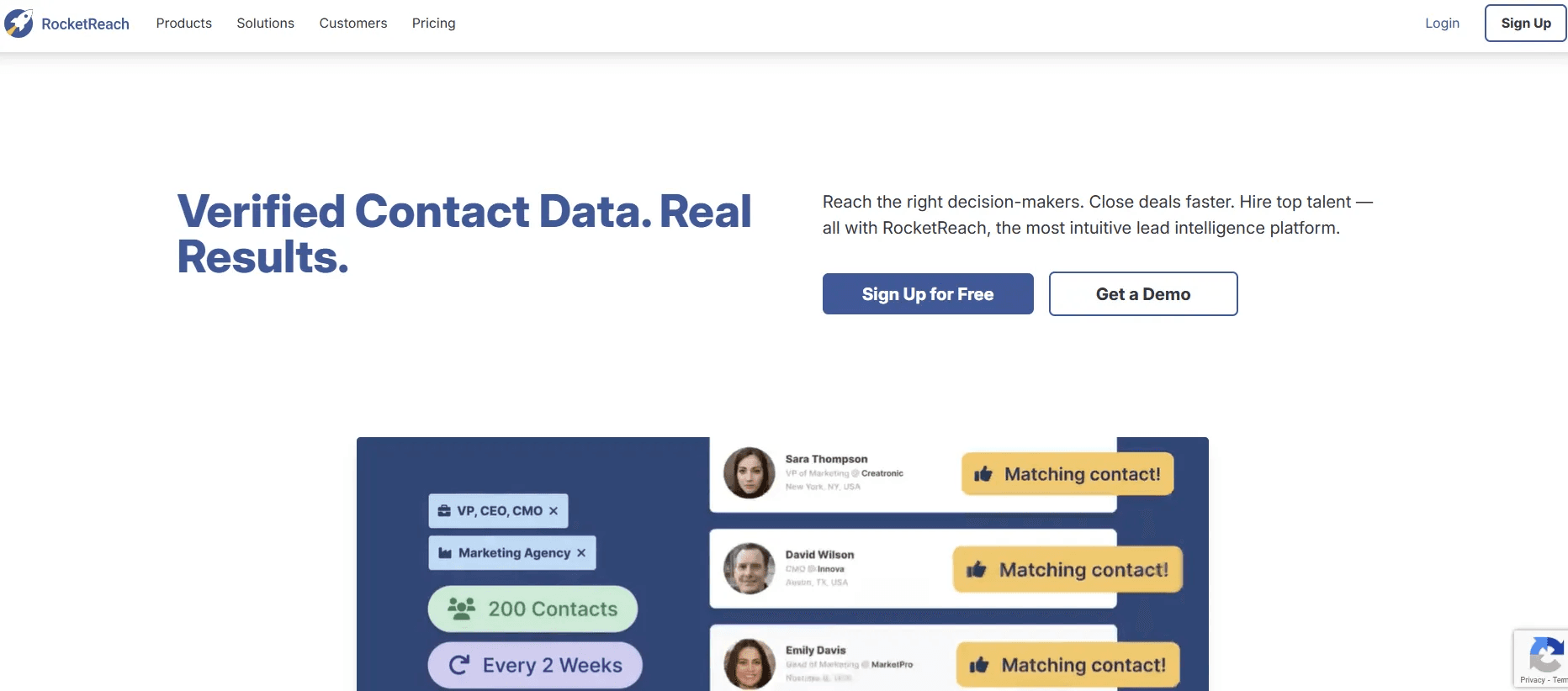
Best For: Finding high-level executives and personal email addresses that are typically hidden from standard business databases.
Best Capabilities: 700M+ Profile Database, AI-Powered Recommendations, and Bulk Enrichment.
Pricing: Starts at $49/month.
Ease of Use:Beginner.
RocketReach is a massive global database that excels where others fall short, particularly in senior leadership and niche roles. While Lusha is great for a quick LinkedIn lookup, RocketReach is the "final boss" tool. If you can’t find a lead’s contact info anywhere else, there’s a high chance RocketReach has a verified personal email or a direct dial on file.
The platform’s major focus is data. It doesn't try to be a full-scale CRM or a sequencer; it just provides the most exhaustive list of professional and personal contact details available. It’s particularly useful for international markets where smaller databases often have significant gaps.
Is RocketReach a more reliable fallback than Lusha for niche roles?
Yes. Because RocketReach has a significantly larger database (700M+ profiles), it often finds contact info that Lusha misses. For "hard-to-find" roles or C-suite executives, it is a much more powerful alternative.
Also read: Rocketreach vs Lusha
Best Capabilities
These features are designed to help you find the person behind the professional profile, even when they aren't at their desk.
- Massive Search: One of the world's largest databases with 700M+ professionals.
- Personal Email Reveal: Finds non-work emails that have a higher response rate for certain roles.
- RocketReach Email Finder Extension: A browser tool that works across LinkedIn, Google, and corporate sites.
- AI Recommendations: Suggests new prospects based on your previous successful searches.
Pricing Plans
Pricing is on the higher side and is tiered based on whether you need email-only or full phone data.
- Free ($0): 5 free lookups with no credit card required to test the data.
- Essentials ($49/mo): 100 monthly lookups for email only.
- Pro ($99/mo): 250 monthly lookups, including email and phone numbers, plus CRM integrations.
- Ultimate ($209/mo): 1,000 monthly lookups with Intent Data and Salesforce custom mapping.
Pros:
- Incredible "find rate" for senior executives and personal contacts.
- Massive global reach, especially in markets outside North America.
- Very simple and approachable search interface.
Cons:
- Expensive on a per-lookup basis.
- Phone data is locked behind the more expensive "Pro" tier.
9. Cognism
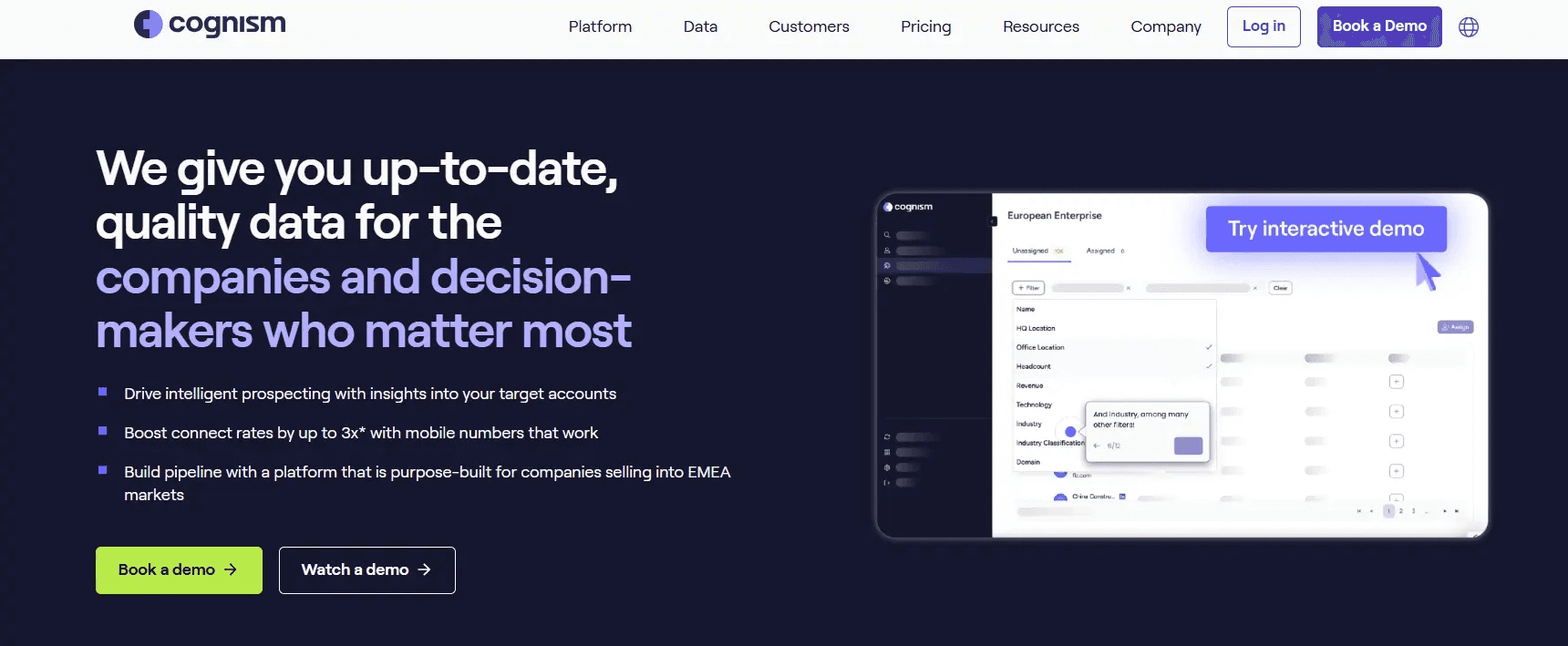
Best For: Mid-market and enterprise teams in Europe (EMEA) that need the highest possible phone accuracy and GDPR compliance.
Best Capabilities: Diamond Data®, Intent Data via Bombora, and Sales Companion.
Pricing: Starts at ~$15,000/year (Platform fee + per-seat licenses).
Ease of Use: Intermediate.
Cognism is the premium choice for teams that conduct extensive cold calling. Their flagship feature is "Diamond Data," where mobile numbers are manually called and verified by a human researcher. This eliminates the "wrong number" or "disconnected line" waste that frustrates SDRs using bulk-scraped tools like Lusha. If you want your reps to spend 90% of their time actually talking to prospects rather than dialing dead air, Cognism is the standard.
For companies operating in Europe, Cognism is almost a compliance requirement. They check 13+ "Do-Not-Call" lists and ensure all data meets the strictest GDPR standards. It is an enterprise-level investment with annual contracts, but for teams that need to scale their EMEA outbound with total confidence, the accuracy and compliance are usually worth the premium.
Why switch from Lusha to Cognism for professional cold calling?
Lusha is a great starter tool, but Cognism is built for the pros. If your SDRs are tired of dialing dead ends or running afoul of European privacy laws, the move to Cognism’s phone-verified, compliant data is the most logical step.
Best Capabilities
These features are built for high-performance sales teams where every dial counts and compliance is non-negotiable.
- Diamond Data®: Human-verified mobile numbers with a 98% accuracy guarantee.
- EMEA Strength: Unrivaled data depth for the UK, DACH, and Nordic regions.
- Intent Data: Integrated B2B intent signals through Bombora to prioritize active buyers.
- Chrome Extension: A powerful extension that works on LinkedIn to reveal compliant data instantly.
Pricing Plans
Cognism does not offer monthly plans; it requires a platform fee plus an annual per-seat license.
- Platinum: Typically starts at $15,000/year (basic data and enrichment).
- Diamond: Typically starts at $25,000/year (includes phone-verified Diamond Data).
Pros:
- The highest verified phone accuracy in the European market.
- Best-in-class GDPR compliance and DNC scrubbing.
- Powerful "Buying Intent" signals help you time your outreach.
Cons:
- Expensive with no low-cost entry or monthly plans.
- North American data coverage isn't as deep as their European database.
10. Apollo.io
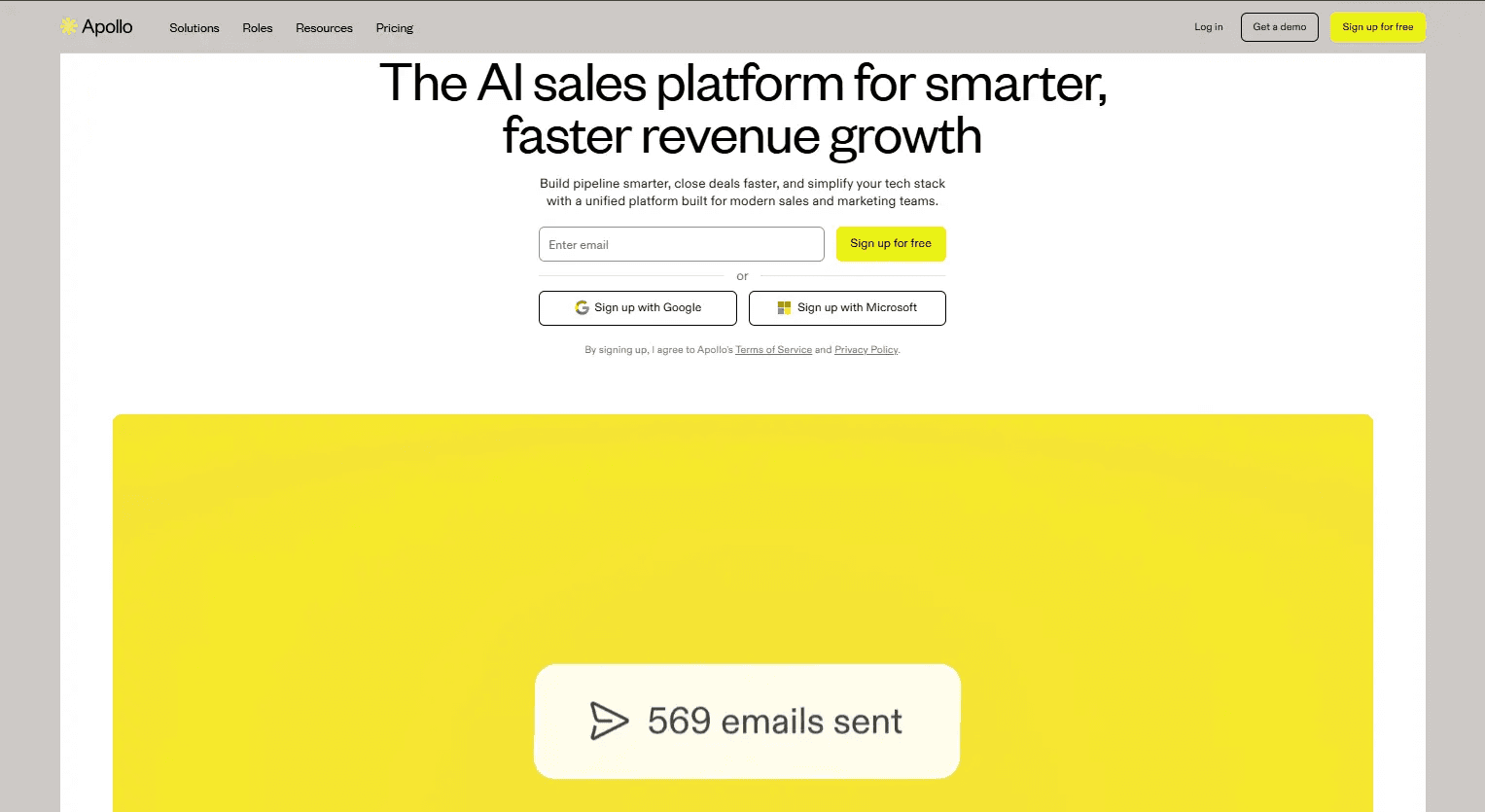
Best For: Teams that want a full 'Sales Operating System' that combines a massive database with a built-in dialer and email sequences for a low price.
Best Capabilities: 275M+ Lead Database, Built-in Cloud Dialer, & Chrome Extension.
Pricing: Starts at $59/user/month (billed monthly).
Ease of Use:Beginner.
Apollo is the "everything tool" of the sales world. Compared to Lusha, which focuses exclusively on high-quality data lookup, Apollo aims to manage your entire sales funnel. It gives you access to a database of over 275 million contacts and provides tools to reach out to them.
However, because Apollo tries to do everything, it doesn't always have the surgical precision of Lusha’s mobile data. You get much more volume for your money, but you might spend more time cleaning the data. Apollo added deep AI features that can write your email sequences based on a prospect's LinkedIn profile, making it a powerful "set and go" platform.
How does Apollo’s all-in-one approach stack up against Lusha’s specialized extension?
Lusha is a precision tool; Apollo is a volume tool. If you only need a few high-quality phone numbers a day, Lusha is usually faster. But if you need to build a list of 500 people and start an automated email campaign immediately, Apollo is much more efficient because you don't have to export data between different platforms.
Also read: Apollo vs Lusha
Best Capabilities
These features let you manage your entire outreach process without leaving the Apollo ecosystem.
- All-in-One Sequences: Build automated multi-channel workflows (Email, Call, LinkedIn).
- AI Writing Assistant: Uses your prospect's data to draft highly personalized emails in seconds.
- Database Filtering: Includes 65+ filters, including "Buying Intent" and "Job Change" alerts.
Pricing Plans
Apollo is known for having one of the most generous free tiers in the industry, followed by low-cost paid plans.
- Free ($0): 75 creditsper user per month, granted upfront
- Basic ($59/mo): 2,500 credits per user per month
- Professional ($99/mo): 4,000 credits per user per month, granted upfront
- Organization ($149): 6,000 credits Per user per month, (min 3 users) Annual Only
Pros:
- Best value for money on the market; replaces multiple tools.
- Massive database with very deep filtering options.
- Excellent free version for testing and small-scale prospecting.
Cons:
- Data accuracy (especially phone numbers) can be less reliable than Lusha.
- The platform can feel overwhelming due to the number of features.
What Users Say:
"Apollo is the easiest choice for a growing team. It’s affordable and handles the whole process from finding the lead to making the call."
G2 Rating: ⭐⭐⭐⭐⭐ 4.8 / 5
11. ZoomInfo
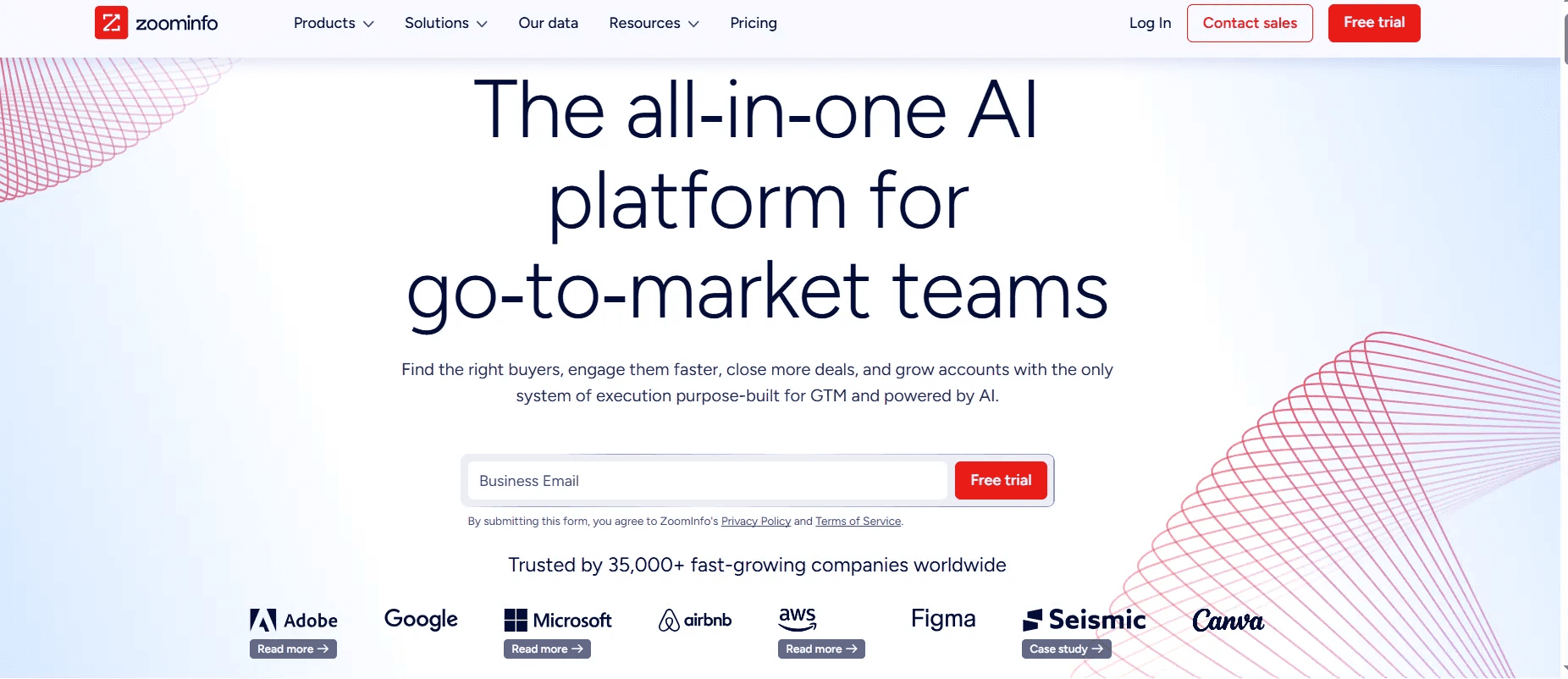
Best For: Scaling B2B organizations and enterprises that need the most detailed corporate intelligence, organizational mapping, and buying intent in the world.
Best Capabilities:Real-time Buying Intent, Deep Org Charts & Website Visitor Tracking.
Pricing: Quote-based (typically $15,000+/year).
Ease of Use: Intermediate to Advanced.
ZoomInfo is the heavyweight champion of B2B data. It is designed to help you map out an entire company. This makes it different from Lusha, which is great for finding a specific person's mobile number. Zoominfo provides deep "Sales Intelligence" that shows you exactly who reports to whom, which software they recently purchased, and which companies are currently searching for your specific product category.
That said, Zoominfo is a massive platform with a price tag to match. Most users are locked into annual contracts that can be quite expensive. But that’s justified because for a large sales team selling complex, high-ticket deals, the depth of ZoomInfo’s data is often the difference between getting a meeting with a CEO and getting stuck at the gatekeeper.
Is the enterprise-level data in ZoomInfo worth the jump from Lusha?
Lusha gives you the "who," but ZoomInfo gives you the "why" and the "when." If you are selling $50k+ deals, you need to know which accounts are actually in-market to buy right now. Lusha does offer "Buying Intent" or "Org Charts," but on a very basic scale. And these features are available with enterprise plans only. Zoominfo, on the other hand, is inherently designed to go deep.
Also read: Zoominfo vs Lusha
Prominent Features
Beyond basic contact information, these tools let you prioritize your outreach based on what is actually happening at your target accounts.
- ZoomInfo Copilot: An AI-powered agent that autonomously reads account intent signals, summarizes recent company news, and drafts hyper-personalized outreach emails directly within the platform.
- Streaming Intent: Identifies companies that are actively researching your product category online.
- Organizational Charts: Visual maps of every department to help you identify stakeholders.
- WebSights: Shows you exactly which companies are visiting your website in real-time.
Pricing Plans
ZoomInfo does not offer monthly plans; they require an annual commitment, and pricing is custom-quoted based on your needs.
- Advanced: Adds intent data, org charts, and CRM workflows.
- Elite: Full enterprise suite with advanced intelligence and support.
Pros:
- The most comprehensive and accurate database for North American enterprise data.
- Intent data allows you to prioritize the "hottest" leads every morning.
Cons:
- Expensive and requires long-term annual contracts.
12. Swordfish AI
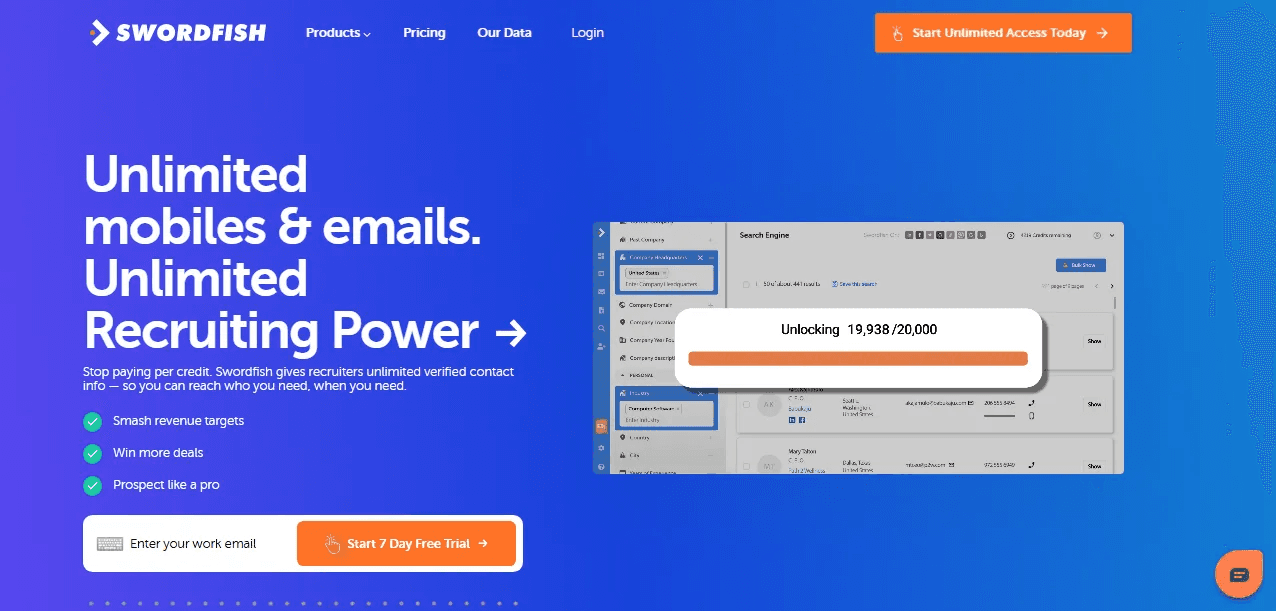
Best For:Finding direct cell phone numbers for prospects in competitive industries like Recruitment, Real Estate, and Tech Sales
Best Capabilities: Social Media Data Extraction, Real-time Phone Validation, and Bulk Enrichment.
Pricing: Starts at $99/month (Monthly) or $49/month (Billed annually).
Ease of Use: Beginner.
Swordfish AI does one thing best: finding the direct cell phone number. Its unique sourcing methods, including social media platforms such as Facebook, GitHub, and Twitter, identify mobile numbers that other tools often miss. This makes it different from Lusha, which draws from a broad database.
The tool lives as a simple Chrome extension, much like Lusha, but is widely cited for having superior "direct dial" data in niche industries. It is not a complex intelligence platform; it rather focuses on being a "phone-first" tool for reps who prioritize calling over emailing.
How does Swordfish compare to Lusha for finding mobile numbers?
If Lusha returns a "No data found" message, Swordfish is often the tool that produces a result. Because it draws from multiple proprietary and social data sources, it serves as a powerful alternative or fallback to ensure your sales team never hits a dead end.
Also read: Swordfish AI vs Lusha
Best Capabilities
These features focus on finding hard-to-reach contacts and ensuring the data is active before you dial.
- Cell Phone Focus: Specialized algorithms designed specifically to find direct-to-prospect mobile lines.
- Social Search: Pulls contact data from platforms where prospects are naturally active, including LinkedIn, Facebook, and StackOverflow.
- Real-time Validation: Checks the status of a phone line and the deliverability of an email immediately when you search for it.
- Prospector: A web-based tool that discovery new leads in bulk using advanced filters like job function, seniority, and headcount.
Pricing Plans
Swordfish offers transparent, unlimited pricing designed to eliminate the stress of "rationing" credits.
- Free Trial: 7-day trial including 10 free credits to test accuracy.
- Professional ($99/mo or $49/mo billed annually): For individual users; includes unlimited contact unlocks (subject to fair use), Chrome extension, and reverse lookup.
- Team & Scale ($599/mo or $299/mo billed annually): For up to 5 users; adds bulk enrichment, file uploads, and CRM/ATS integrations.
- Enterprise & API (Custom): Custom pricing for high-volume API access, full database snapshots, and dedicated support.
Pros:
- Excellent "hit rate" for direct cell phone numbers, with ~80% global accuracy for mobiles and 95%+ for emails.
- Unlimited flat-price model prevents teams from overpaying for overages or rationing outreach.
- Simple and fast extension that integrates seamlessly into LinkedIn and other social platforms.
Cons:
- No data on EU-based individuals to maintain strict GDPR compliance.
- Not as effective for building massive, high-volume email lists as "all-in-one" platforms like Apollo.
- Accuracy can be inconsistent for certain international regions outside of North America.
Which Lusha Alternative Should You Actually Choose?
Selecting the right tool depends entirely on where your sales process is currently breaking down. There is no "perfect" tool. To make the right decision, you need to identify your primary bottleneck:
If you are encountering "Data Not Found," Choose FullEnrich. When a single database like Lusha fails, the only logical step is to use a waterfall system that cross-references 20+ sources at once. It’s the most effective way to maximize your match rates without paying for multiple separate subscriptions.
If you are selling into the European market, go with Cognism or Dealfront. Lusha’s data is strongest in North America, but European privacy laws and data coverage require a specialist.
If you are a Recruiter or Headhunter, RocketReach or Swordfish AI are the top choices. These tools prioritize personal email addresses and direct cell phone numbers, which are essential for reaching candidates who aren't at a desk.
Why FullEnrich Could Really Be a Game Changer for You?
FullEnrich changes the math of prospecting. Instead of gambling on a single database, you’re using a 20-source engine that works until it finds a result. It’s the difference between having one shot at a target and having twenty.
Higher Match Rates: Because we draw from 20+ premium sources, we identify mobile numbers and email addresses that single-source tools simply don't have.
Pay for Success, Not Seats: Stop paying a "user tax." Add your entire team for free, and use credits only on data that is verified.
Zero Risk to Start: You don't need a demo or a credit card to see the difference. Get your first 50 leads for free and test us against your hardest-to-find prospects.
Frequently Asked Questions (FAQs)
Which Lusha alternative has the best mobile phone data?
For North America, FullEnrich and ZoomInfo are the leaders. In the UK and Europe, Cognism is the gold standard because it human-verifies its "Diamond" mobile numbers to ensure they actually ring.
Is there a free alternative to Lusha?
Most tools offer a limited free tier. Apollo.io offers a generous free plan for email, while Kaspr and FullEnrich provide free credits at signup so you can test their phone-finding capabilities before paying.
How does waterfall enrichment differ from a standard database?
A standard database is a single list. If their data is old, you’re stuck. Waterfall enrichment is an automated process that checks one database; if that check fails, it immediately checks another, and another up until it finds a verified result.
Which tool is best for European (GDPR) compliance?
Cognism and Dealfront are built specifically for the European market. They scrub phone numbers against national "Do Not Call" registries and provide the audit trails.
Can I find personal email addresses for recruitment?
Yes. While Lusha is business-focused, tools like RocketReach and Swordfish AI are known for surfacing personal Gmail or Outlook addresses.
Do I have to pay for "seats" with every alternative?
No. This is a major pain point with Lusha. Alternatives such as FullEnrich offer unlimited seats across all plans. This allows your whole team (SDRs, AEs, and Ops) to share one credit pool without paying a "per-user" tax.
Will these tools integrate with my CRM?
Almost all the tools on this list, including FullEnrich, LeadIQ, and Lusha, sync directly with Salesforce, HubSpot, and Pipedrive.
How is the email data actually verified?
Look for tools that perform "real-time" SMTP verification. FullEnrich and UpLead verify the email address in real time when you search for it, ensuring it won't bounce and protecting your sender reputation.
Can I use these tools to find leads in bulk?
Yes. While Lusha is known for its "one-by-one" approach, alternatives such as Apollo and FullEnrich allow you to upload a CSV list of names or LinkedIn URLs and retrieve hundreds of verified phone numbers and emails in a single step.