
Being an SDR in 2025 is no joke. You're drowning in prospect lists, sending hundreds of messages, chasing people on LinkedIn, updating your CRM, and somehow expected to hit quota while doing all of it manually.
Is it sustainable? Nope.
That's why we put together this guide. At FullEnrich, we talk to SDR teams every single day. We know what's working, what's not, and which tools are actually worth your time (and budget).
If you look at some other posts on this subject, they're just regurgitating feature lists from landing pages and stuffing in affiliate links. But this post is different. We're going to be straight with you about what each tool does well — and where it falls short.
The best SDR tools combine AI with practical automation so your sales team can actually focus on booking meetings — not data entry.
Alright, let's get into it.
12 best SDR tools to boost productivity in 2025
Here are the 12 SDR tools worth your attention this year:
FullEnrich (best for B2B data enrichment)
Apollo.io (best all-in-one for startups)
Outreach (best for enterprise sales cadences)
Salesloft (best for high-volume sequences)
ZoomInfo (best for enterprise-level data)
Instantly (best for cold email at scale)
Lemlist (best for personalized outreach)
Reply.io (best for multi-channel automation)
Smartlead (best for deliverability optimization)
LinkedIn Sales Navigator (best for LinkedIn prospecting)
Cognism (best for European data)
HubSpot Sales Hub (best for HubSpot CRM users)
Okay, let's dig into each one.
1. FullEnrich (best for B2B data enrichment)
Yeah, we're putting ourselves first. But hear us out.
Here's the problem with most data tools: they give you one data source and call it a day. If that source doesn't have the email or phone number you need, you're out of luck. You either move on or start manually hunting on LinkedIn.
We built FullEnrich because we were frustrated with this exact problem.
Our approach is called waterfall enrichment. Instead of relying on a single provider, we automatically cycle through 20+ data sources until we find verified contact info for your prospect. When one source fails, the next one kicks in. It's like having 20 different data vendors working for you simultaneously.
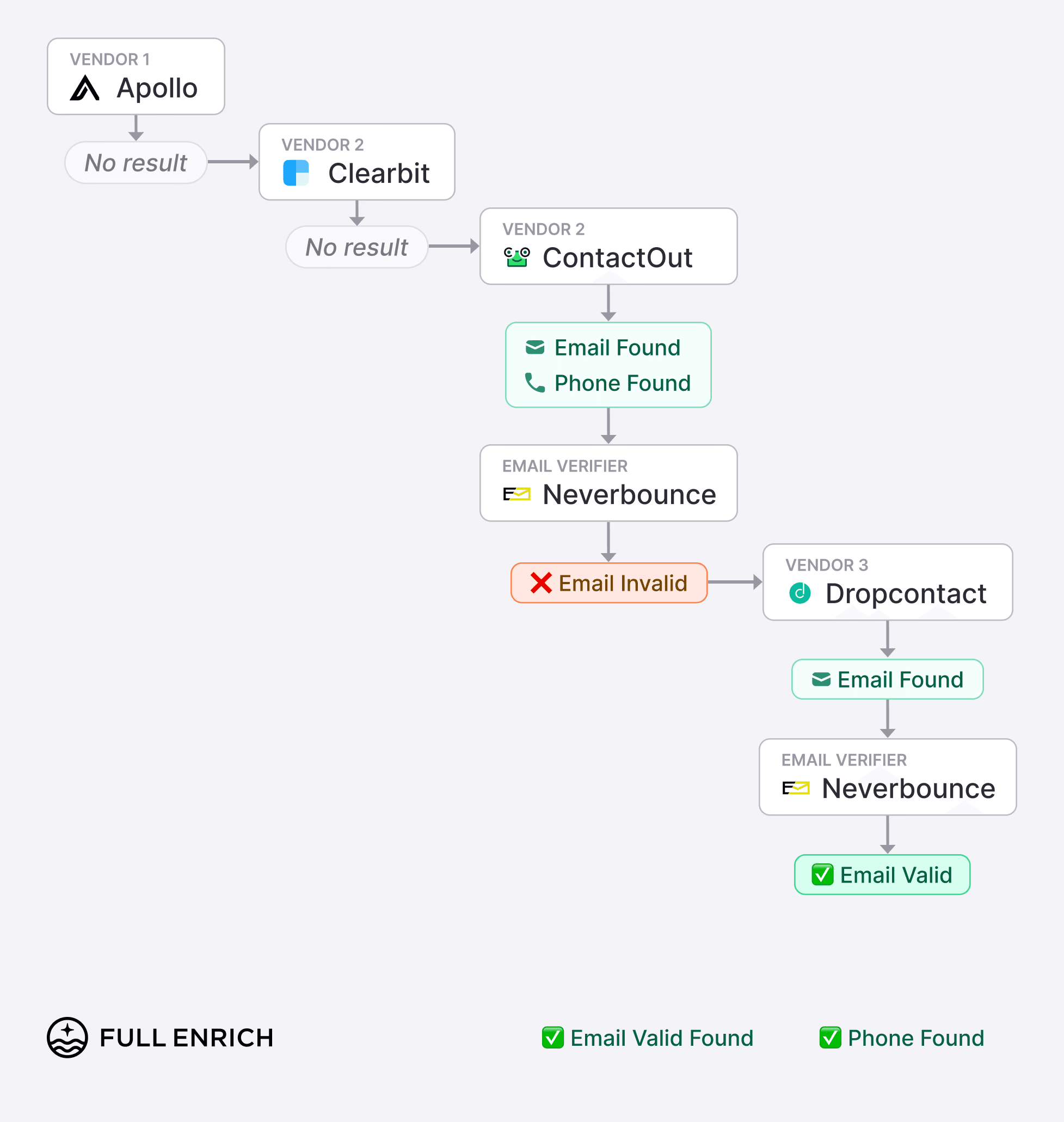
The results speak for themselves. Teams that switch to waterfall enrichment typically go from 40-50% match rates to 85%+. That's not a small improvement — that's potentially doubling the number of prospects your SDRs can actually reach.
What makes it stand out:
Waterfall enrichment across 20+ sources — finds emails and phone numbers that single-source tools miss
Real-time data verification — reduces bounce rates and protects sender reputation
Credit rollover for 3 Months for each plan
You only pay for successfull enrichment, if we don't find the data you won't get charged for it
Api access included on all plans
Bulk enrichment — clean up your existing database in minutes
We integrate with major go-to-market tools like N8N, Clay, Zapier for any sales rep workflow
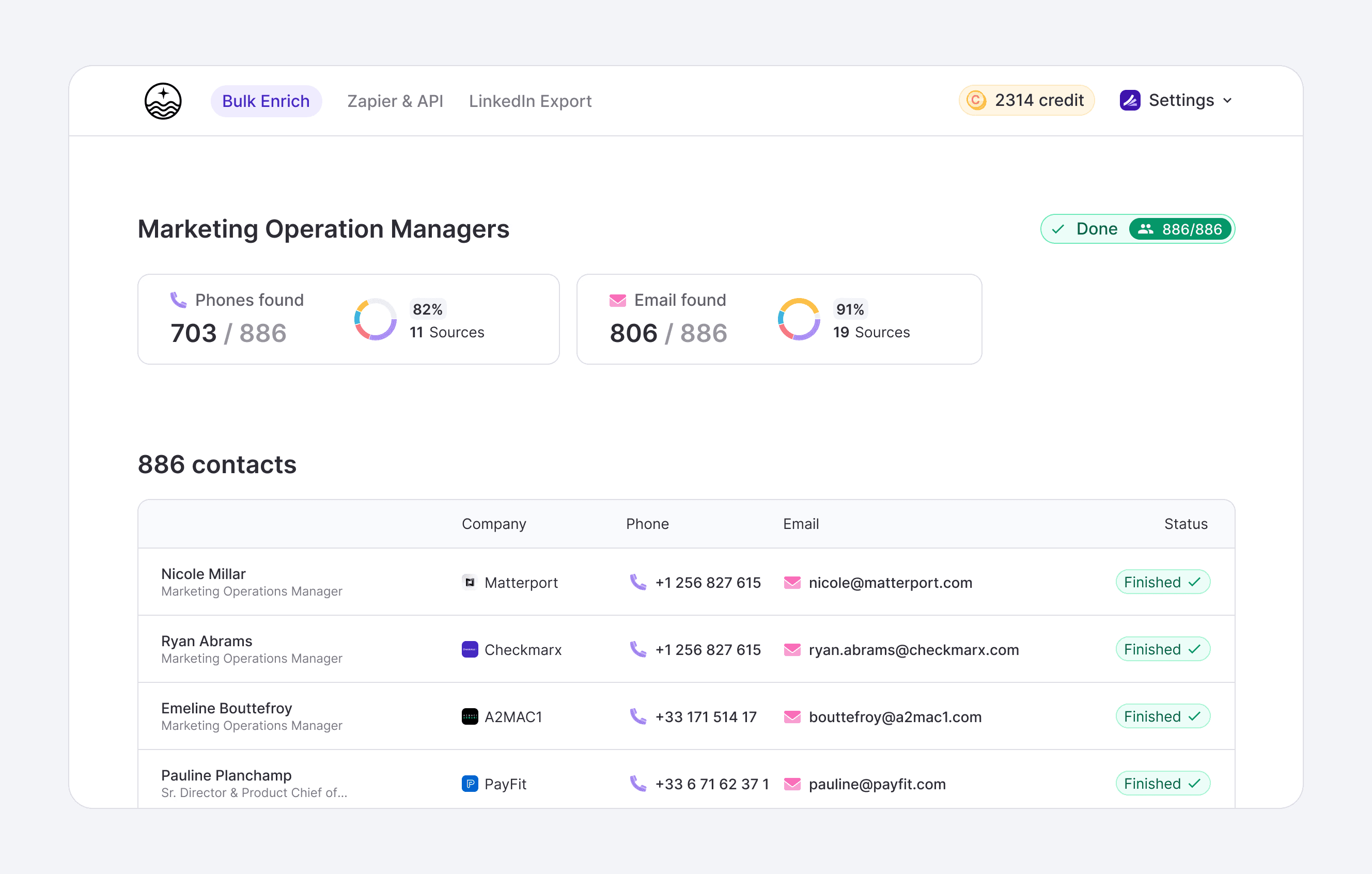
The good: Highest data accuracy on the market. Waterfall approach finds contact info that other tools miss. Seamless CRM integration saves hours of manual work every week.
The bad: We're focused on data enrichment, not outreach sequences. You'll need to pair us with an automation tool if you want built-in email sending. And yes, our pricing requires a demo call — we customize based on volume.
Pricing: Starting price at 29$/Month for 500 credits. We offer a free trial so you can test data quality before committing.
👉 Try FullEnrich free and see how waterfall enrichment compares to your current data source.
2. Apollo.io (best all-in-one for startups)
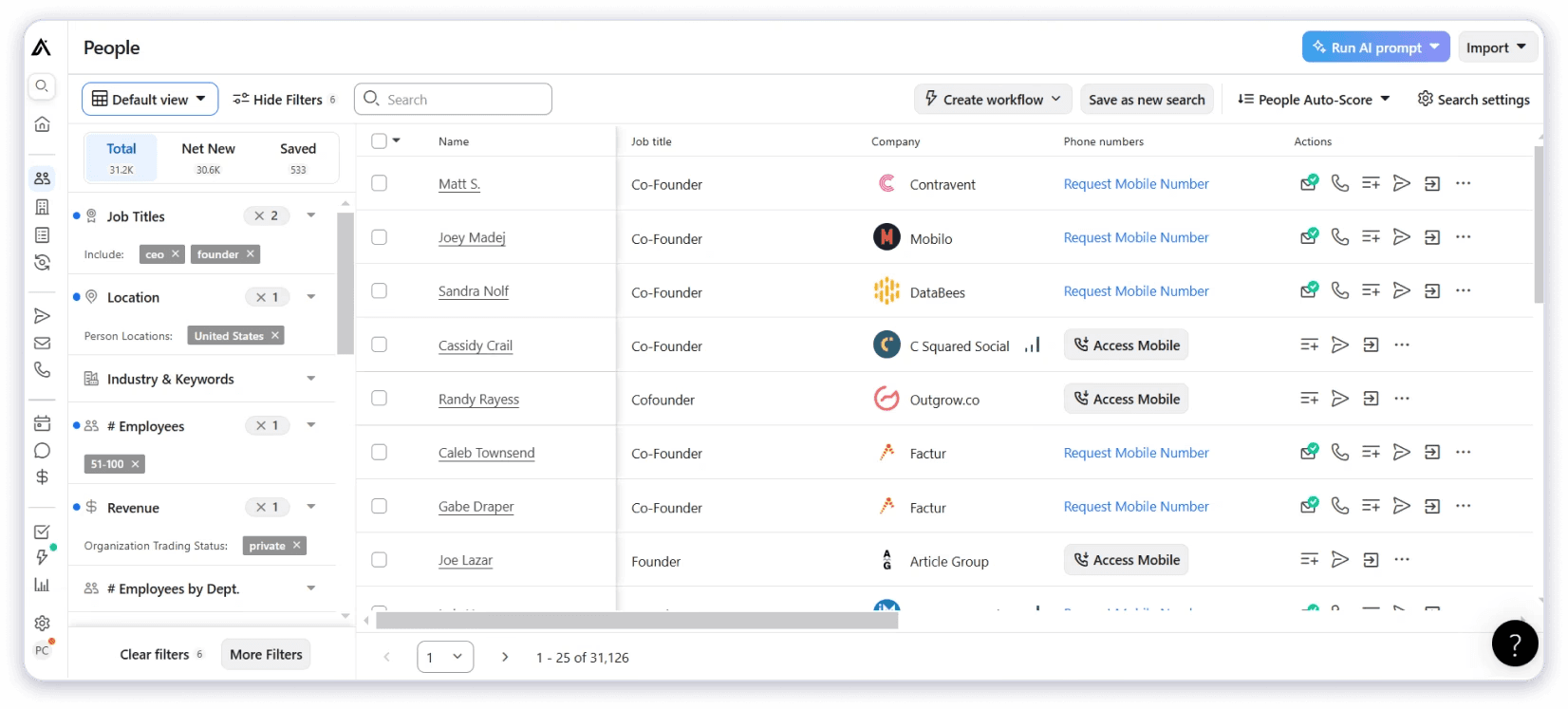
If you're a startup or mid-market team and you want everything in one place, Apollo is hard to beat.
They've built a massive B2B database (275M+ contacts) and combined it with email sequences, a dialer, and solid analytics. Instead of stitching together five different tools, you get prospecting, outreach, and pipeline tracking in a single platform.
The free plan is genuinely generous — one of the best in the space. You can get started without spending a dime, which is perfect for early-stage teams testing their outbound motion.
We've seen a lot of our customers use Apollo alongside FullEnrich. They'll use Apollo for sequencing and engagement, then pump in enriched data from us when Apollo's database comes up short on certain contacts. It's a solid combo.
What makes it stand out:
275M+ contact database with email and phone data built-in
Email sequences and sales cadences — no separate tool needed
Chrome extension for LinkedIn prospecting on the fly
AI writing assistant for email personalization
Engagement analytics and pipeline tracking
Salesforce and HubSpot integration included
The good: All-in-one simplicity. Generous free tier. Intuitive UI that SDRs actually enjoy using. Good LinkedIn integration via their Chrome extension.
The bad: Data accuracy varies — especially for European contacts and smaller companies. Email deliverability can struggle at high volumes since everyone's sending from the same IP pools. Advanced features are locked behind pricier tiers.
Pricing: Free plan available. Paid plans start at $49/user per month.
💡 Pro tip: If Apollo's database is missing contacts you need, enrich those gaps with FullEnrich to maximize your coverage.
3. Outreach (best for enterprise sales cadences)
When enterprise sales teams talk about sales engagement platforms, Outreach is usually the first name that comes up.
It's built for sophisticated, multi-touch sales cadences — the kind where you're orchestrating emails, calls, LinkedIn messages, and maybe even SMS in a carefully timed sequence. The workflow automation is incredibly powerful once you learn how to use it.
The analytics and reporting are where Outreach really shines. Sales managers get visibility into every stage of the sales cycle, rep performance, and which messages are actually driving pipeline. If you're running a large SDR team and need that level of control, Outreach delivers.
That said, it's not cheap. And the learning curve is real. This isn't a tool you set up in an afternoon.
What makes it stand out:
Advanced multi-channel sequences — email, phone, LinkedIn, SMS in one workflow
AI-driven prospect scoring and prioritization
Real-time analytics and sales performance dashboards
Native Salesforce integration with bi-directional sync
Conversation intelligence for analyzing sales calls
Team playbooks and templates for consistency across reps
The good: Most powerful sequencing capabilities on the market. Enterprise-grade analytics and Salesforce integration. Great for teams that need sophisticated multi-channel cadences.
The bad: Expensive — not built for startups or small teams. Steep learning curve for new users. Requires significant onboarding investment to get full value.
Pricing: Starts around $100/user per month. Enterprise pricing varies.
4. Salesloft (best for high-volume sequences)
Salesloft is Outreach's main competitor, and honestly, many teams prefer it.
The interface is a bit more intuitive, especially for SDRs who are new to sales engagement platforms. The cadence builder uses drag-and-drop, which makes setting up sequences less intimidating. And the dialer with local presence is solid for teams doing heavy cold calling.
Like Outreach, Salesloft excels at automating repetitive outreach while still allowing for personalization. The AI features suggest optimal send times and can help tweak messaging based on what's working.
One thing to note: Salesloft doesn't include a prospect database. It's purely an engagement tool. So you'll need a data source to feed it contacts.
What makes it stand out:
Drag-and-drop cadence builder — easier to learn than Outreach
AI-powered send time optimization and email suggestions
Built-in dialer with local presence and call recording
Salesforce and HubSpot CRM integration
Conversation intelligence for coaching reps
Pipeline analytics and deal forecasting
The good: More intuitive than Outreach for most users. Strong dialer and call recording features. Excellent customer success team.
The bad: Still expensive for smaller teams. No built-in prospecting data — you need another tool for that. Some automation options feel limited compared to Outreach.
Pricing: Approximately $75/user per month. Custom enterprise pricing available.
💡 Pro tip: Pair Salesloft with FullEnrich to keep your sequences fed with accurate, verified prospect data.
5. ZoomInfo (best for enterprise-level data)
ZoomInfo is the 800-pound gorilla in sales intelligence. If budget isn't your main concern and you need the deepest B2B database with intent signals, org charts, and technographics — this is the enterprise standard.
Their data goes beyond just emails and phone numbers. You get buying intent signals showing which companies are actively researching solutions like yours. You get org charts to map entire buying committees. You get technographic data showing what tools prospects already use.
For enterprise account-based motions, ZoomInfo is powerful.
But here's the reality: it's extremely expensive. We're talking $15,000+ annually, and that's often just the starting point. Contracts tend to be aggressive, and renewal negotiations can be painful. A lot of teams end up paying for way more than they actually use.
What makes it stand out:
100M+ company profiles and 150M+ contacts — massive database
Intent data showing active buying signals
Org charts and relationship mapping for account-based selling
Technographic and firmographic filters for precise targeting
Native Salesforce integration
Website visitor identification to catch anonymous traffic
The good: Deepest B2B database available. Intent data helps prioritize hot prospects. Excellent for enterprise account-based strategies.
The bad: Extremely expensive — $15K+ annually. Long contracts with aggressive renewal tactics. Can be overwhelming for smaller teams who don't need all the bells and whistles.
Pricing: Plans start around $15,000/year. Enterprise pricing goes much higher.
💡 Reality check: We've seen companies switch from ZoomInfo to FullEnrich + a sales engagement tool and save 50-70% while getting similar or better match rates. Worth exploring if your ZoomInfo renewal is coming up.
6. Instantly (best for cold email at scale)
If you're running aggressive cold email campaigns and deliverability is your obsession, Instantly has quickly become the go-to tool.
They're laser-focused on one thing: helping you send high-volume cold emails that actually land in the inbox. The platform handles email warmup automatically, rotates through multiple sending accounts, and gives you deliverability analytics so you know exactly what's working.
The pricing model is refreshing too. Instead of charging per user, they let you connect unlimited email accounts for a flat monthly fee. For agencies or teams sending serious volume, this is way more cost-effective than per-seat pricing.
The catch? Instantly is email-only. No multi-channel sequences, no dialer, no LinkedIn automation.
What makes it stand out:
Unlimited email sending accounts for one flat price
Automated email warmup to protect deliverability
Smart inbox rotation for higher send volumes
AI-powered email personalization
Deliverability analytics dashboard
Lead list management and campaign tracking
The good: Best-in-class email deliverability. Affordable for high-volume senders. Dead-simple to set up and use.
The bad: Email-only platform — no multi-channel outreach. No built-in prospect database. Limited CRM integration options compared to bigger players.
Pricing: Plans start at $37/month for unlimited accounts.
7. Lemlist (best for personalized outreach)
If your outbound strategy relies on standing out rather than blasting volume, Lemlist is built for you.
They specialize in personalization that goes way beyond {{first_name}} merge tags. We're talking custom images with each prospect's LinkedIn photo embedded, personalized video thumbnails, dynamic landing pages. The kind of stuff that makes prospects think "wait, did they actually make this just for me?"
For SDRs targeting high-value accounts where you can't afford to look like every other cold email, this approach works. The conversion rates on truly personalized outreach consistently beat generic volume plays.
The downside is that heavy personalization takes more time to set up. And the per-user pricing adds up quickly if you have a large team.
What makes it stand out:
Custom image personalization — add prospect photos to images automatically
Personalized video thumbnails that grab attention
AI-powered opening lines based on prospect data
Multi-channel sequences (email, LinkedIn, calls)
Email warmup and deliverability tools built-in
CRM integration with HubSpot and Salesforce
The good: Most creative personalization features on the market. Multi-channel sequences including LinkedIn. Great templates and community resources for inspiration.
The bad: Not built for massive volume sending. Can be time-intensive to set up campaigns properly. Per-user pricing gets expensive for larger teams.
Pricing: Plans start at $59/user per month. Free trial available.
8. Reply.io (best for multi-channel automation)
Reply.io positions itself as the complete multi-channel sales engagement platform, and it delivers on that promise.
You can build sequences that span email, LinkedIn messages, calls, SMS, and even WhatsApp — all from one dashboard. For teams that want true multi-channel outreach without juggling multiple tools, it's a solid option.
Their AI SDR agent feature is interesting. It can handle initial prospect responses, qualify leads based on your criteria, and book meetings directly on your calendar. Basically, it automates the back-and-forth that usually eats up SDR time.
The interface can feel a bit cluttered compared to more focused tools, and the LinkedIn automation has some limitations. But for the price, you get a lot of functionality.
What makes it stand out:
True multi-channel sequences — email, LinkedIn, calls, SMS, WhatsApp
AI SDR agent for automated responses and meeting booking
LinkedIn Sales Navigator integration
Email warmup and deliverability monitoring
CRM integration with Salesforce and HubSpot
Team collaboration and shared analytics
The good: True multi-channel automation in one platform. AI agent handles routine responses and booking. Comprehensive analytics across all channels.
The bad: Interface can feel cluttered and overwhelming. LinkedIn automation features have limitations. Steeper learning curve than simpler tools.
Pricing: Plans start at $60/user per month.
9. Smartlead (best for deliverability optimization)
Smartlead is built by cold email nerds, for cold email nerds.
If you're technical about deliverability — rotating domains, warming up inboxes, monitoring sender reputation across multiple accounts — this tool speaks your language. It's less polished than some competitors, but the infrastructure is solid.
Like Instantly, the pricing is volume-based rather than per-user, which makes it attractive for agencies and teams running high-volume outbound. You can connect unlimited mailboxes and let Smartlead handle the complexity of maintaining sender reputation at scale.
The UI isn't as pretty as Instantly's, but the underlying tech is comparable. It really comes down to personal preference.
What makes it stand out:
Unlimited email accounts and automated warmup
Smart mailbox rotation for better deliverability
AI-powered email categorization and response detection
Lead list management and scoring
Detailed deliverability analytics
API and webhook automation for custom workflows
The good: Excellent deliverability infrastructure. Affordable for high-volume senders. Technical features that power users appreciate.
The bad: Email-only — no multi-channel capabilities. No built-in prospecting data. UI is less polished than competitors.
Pricing: Plans start at $39/month.
10. LinkedIn Sales Navigator (best for LinkedIn prospecting)
If LinkedIn is a core part of your prospecting workflow, Sales Navigator is basically mandatory.
The free LinkedIn search is extremely limited. Sales Navigator unlocks advanced filters — job title, company size, years in role, posted on LinkedIn recently, and dozens more. You can build highly targeted prospect lists and get alerts when people change jobs or engage with content.
The InMail credits let you message people outside your network. And the integration with tools like Outreach and Salesloft means you can add LinkedIn touches to your sales cadences.
It's expensive for what you get ($99/user/month), and InMail response rates are generally lower than email. But for B2B sales development, LinkedIn is often your highest-converting channel. The ROI usually makes sense.
What makes it stand out:
Advanced lead and account search filters — way beyond free LinkedIn
InMail messaging credits to reach outside your network
Lead recommendations based on your saved preferences
Real-time alerts for job changes and prospect activity
CRM integration (Salesforce, HubSpot, Microsoft Dynamics)
TeamLink to find warm introduction paths
The good: Best LinkedIn prospecting experience available. Lead alerts for job changes and engagement. Essential for social selling strategies.
The bad: Expensive for what's essentially enhanced LinkedIn access. InMail limits can be frustrating. No email or phone data included — you still need an enrichment tool.
Pricing: Professional plan starts at $99/user per month.
💡 Pro tip: Sales Navigator shows you WHO to contact, but not their email or phone. Use FullEnrich to instantly enrich LinkedIn profiles with verified contact data.
11. Cognism (best for European data)
If you're selling into Europe or care about GDPR compliance, Cognism is worth a serious look.
Most US-based data providers struggle with European coverage and compliance. Cognism was built in the UK with GDPR in mind from day one. Their Diamond Data feature offers phone-verified mobile numbers, which dramatically increases connect rates for cold calling.
The European data quality is noticeably better than ZoomInfo or Apollo for that region. If a significant portion of your target market is in Europe, Cognism should be on your shortlist.
For US-only teams, there are probably better options. Their American coverage is solid but not best-in-class.
What makes it stand out:
GDPR-compliant B2B contact database — built for European markets
Diamond Data — phone-verified mobile numbers
Intent data and buying signals
Chrome extension for LinkedIn enrichment
Salesforce and HubSpot integration
DNC list compliance features built-in
The good: Best European data quality and coverage. Phone-verified mobile numbers. Strong compliance features for GDPR and DNC lists.
The bad: Custom pricing can get expensive. US data less comprehensive than ZoomInfo. Smaller overall database than some competitors.
Pricing: Custom pricing based on team size and data needs.
12. HubSpot Sales Hub (best for HubSpot CRM users)
If your company already lives in HubSpot, Sales Hub keeps everything in one ecosystem.
You get email sequences, meeting scheduling, calling, and pipeline management without adding another vendor. Every email, call, and customer interaction automatically logs to the CRM. For teams who value simplicity over best-in-class point solutions, it's a compelling package.
The free tier is genuinely useful for small teams getting started. But as you add seats and features, costs escalate quickly. And if you're using Salesforce as your primary CRM, this obviously isn't the right fit.
What makes it stand out:
Native HubSpot CRM integration — everything syncs automatically
Email sequences and templates
Meeting scheduling with calendar sync
Built-in calling and conversation tracking
Pipeline and deal management
Sales analytics and reporting
The good: Seamless if you're already on HubSpot. No data sync issues — it's all one platform. Strong free tier for small teams.
The bad: Features less advanced than dedicated sales engagement tools. Gets expensive as you scale. Not ideal if you're on Salesforce.
Pricing: Free tools available. Paid plans start at $45/user per month.
How to choose the right SDR tool for your team
Here's the framework we recommend when talking to sales teams:
First, diagnose your actual bottleneck.
If your SDRs waste hours finding accurate emails and phone numbers, you have a data problem. Tools like FullEnrich, ZoomInfo, or Cognism should be your priority.
If data isn't the issue but your reps drown in manual follow-ups and CRM updates, you have an automation problem. Focus on Outreach, Salesloft, Apollo, or Reply.io.
Most teams have a bit of both. The answer is usually a data enrichment tool paired with an engagement platform.
Second, check your CRM integration.
This is non-negotiable. Any SDR tool needs to integrate cleanly with Salesforce or HubSpot (whichever you use). If data lives in silos, the whole sales process breaks down. Always verify native integration — Zapier workarounds break at the worst times.
Third, think about your outreach channels.
Email-only? Instantly or Smartlead will serve you well at a lower cost.
Heavy on LinkedIn? Sales Navigator plus a tool like Lemlist or Reply.io.
Complex multi-channel sequences? Outreach or Salesloft is worth the investment.
Finally, be realistic about budget.
Per-user pricing adds up fast as your SDR team grows. Tools like Instantly and Smartlead offer volume-based pricing that scales better. Enterprise tools like ZoomInfo require serious budget commitment — make sure the ROI math works before signing a long contract.
Our methodology
We didn't want this guide to just be marketing fluff, so here's how we evaluated these tools:
Data accuracy: For prospecting and enrichment tools, we tested match rates across different company sizes and regions. Waterfall enrichment consistently outperforms single-source alternatives.
Ease of integration: We checked CRM integrations with both Salesforce and HubSpot, looking for native connectors and reliable bi-directional sync.
Actual productivity gains: We talked to SDR teams using each tool and measured time saved on repetitive tasks. The best tools eliminate hours of manual work per week.
Pricing transparency: We penalized tools with hidden costs or aggressive contract terms. Pricing should be straightforward.
Real user feedback: We weighted G2 and Capterra reviews, especially recent ones, to understand what actual users experience.
Frequently asked questions
What is the best free SDR tool?
Apollo.io has the most generous free plan — you get database access, limited email sequences, and CRM integration at no cost. HubSpot Sales Hub also has solid free tools if you're on their CRM. That said, free plans always have limitations. Expect to upgrade once you see results.
Are AI SDR tools worth it?
Depends on your sales cycle. For high-volume, transactional sales, AI-powered tools that automate outreach and handle initial qualification can significantly boost productivity. For complex enterprise deals, AI helps with prioritization and personalization, but you still need human SDRs driving relationships. Calculate cost per meeting booked and compare to your deal values.
Which SDR tool integrates best with Salesforce?
Outreach and Salesloft both have enterprise-grade Salesforce integrations with bi-directional sync and activity logging. For data enrichment specifically, FullEnrich, ZoomInfo, and Cognism all offer strong Salesforce integration to keep your CRM populated with accurate prospect data.
What's the difference between an SDR tool and a CRM?
A CRM (like Salesforce or HubSpot) is your system of record — it stores contacts, tracks deals, and manages customer interactions. SDR tools sit on top of your CRM to help with specific sales development tasks: finding prospects, enriching data, automating outreach, and booking meetings. Most teams use both.
How do I improve my sales team's productivity with these tools?
Start by identifying your biggest time wasters. If reps spend hours on manual data entry and enrichment, add a tool like FullEnrich. If outreach is the bottleneck, implement sales cadences with Outreach, Salesloft, or Apollo. Track pipeline generated per rep before and after implementation — the right SDR tool should free up 5-10 hours per rep per week.
Wrapping up
The best SDR tool for your sales team isn't necessarily the one with the most features or the biggest brand name. It's the one that solves your specific bottleneck and integrates smoothly into your existing workflow.
If data accuracy is killing your connect rates, give FullEnrich a try. Our waterfall enrichment approach consistently outperforms single-source alternatives, and we'll let you test it before committing.
For all-in-one simplicity, Apollo delivers remarkable value. For enterprise scale, Outreach and Salesloft remain the gold standards for sales engagement.
Whatever you choose, remember: tools help SDRs work smarter, but they don't replace the fundamentals. Great prospecting, relevant messaging, and persistent follow-up still win deals.
The right SDR tool just helps you do more of it.
👉 Start your free FullEnrich trial and see the difference waterfall enrichment makes.



Other Articles
Cost Per Opportunity (CPO): A Comprehensive Guide for Businesses
Discover how Cost Per Opportunity (CPO) acts as a key performance indicator in business strategy, offering insights into marketing and sales effectiveness.
Cost Per Sale Uncovered: Efficiency, Calculation, and Optimization in Digital Advertising
Explore Cost Per Sale (CPS) in digital advertising, its calculation and optimization for efficient ad strategies and increased profitability.
Customer Segmentation: Essential Guide for Effective Business Strategies
Discover how Customer Segmentation can drive your business strategy. Learn key concepts, benefits, and practical application tips.