
person-data-enrichmentCustomer profile enrichment enhances existing customer records by layering behavioral data, firmographic intelligence, engagement patterns, and predictive signals onto sparse account entries.
Most CRM records are built at the point of acquisition and never meaningfully updated. A company name, a contract date, and one contact email. That is enough to bill a customer. It is not enough to retain them, grow them, or serve them well.
Enrichment changes what customer success, sales, and product teams can actually see. Instead of reacting to problems after they surface, enriched profiles make the signals visible earlier, when intervention is still cheap.
What Is Customer Profile Enrichment?
Customer profile enrichment draws from two data layers that, used together, produce intelligence neither can deliver alone.
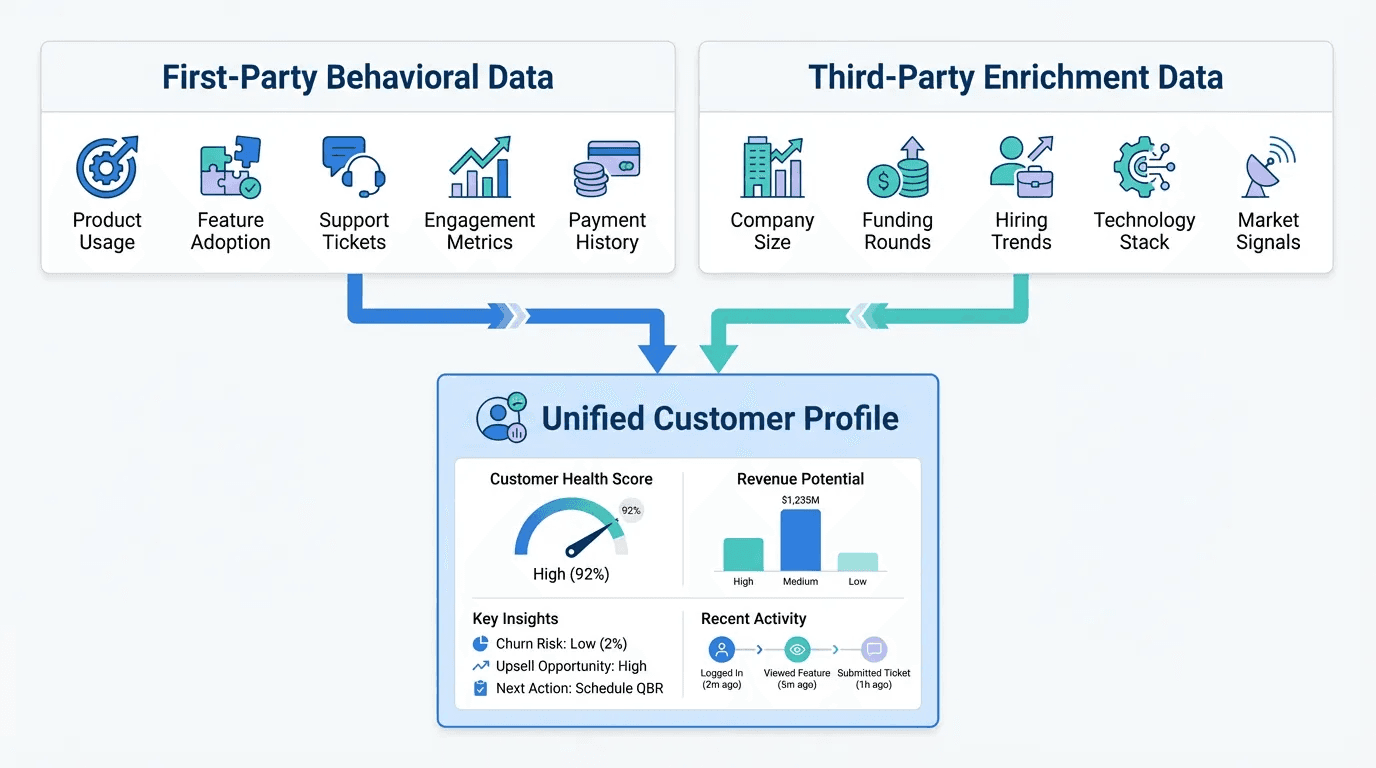
The first is first-party behavioral data: product usage frequency, feature adoption rates, support ticket history, login patterns, API call volumes, and payment behavior. This data already exists inside your systems.
The problem is that it sits fragmented across a product analytics platform, a CRM, a support tool, and a billing system, never unified into a single customer view.
The second is third-party enrichment data: company headcount changes, funding rounds, technology stack updates, organizational restructures, and competitive signals. This is what happens outside your visibility.
A customer's engagement metrics look stable. External data reveals they hired a new CTO who ran a competing platform at their previous company. That context changes everything about how the account should be handled.
Combined, these two layers power profile enrichment, at the customer level, transforming a flat account record into a living intelligence file that updates as circumstances change.
Why Does Customer Profile Enrichment Matter?
The economics of customer retention make this a straightforward business case. According to Bain & Co research, a 5% increase in retention rates produces a 25–95% improvement in profits. Yet 65% of revenue comes from existing customers, a segment that most companies systematically underinvest in relative to acquisition.
The gap between what companies know about their customers and what they need to know is the core problem. A support ticket arrives. Without enrichment, the response is generic.
With enrichment, the same ticket reveals a power user in an account that has grown headcount 40% in six months, matches the expansion profile exactly, and has been browsing the pricing page for the premium tier. The ticket becomes an upsell conversation.
Research shows that executive teams making extensive use of customer data analytics across business decisions see a 126% profit improvement over companies that do not. The bottleneck is rarely analytical capability. It is data completeness. Enrichment removes that bottleneck by filling the gaps that internal systems cannot capture on their own.
The cost argument is equally direct. Acquiring a new customer costs five times more than retaining an existing one. Every intervention that prevents a churn event, or identifies an expansion opportunity before a competitor does, compounds into revenue that pure acquisition spending cannot replicate.
What Data Does Customer Profile Enrichment Cover?
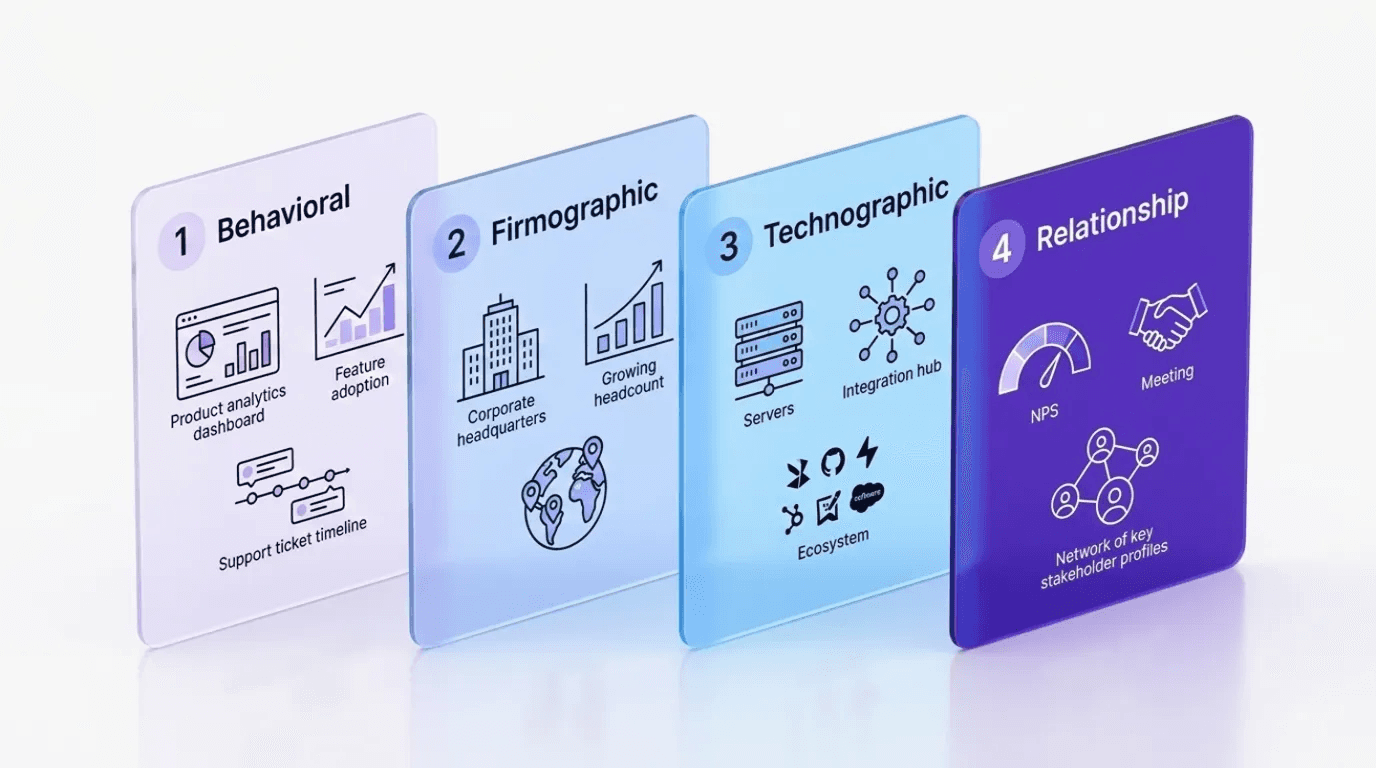
Enrichment draws from four categories, each serving a distinct function across customer success, product, and revenue operations workflows. The right combination depends on use case, not completeness for its own sake.
It is worth distinguishing this from lead enrichment which targets prospects before acquisition, customer profile enrichment operates post-sale, where the objective shifts from conversion to retention, expansion, and satisfaction.
1. Behavioral and Usage Data
This is the layer most teams already have access to but rarely use well. Product analytics capture login frequency, feature adoption rates, workflow completion patterns, and API usage volumes. Support platforms log ticket trends, resolution times, and channel preferences. Marketing automation records email engagement and content consumption.
The enrichment value here is not in collecting more behavioral data. It is in unifying what already exists across disconnected systems into a single customer timeline. When usage decline appears in context alongside a surge in support tickets and a drop in email opens, the pattern reads differently than any of those signals would in isolation.
2. Firmographic Intelligence
Company-level data from external providers fills the gaps that internal systems cannot see. Headcount changes, funding announcements, revenue range updates, geographic expansion, and leadership transitions all affect how a customer account should be managed, but none of them appear in your product analytics.
This is where B2B data enrichment integrates with the customer success function. A customer that raised a Series B last quarter has different expansion potential than it did six months ago.
A customer that lost its CFO and paused hiring during a restructure is a different retention risk than its usage metrics suggest. Firmographic signals add the business context that behavioral data lacks.
3. Technographic Data
Technology stack information reveals how customers fit into a broader ecosystem. Which platforms they run alongside your product, which integrations they have built, and which tools they are evaluating or replacing all inform both product roadmap decisions and expansion conversations.
If a customer adopts a complementary platform that your product integrates with, that is an onboarding and activation opportunity. If they adopt a competing tool in an adjacent category, that is an early churn signal. Technographic data surfaces both.
4. Engagement and Relationship Signals
This layer covers the qualitative dimension of the customer relationship: NPS trajectory, stakeholder changes within the account, community participation, case study willingness, and renewal conversation history.
Combined with contact data enrichment that keeps stakeholder records current as people change roles, this layer ensures that customer success teams always know who the real decision-makers and advocates are inside each account.
How Does Customer Profile Enrichment Work?
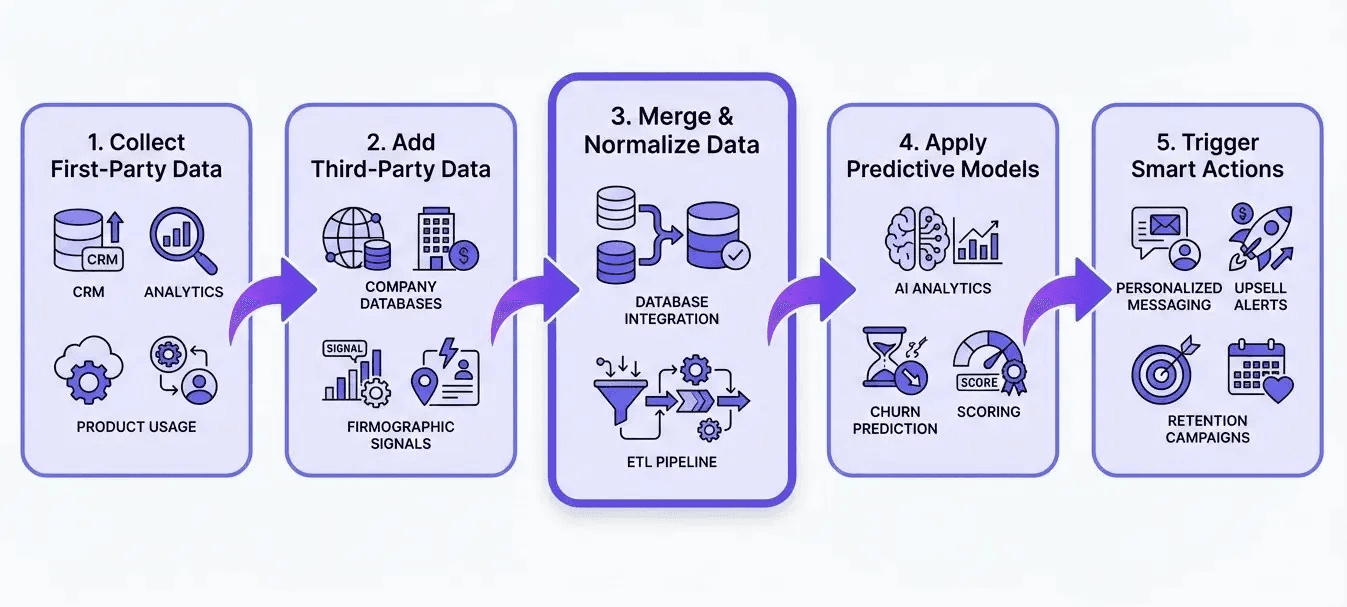
The enrichment process moves through three stages that determine both data quality and operational utility.
Unifying First-Party Data
Before any external data is appended, internal signals need to be consolidated. Product analytics, CRM records, support history, billing data, and marketing engagement typically live in separate systems with separate customer identifiers. A customer data platform or ETL pipeline resolves these into a unified record under a single customer ID.
This unification step is where most implementations fail. External enrichment appended to fragmented internal records produces fragmented enriched records. The foundation has to be clean before the layers can be added.
This is also what separates customer profile enrichment from CRM contact enrichment, which focuses on filling individual contact fields rather than building unified account intelligence.
Appending Third-Party Attributes
Once internal data is unified, external enrichment providers append firmographic, technographic, and organizational attributes through API connections or scheduled batch processes.
Field mapping rules determine which enriched data updates which record fields, and overwrite logic protects manually verified data from being replaced by external records.
Real-time data enrichment triggers on specific events rather than batch schedules, keeping profiles current when it matters most. A funding announcement, a leadership change, or a technology adoption signal updates the customer record immediately rather than waiting for the next quarterly refresh.
Predictive Scoring and Segmentation
Enriched profiles feed health scoring models that combine behavioral signals with external context. Using health scores to trigger proactive interventions reduces churn by 16–28% in subscription models, according to modeled SaaS benchmarks.
The key distinction from basic usage scoring is that enriched health scores incorporate external stress signals alongside internal engagement metrics, producing risk assessments that reflect business reality rather than product activity alone.
This is also where [lead scoring](internal link: Lead Scoring) methodology applies to the expansion side of the customer base: identifying which accounts demonstrate readiness signals that justify proactive outreach, and which require retention focus before expansion conversations are appropriate.
Key Use Cases for Customer Profile Enrichment
Enriched profiles are only valuable when they drive specific actions. These four use cases represent where the data-to-decision chain is most direct.
1. Proactive churn prevention: Health scoring models combining usage decline with external signals, such as a recent leadership change or a competitor funding round, flag at-risk accounts before the customer signals intent to leave. The intervention window is wider and the cost is lower when the signal arrives early rather than at renewal.
2. Targeted expansion identification: Accounts approaching seat limits, recently funded, or showing power user behavior in a feature tier below their potential all represent expansion opportunities that surface automatically from enriched profiles rather than requiring manual account research. This turns expansion from a reactive sales motion into a systematic, data-driven workflow.
3. Personalized onboarding paths: New customer profiles enriched with company size, technical maturity, and industry context at the point of acquisition enable differentiated onboarding. Enterprise accounts get dedicated success resources. Technical teams receive API documentation and developer content first. Business stakeholders see ROI dashboards and workflow guides. Activation rates improve when onboarding reflects what the customer actually needs.
4. Segmented support prioritization: Enriched customer value scores and health indicators determine how support queues are managed. High-value accounts in risk windows receive immediate attention. Low-engagement accounts on stable trajectories route to self-service. The same headcount produces better outcomes when allocation reflects account intelligence rather than ticket order.
How FullEnrich Supports Customer Profile Enrichment?
Customer success teams lose visibility into accounts the moment contacts change roles. A champion gets promoted, a key decision-maker moves to a new company, a technical lead is replaced during a restructure. The account record still shows the old name and the old email. Outreach goes to a dead inbox. Risk signals go undetected.
FullEnrich keeps stakeholder records current by running waterfall enrichment across 20+ premium data providers, sequencing each source until a verified result is returned. When a contact within a customer account changes roles or moves on, enriched records reflect that shift before it becomes a blind spot.
Find rates reach 89% for US emails and 86% for US mobile phones, with EMEA at 84% email and 71% phone.
For teams managing large customer bases, bulk enrichment processes entire account contact lists in a single operation, useful for quarterly stakeholder audits or pre-renewal reviews where contact accuracy directly affects outcome.
For event-driven workflows, the API enriches records at the point of a trigger, so a new stakeholder added to an account gets a complete profile before the first touchpoint rather than after.
Triple email verification against live mail servers produces bounce rates under 1%. Credits are charged only on verified successful enrichment. No seat fees, no charges for failed lookups, and no persistent storage of personal contact records, keeping operations aligned with GDPR, CCPA, and SOC 2 Type II requirements.
Start enriching your customer profiles with FullEnrich →
Conclusion
Customer profile enrichment turns static account records into living intelligence that drives retention, expansion, and personalization at scale. The data layer is the combination of first-party behavioral signals already inside your systems and third-party firmographic, technographic, and engagement context from external providers.
The operational value is knowing what is actually happening inside each customer account before it becomes a problem or a missed opportunity.
Frequently Asked Questions
What is the difference between customer profile enrichment and contact enrichment? Customer profile enrichment builds comprehensive account intelligence by combining behavioral, firmographic, and engagement data across an entire customer relationship. Contact enrichment fills missing fields on individual contact records such as phone numbers, job titles, and email addresses. The former serves retention and expansion strategy. The latter serves outreach execution.
What is the difference between customer enrichment and lead enrichment?
Lead enrichment operates pre-sale to support qualification and conversion. Customer profile enrichment operates post-sale to support retention, expansion, and satisfaction. The data priorities differ: lead enrichment focuses on ICP fit signals, while customer enrichment focuses on health, engagement, and growth indicators.
How often should customer profiles be re-enriched?
Behavioral data from internal systems should update daily. Firmographic data from external providers refreshes monthly. Health scores recalculate weekly incorporating recent signals. Critical event-driven attributes, such as funding announcements or leadership changes, should update in real time when possible.
Does customer profile enrichment work for B2C companies?
Yes, though the data mix shifts. B2C customer enrichment emphasizes purchase patterns, engagement frequency, lifecycle stage, and demographic attributes rather than organizational intelligence. The underlying principle, combining first-party behavioral data with third-party contextual data, applies to both models.
What are the privacy considerations for customer profile enrichment?
Enrichment must comply with GDPR, CCPA, and applicable industry regulations. For European customer data, lawful basis for processing must be established. Enrichment providers should be audited for compliance certifications, data sourcing transparency, and support for data subject rights requests.
How does customer profile enrichment connect to product roadmap decisions?
Enriched profiles reveal which customer segments drive specific feature requests and which cohorts are underserved by the current product. Enterprise customers requesting advanced permissioning, SMB users needing simplified workflows, and technical buyers requiring API extensibility all appear as distinct patterns when firmographic context is layered onto usage data.