
Building a B2B SaaS product takes a massive amount of time, money, and focus. But the harsh truth is that a great product does not sell itself.
You can spend a year coding the perfect software, hit the launch button, and hear absolute silence. That is the frustrating reality for many teams. You burn through your cash runway while your sales reps stare at an empty pipeline.
It hurts even more when you watch a competitor with a much worse product close massive enterprise deals simply because they know how to get in front of the right buyers.
You do not need to add more features to fix this problem. You need a strict SaaS go-to-market (GTM) strategy. A proper GTM strategy is a step-by-step action plan that tells you exactly who to target, what to say, and how to turn a quiet launch into a predictable flow of revenue.
This guide will show you exactly how to build one from the ground up.
What is a SaaS Go-To-Market Strategy?
A SaaS go-to-market (GTM) strategy is an action-oriented, specific plan for launching a new product, entering a new market, or relaunching a brand. It is the exact roadmap a company uses to bring a piece of software from the final stages of development directly into the hands of paying customers.
GTM strategy forces you to make hard decisions up front. It outlines the exact buyers you are targeting, the specific pricing model you will use, and the exact distribution channels your team will focus on to generate early revenue.
It’s basically a blueprint that minimizes the financial risk of a new launch by making sure that every department, from sales to marketing to customer success, knows exactly what to do on day one.
Difference between SaaS GTM Strategy and B2B Marketing Strategy
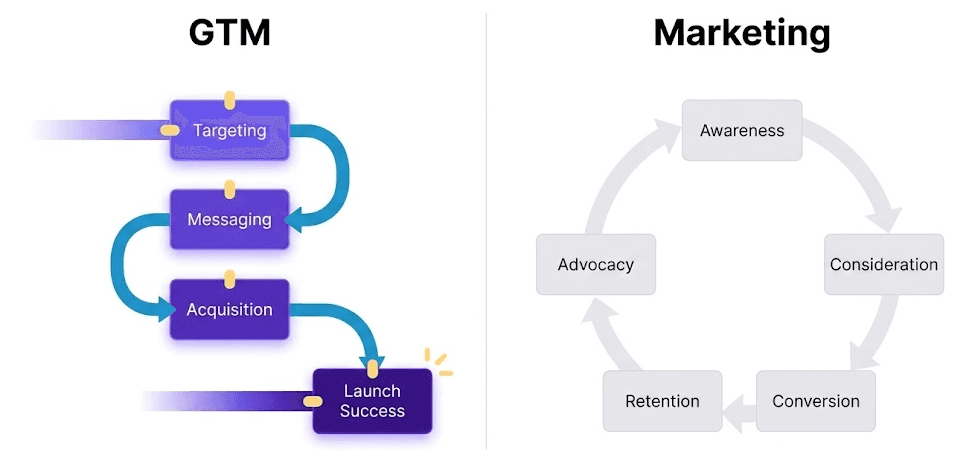
A B2B marketing strategy is a continuous, long-term operation designed to build brand awareness over time, whereas a SaaS go-to-market (GTM) strategy is a highly focused action plan built to launch a specific product or enter a new market.
The timeline is the biggest difference. Your general marketing runs constantly, with no end date, working to keep a steady flow of leads in your pipeline. A GTM strategy operates on a strict deadline and officially ends the moment the initial launch phase is over and the product folds into normal operations.
The scope and goals also change entirely. Marketing covers your overall brand reputation. A GTM strategy is a highly targeted strike. It focuses on a very specific buying center to hit a single, immediate goal, like securing early revenue for a brand-new feature.
Because of this, the components of a GTM strategy are much tighter. It requires complete internal alignment regarding the specific pricing model, exact sales cadences, and immediate revenue operations tracking.
B2B marketing strategy: The marketing department runs an ongoing SEO blog and a weekly newsletter to teach sales managers how to book more meetings and save time during their daily routines.
SaaS GTM strategy: The revenue team executes a strict 90-day plan to launch a new medical compliance module, complete with a dedicated pricing tier and targeted outbound emails sent strictly to hospital IT directors.
Why a SaaS company needs a GTM strategy
A SaaS company needs a GTM strategy to protect its launch budget and guarantee a clear path to early revenue. While building software costs a lot of money, launching it into the market without a strict action plan is exactly how startups burn their cash and fail.
A defined strategy ensures your product actually reaches the people who are ready to buy it.
A defined plan removes the guesswork from your launch and provides three major advantages:
Prevents wasted launch budgets: A GTM plan requires you to research exactly where your buyers spend their time. This means you put every dollar into the specific channels that actually reach your target audience, rather than paying for useless traffic.
Sales and marketing alignment: In many companies, marketing brings in leads, and sales ignores them because they are the wrong fit. A strict GTM strategy fixes this by making both teams agree on the exact Ideal Customer Profile (ICP) and messaging before a single email goes out.
Establishes a clear path to early revenue: The goal of a launch is not just to get free signups, it is to generate actual cash flow quickly. A GTM plan maps out the specific pricing model and sales process you need to turn early interest into paying customers. This proves your product has real market demand and gives your company the financial momentum it needs to keep growing.
Advantages of a SaaS Go-To-Market Strategy
A SaaS go-to-market strategy protects your cash flow by helping you turn your marketing budget into revenue. It gives you a clear financial roadmap that connects your new software directly to paying customers, keeping your team focused entirely on tactics that drive real sales.
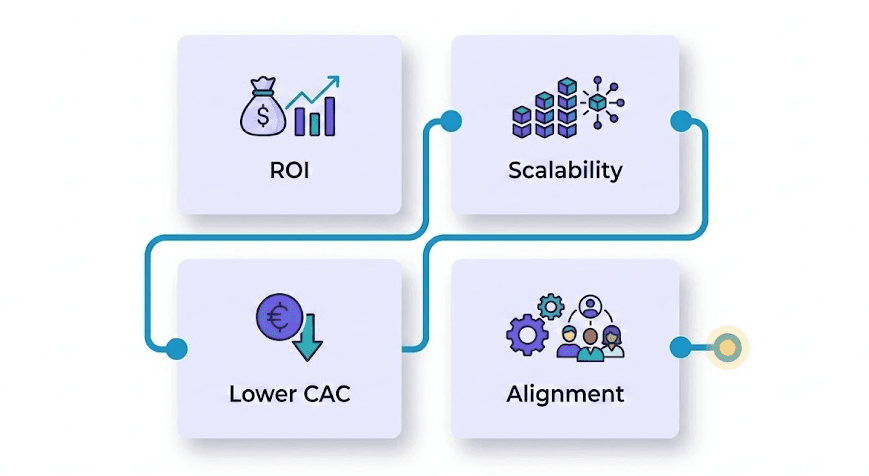
Here are the four biggest advantages of building a strict GTM plan:
Better return on investment (ROI)
A GTM strategy forces you to figure out exactly where your ideal buyers spend their time before you launch. This means you run campaigns only on the channels that actually work. When you stop paying for useless traffic and focus entirely on high-intent buyers, your overall marketing ROI goes up significantly.
Predictable scalability
A defined strategy gives you a repeatable, step-by-step process. Once you find a specific marketing channel and a sales message that consistently brings in new users, you can safely increase your budget for that channel. This allows you to scale your monthly revenue predictably without worrying that your entire system will break under the pressure.
Lower customer acquisition costs
By strictly defining your buyer personas and creating highly specific messaging for them, you capture their attention much faster. This highly targeted approach shortens your sales cycle. Because you spend less time and fewer resources trying to convince a single user to buy, your overall customer acquisition cost drops.
Total alignment across sales, marketing, and product
Marketing brings in leads that the sales team refuses to call, while the product team builds features no one actually asked for. A GTM plan acts as a unified revenue operations anchor. It forces every department to agree on the same goals, the same KPIs, and the exact same ideal customer profile before the launch even begins.
Core elements of a SaaS GTM strategy
A successful SaaS go-to-market strategy is built on six foundational elements that dictate who you sell to, how you sell, and how you measure success. If you miss even one of these pieces, your entire launch will lack direction. Before you start running ad campaigns or making cold calls, you must lock in these core components.
Ideal Customer Profile (ICP) and buyer personas
You need to know exactly who is going to pull out their company credit card. Your ICP defines the exact type of business that needs your software, detailing their revenue size, industry, and employee count. Your buyer personas go a step further by outlining the actual human beings making the purchase. You must understand the difference between the end-user who logs into the software every day and the executive who actually holds the budget and signs the contract.
Value matrix and messaging
Once you know who you are talking to, you have to know exactly what to say. A value matrix connects your software's specific features to the actual pain points of your buyer. You do not just list what your product does; you explain exactly how it makes their workday easier or saves their company money. This core messaging must stay completely consistent across your website, your cold emails, and your sales pitches.
Pricing model
How you charge for your product completely changes how you sell it. You have to pick a pricing model that matches your target audience. If you are selling to small startups, a simple tiered monthly subscription or a freemium model usually works best. If you are targeting massive enterprise companies, you will likely need custom, annual contracts. Your pricing must cover your customer acquisition costs while making sense to your specific market.
Acquisition channels
This is how you actually put your message in front of your buyers. You cannot be everywhere at once, especially during a new launch. You need to pick two or three primary channels where your audience already spends their time. This might mean running highly targeted LinkedIn ads, building an SEO content engine, or relying entirely on direct outbound cold calling. Pick the exact channels that fit how your buyers naturally consume information.
Sales and marketing alignment
A launch falls apart quickly if marketing generates leads that the sales team refuses to call. Both departments must agree on the exact definition of a qualified lead before the launch begins. They need to share the same goals, work from the same database, and understand the exact handoff process. When marketing and sales operate as a single, unified team, high-value prospects do not slip through the cracks.
Key metrics and KPIs
You cannot fix a strategy if you do not know what is broken. You have to define your Key Performance Indicators (KPIs) before day one. Decide exactly which numbers will tell you if the launch is actually working. This usually means tracking your Customer Acquisition Cost (CAC), your lead-to-customer conversion rate, and your pipeline velocity. Setting these benchmarks early allows you to pivot quickly if a specific campaign is burning cash without generating returns.
How to build a SaaS go-to-market strategy step-by-step
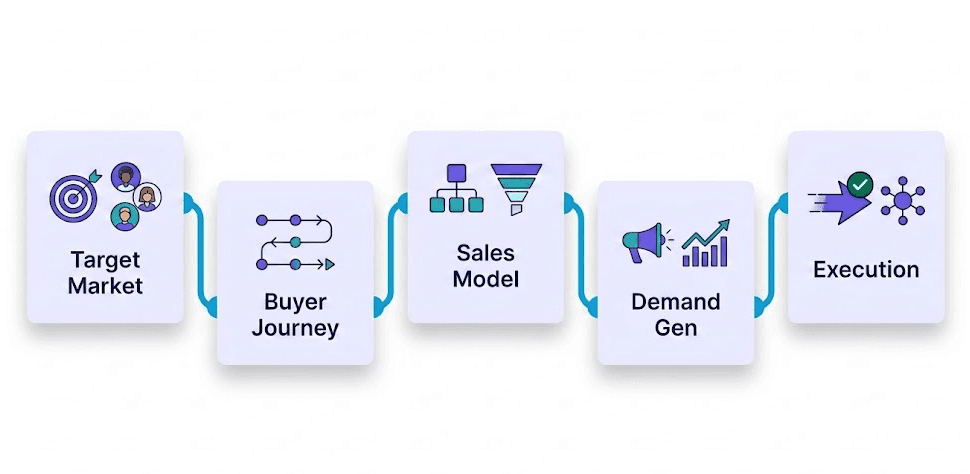
Building a SaaS go-to-market strategy is a sequential process that aligns your software with the exact people who will pay for it. It takes the core elements of your business and organizes them into a strict timeline. If you rush this planning phase or guess what your buyers want, your launch will fall flat. Here is the exact framework to build a predictable revenue engine from scratch, starting with your audience.
Step 1: Define your target market and buying center.
You cannot sell a B2B product to everyone. A target market is the specific group of companies that experience the exact operational problem your software solves and actually have the money to pay for it. Defining this market is critical because it directly dictates your pricing strategy.
If your target market consists of early-stage startups, your pricing must match their limited cash flow, pushing you toward a low-cost monthly subscription. If you target massive enterprise organizations, you need to structure complex, high-ticket annual contracts. To lock this in, you need to establish two specific frameworks:
1. The Ideal Customer Profile (ICP)
You must draw a hard box around the companies you want to reach. Getting specific automatically highlights who you should not sell to, saving your marketing team from wasting budget on bad leads. Define your ICP using these exact firmographic details:
Industry focus: The specific sector they operate in.
Annual revenue: The baseline money they need to make to afford your tool.
Employee count: The overall size of the company and specific departments.
Current tech stack: The exact software tools they already use every day.
2. The Buying Center
In the B2B SaaS space, one single person rarely makes the final purchasing decision. You are selling to an entire committee. You need to identify the different roles inside that organization and understand exactly what each person cares about to keep the deal moving forward.
Role | Who They Are | What They Care About Most |
The End-User | The person logging into your software daily. | Usability, clean interfaces, and saving time on daily tasks. |
The Economic Buyer | The executive (CEO/CFO) who signs the contract. | Return on investment (ROI) and overall impact on the bottom line. |
The Technical Buyer | The IT director or security officer. | Data security, compliance, and smooth integration with current tools. |
The Champion | Your internal cheerleader who found your product. | Solving a specific departmental pain point and looking good to their boss. |
You have to create distinct messaging for each of these people. If your sales pitch only speaks to the end-user but completely ignores the economic buyer, the deal will fall through the second it hits the finance department.
Step 2: Map the buyer's journey
A prospect does not just wake up and decide to buy enterprise software. They go through a specific psychological journey. You have to map out every step they take, from the moment they realize they have a problem to the day they finally sign the contract. We break this down into three main phases:
Journey Stage | What the Buyer is Doing | What You Need to Provide |
Awareness | They have a problem & are searching for answers. | Blog posts, industry reports, and social media videos that diagnose their exact pain point. |
Consideration | Now comparing different software tools to fix it. | In-depth webinars, comparison charts, and detailed case studies showing how you helped similar companies. |
Decision | They are ready to pick a vendor and sign a contract. | Free trials, live product demonstrations, custom pricing proposals, and ROI calculators. |
If you understand this journey, you can create the exact content and sales materials they need at each specific stage.
Step 3: Build your specific sales strategy
How exactly are you going to close the deal? You have to pick a primary lane for your sales motion. Trying to do everything at once usually confuses your buyers and exhausts your internal team. The two main models in SaaS are Product-Led Growth (PLG) and Sales-Led Growth (SLG).
Product-Led Growth (PLG): This strategy relies on the software itself to acquire and upgrade users. You offer a freemium version or a free trial. The buyer signs up, uses the tool, gets immediate value, and eventually upgrades to a paid tier completely on their own. This works perfectly for highly intuitive software with a lower price point.
Sales-Led Growth (SLG): This requires a dedicated sales team to guide the prospect through the purchase. You use this for expensive, complex enterprise software. It involves high-level consultative selling, where your reps act as advisors. They focus heavily on value-based selling, proving exactly how the software will generate a financial return before ever discussing the technical features.
Step 4: Create your demand generation plan
Now you need to actually get people into your pipeline. Demand generation is about capturing interest and pulling target accounts into your buyer's journey.
To build a reliable pipeline, you need a multi-channel outreach approach. Relying entirely on organic search traffic or a single ad platform is too risky. You need a mix of inbound and outbound tactics:
Inbound marketing: Pulling people to your website through SEO-optimized blog posts, active LinkedIn publishing, and high-value lead magnets like templates or calculators.
Outbound sales: Actively reaching out to specific decision-makers. This involves targeted cold emails and direct phone calls to book introductory meetings.
Account-based marketing (ABM): If you target massive enterprise deals, you will treat one specific company as an entire market. Your marketing and sales teams work together to surround that single company with highly specific ads and direct outreach.
Step 5: Set clear timelines and responsibilities
A strategy is completely useless if no one knows what they are supposed to do. You have to set hard deadlines and assign clear owners for every single task. If a task belongs to "the marketing team," it will likely get ignored. It needs to belong to one specific person.
Create a shared calendar that works backward from your official launch date. Assign specific dates for when the website copy needs approval, when the ad campaigns go live, and when the sales team needs to start dialing.
This is also the exact time to implement a strong revenue operations strategy. By putting a RevOps system in place before you launch, you ensure that your marketing, sales, and customer success teams are completely aligned. It keeps your data clean, tracks your actual performance metrics, and makes sure no high-value leads fall through the cracks during the handoff between departments.
B2B vs. B2C SaaS GTM strategies: The core differences
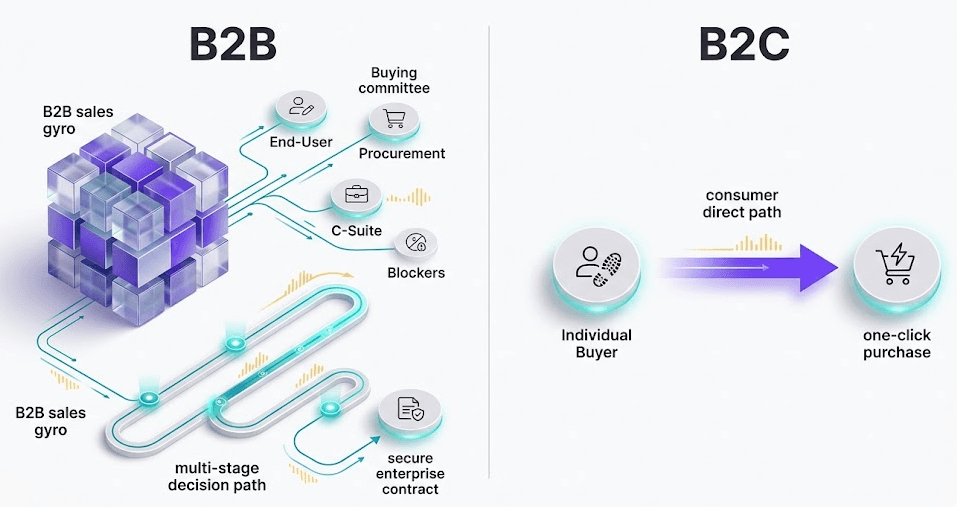
B2B and B2C SaaS go-to-market strategies fundamentally differ in who holds the purchasing power and exactly why they decide to buy. B2B focuses entirely on providing a financial return to a group of executives over several months, while B2C focuses on triggering an immediate, emotion-driven purchase from a single individual.
The mechanics of a B2B SaaS GTM strategy
Selling business software is a highly rational process. You are not asking a person to spend their own money; you are asking them to spend the company's budget. This requires you to prove a clear Return on Investment (ROI). The sales cycle is naturally long because you have to convince an entire buying committee, including the daily end-users, IT directors, and financial executives. To win these deals, your strategy must rely heavily on deep educational content, consultative sales calls, and targeted outbound prospecting to build long-term trust.
The mechanics of a B2C SaaS GTM strategy
Selling software directly to a consumer relies on immediate convenience and personal desire. The sales cycle is incredibly fast. A single person looks at your product, decides they want it, and enters their credit card information in a matter of minutes. Because the price point is usually low, they do not need approval from anyone else. This strategy requires massive brand awareness, viral social media campaigns, and highly optimized free trials to drive quick, high-volume signups.
Quick comparison of B2B and B2C strategies
Feature | B2B SaaS Strategy | B2C SaaS Strategy |
Target Audience | Entire companies and buying committees. | Individual, everyday consumers. |
Primary Decision Driver | Rational financial return and operational efficiency. | Emotional desire, entertainment, or personal convenience. |
Sales Cycle Length | Long (often weeks to several months). | Very short (often minutes to a few days). |
Pricing Structure | High-ticket, tiered models, or custom annual contracts. | Low-cost, fixed monthly subscriptions. |
Top Acquisition Channels | Outbound sales, SEO guides, and account-based marketing. | Social media ads, influencer partnerships, and app store optimization. |
Real-world examples of B2B and B2C SaaS strategies
To see how these concepts play out in the market, here is a look at how top companies execute these specific strategies:
B2B Example (Salesforce): Salesforce targets massive enterprise organizations. Their GTM strategy involves a dedicated outbound sales team, complex live product demonstrations, and multi-year custom contracts. They sell by proving to a CEO exactly how their CRM will increase the company's overall revenue.
B2C Example (Spotify): Spotify targets everyday music listeners. Their GTM strategy focuses heavily on a freemium model and emotional marketing campaigns. They allow users to listen for free with ads, creating an immediate habit, and then push simple, low-cost monthly subscriptions to remove those ads.
Common SaaS GTM failures (and how to fix them)
Even the best plans can fall apart if you ignore the basics. Many software launches fail not because the product is bad, but because the team makes completely preventable mistakes during the rollout. Here are the most common traps companies fall into and exactly how to fix them before they stall your growth.
Copying competitor pricing without testing it
The failure: Startups often look at the biggest player in the market and just copy their exact pricing page. But that competitor has a completely different cash flow, level of brand trust, and customer acquisition cost. What works for them will likely starve your smaller team of the cash it needs to operate.
The fix: Build your pricing based on your own customer research and the actual value you provide. Test different models with a small group of early users to see what they are actually willing to pay before locking in your public prices.
Targeting an audience that is way too broad
The failure: Trying to sell to everyone usually means your messaging connects with no one. If your marketing materials claim your software helps various brands across every possible industry, buyers will immediately assume the tool lacks the specific depth they actually need to solve their unique problems.
The fix: Force your team to narrow down the Ideal Customer Profile (ICP). Pick one specific industry or company size to dominate first. Once you win that exact market and build strong case studies, you can safely expand to other areas.
Misalignment between the product and sales teams
The failure: The product team pushes a major new update live, but the sales team has no idea how to pitch it. Reps end up selling features that do not exist yet, or they ignore the new release completely because they do not have the right training materials. This creates a terrible experience for new buyers.
The fix: Do not launch anything to the public until internal training is 100% complete. Your sales reps need updated pitch decks, clear value propositions, and a firm understanding of the product roadmap so they can set accurate expectations on their very first cold call.
How to track your GTM strategy success
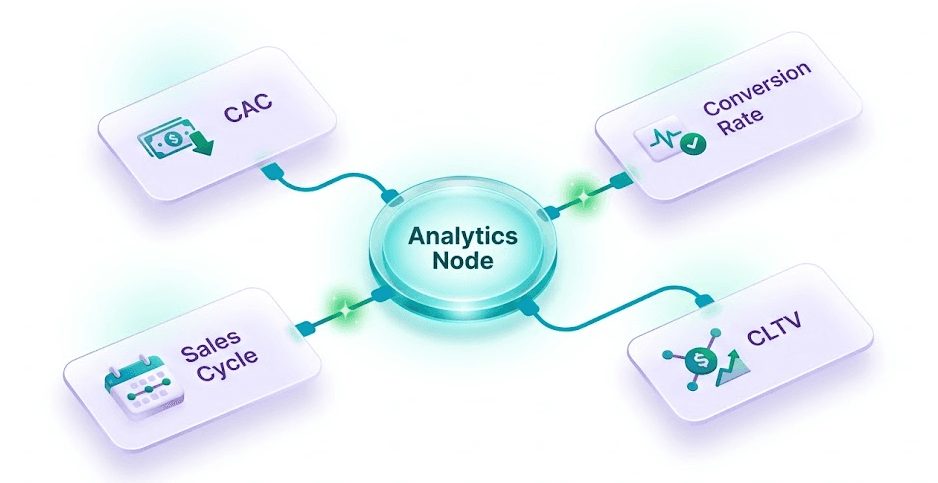
To know if your GTM strategy actually works, you have to track the hard numbers. Website traffic and social media followers do not pay the bills. You need to measure exactly how much money goes out and how much revenue comes back in to ensure your launch is actually profitable.
Here are the three specific metrics you need to monitor constantly:
Customer Acquisition Cost (CAC): This metric shows you exactly how much cash you spend to secure one paying user. You calculate it by dividing your total marketing and sales expenses by the number of new customers you acquired during the launch. If it costs you more to acquire a customer than they actually pay for the software, your strategy is burning cash and needs an immediate fix.
Length of the sales cycle: This measures how many days it takes for a prospect to go from their first interaction with your brand to actually signing the contract. A fast sales cycle means your messaging is hitting the right pain points and creating urgency. If this number drags out into several months, it usually means your sales team is talking to the wrong people or struggling to prove the software's financial value.
Lead-to-customer conversion rate: Getting people to download a free guide is easy; getting them to buy is hard. This rate tracks the exact percentage of your total leads that actually turn into paying accounts. A low conversion rate highlights a massive leak in your pipeline. It usually shows that your marketing team is bringing in unqualified traffic, or your sales reps are failing to close warm leads.
Customer Lifetime Value (CLTV): This number shows the total amount of revenue a single customer generates for your business over their entire relationship with you. It is the ultimate test of your long-term financial health. If you spend $500 to acquire a user, but their lifetime value is only $300 before they cancel, you are losing money on every single sale.
Real-world SaaS go-to-market strategy examples
Looking at successful companies shows you exactly how these strategies work in the real world. The biggest software brands did not grow by accident. They picked one specific growth model and executed it perfectly. Here is how three major companies launched and scaled their products.
1. HubSpot
HubSpot basically invented the modern concept of inbound marketing. Instead of spending their early budget on massive cold-calling teams, their primary strategy was to create high-quality educational resources. They focused heavily on SaaS SEO, writing deep-dive blog posts and guides that answered the exact questions their target buyers were searching for on Google.
Once people trusted their content, HubSpot pulled them into its ecosystem by offering a free CRM tool. This freemium model was brilliant. After businesses got comfortable using the free tools to organize their contacts, the CRM expansion made it natural to upsell them on HubSpot's paid marketing and sales hubs.
2. Zoom
Zoom entered a crowded, highly competitive market filled with clunky, frustrating video tools. To stand out, their entire GTM strategy revolved around a completely frictionless user experience. They wanted to make joining a video call as easy as possible.
They offered a free tier that allowed up to 40-minute meetings. More importantly, you did not even need an account to join a call; you just clicked a link. By removing all the typical software barriers, they let the product speak for itself. Users experienced the high video quality firsthand and naturally upgraded to paid plans when they needed longer meetings for their business.
3. Dropbox
When Dropbox launched, they had to convince people to trust cloud storage, which was still a very new concept. Buying traditional search ads was too expensive for their budget, so they built a viral referral program directly into their product.
Their freemium model gave users a small amount of free space. To get more, they offered a simple reward: if you invite a friend to use Dropbox, both of you get extra storage for free. This strategy turned every single free user into an active, motivated promoter for the company. It drove massive, rapid growth without requiring a huge advertising budget.
How FullEnrich powers your SaaS go-to-market strategy
A SaaS go-to-market strategy lives or dies by the quality of your contact data. You can build the perfect ideal customer profile and design the best pricing model, but if your sales team is sending pitches to dead inboxes, your launch will fail.
FullEnrich acts as the data engine for your GTM strategy. We built a system that directly fixes data quality issues so your team can focus entirely on executing the launch and hitting your early revenue goals. Here is exactly how we help you drive a successful GTM campaign:
Drive high outbound accuracy: Finding the right buyers is the hardest part of entering a new market. We use a unique waterfall enrichment process that pulls data from over 20 premium vendors at the exact same time. This gives you an 85%+ match rate, allowing you to scale your prospecting efforts and reach the exact decision-makers outlined in your target audience.
Premium data quality: Bad data ruins email domains, which is the last thing you need during a major launch. We run every single email address through a strict triple verification process to keep your bounce rates under 1%. Your team gets fresh, highly accurate contact details for hot leads within minutes.
Lower your Customer Acquisition Cost (CAC): A major goal of any GTM strategy is to keep your early expenses down. Because we give you direct access to verified buyers, you do not have to rely heavily on expensive paid traffic. This drastically reduces your wasted ad spend and brings your overall acquisition costs down.
Keep your data costs completely under control: Executing a new launch takes a lot of capital, so your data provider should not be heavy on your pocket. We make sure your GTM strategy stays affordable by running a strict pay-per-success model. You only pay when we actually find a valid, verified email or phone number. To keep your costs even lower, we let you add unlimited users.
Final Thoughts
Building a successful SaaS product takes months of hard work, but getting it into the hands of paying customers requires a strict, calculated plan. SaaS GTM strategy aligns your sales and marketing teams, protects your budget, and gives you a clear, repeatable path to early revenue.
However, even the best strategy will fail if you cannot actually reach your target buyers. Data quality is the foundation of your entire outreach effort. By combining a highly targeted GTM plan with verified, accurate contact data, you stop hoping for signups and start actively driving predictable growth.



Other Articles
Cost Per Opportunity (CPO): A Comprehensive Guide for Businesses
Discover how Cost Per Opportunity (CPO) acts as a key performance indicator in business strategy, offering insights into marketing and sales effectiveness.
Cost Per Sale Uncovered: Efficiency, Calculation, and Optimization in Digital Advertising
Explore Cost Per Sale (CPS) in digital advertising, its calculation and optimization for efficient ad strategies and increased profitability.
Customer Segmentation: Essential Guide for Effective Business Strategies
Discover how Customer Segmentation can drive your business strategy. Learn key concepts, benefits, and practical application tips.