
The baseline rules for cold email changed permanently in early 2024. The joint Google and Yahoo deliverability mandate means that sending to unverified lists is no longer just a quick way to waste your marketing budget.
It is a direct threat to your infrastructure. If you trip their strict spam complaint thresholds or register too many hard bounces, inbox providers will simply suspend your domain.
In this environment, email verification software is mandatory insurance. The tools available this year have moved far beyond basic syntax checks looking for missing at-symbols.
Modern platforms execute a background SMTP handshake. This means they ping the receiving mail server to confirm a specific inbox exists without actually sending a message, allowing you to clean your database without risking your sender reputation.
Top Email Verification Tools 2026
The table below breaks down the leading verification services by primary strength, price, and current user sentiment. We’ve focused on tools that provide high accuracy and reliable integration for modern marketing workflows.
Tools | Best For | Free Trial | Starting Price | Core Feature | G2 Rating |
FullEnrich | Sales & Outreach | 50 Credits | $29/mo | Triple-Validation Waterfall | |
ZeroBounce | Enterprise Lists | 100 Credits | $39/mo | Spam Trap Detection | |
Kickbox | Developers | 100 Credits | $5/ (500 credits) | Real-time Verification API | |
ClearOut | Bulk Cleaning | 100 Credits | $23/mo | Algorithmic Gibberish and Syntax Detection | |
Findymail | Apollo/SalesNav | 10 Credits | $49/mo | Catch-all Recovery | |
Leadmagic | SDR Teams | 100 Credits | $59.99/mo | Real-time Visitor Identification and Verification | |
EmailListVerify | Budget Focused | 100 Credits | $5/ (1,000 credits) | Anti-Greylisting Tech |
The comparison above highlights key features, but picking the right software needs a closer look at how these engines perform under pressure. Each platform on this list has a unique technical strength, from deep server pings to complex behavioral analysis. Below, we outline the specific strengths of each tool. This shows how they protect your domain from the effects of bad data.
Why Email Verification Determines Your Domain Health
If you buy a massive list of leads and immediately load it into your sequencer, you are flying blind into a minefield of spam traps. A spam trap or honeypot is a hidden, monitored email address created by internet service providers solely to catch lazy senders. Hitting just one of these can instantly blacklist your IP address across major networks.
Beyond avoiding honeypots, verification protects you against the reality of B2B data decay. People change jobs constantly. Every time you message a dead address, you trigger a hard bounce.
When your hard bounce rate climbs, algorithms automatically start routing your legitimate emails directly into your prospects' spam folders. By scrubbing your data right before you hit send or verifying it at the point of entry on your signup forms, you guarantee that your domain history stays clean and your messages actually land in the primary inbox.
But not every list cleaner actually performs a deep server check. Many legacy tools simply look for basic syntax typos and call it a day. This leaves your domain fully exposed to catch all servers and advanced honeypots.
To find the platforms that actually protect your sending infrastructure, we evaluated the market based on real time API capabilities, greylisting defense, and pure verification accuracy. Here are the seven tools built to handle the strict deliverability mandates of 2026.
1. FullEnrich
Best for: Finding and triple-verifying the hardest-to-reach B2B contacts.
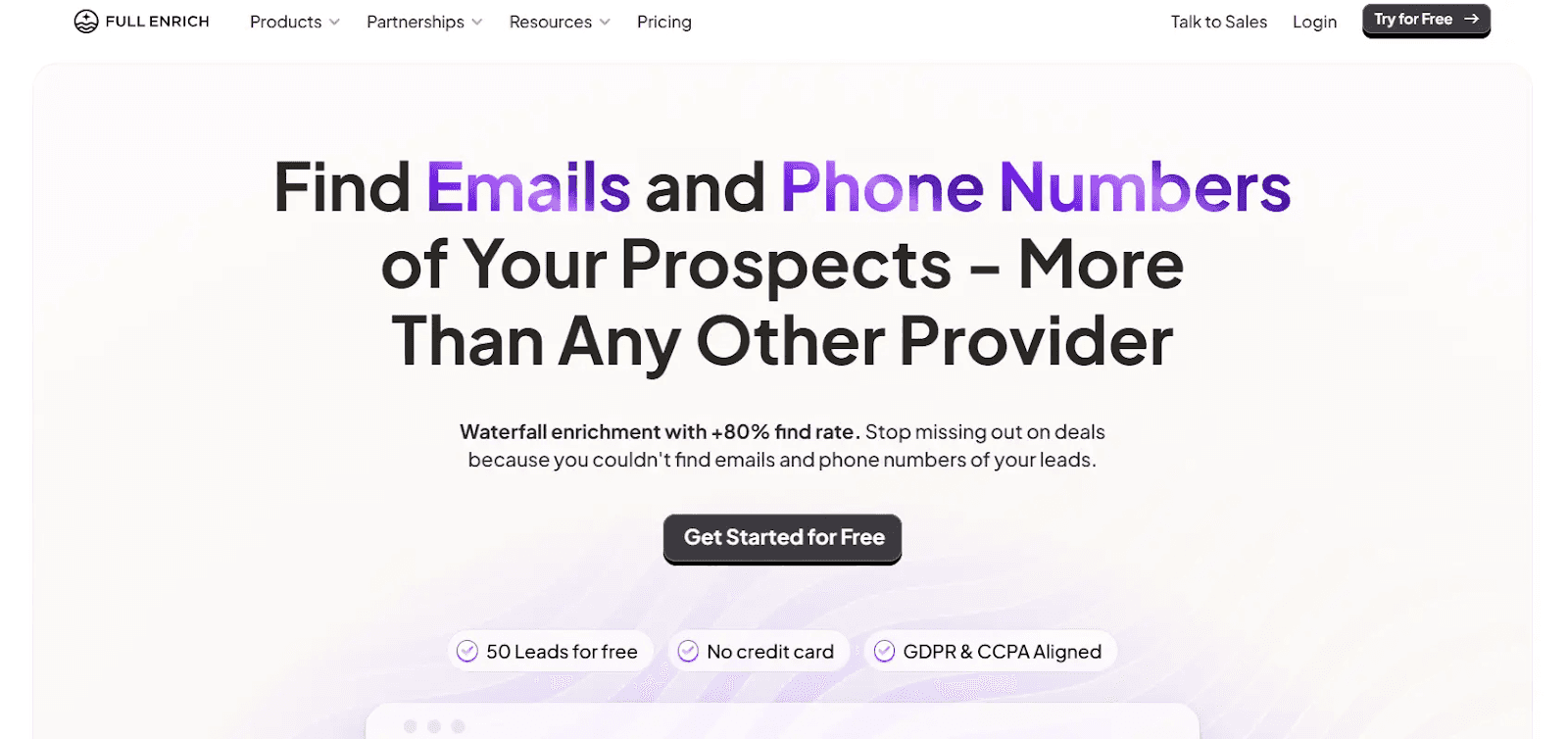
Most tools expect you to bring your own list and simply run a basic syntax check. FullEnrich approaches the problem differently by combining the discovery and verification phases into a single workflow.
Instead of relying on a single server ping that might get tricked by a corporate catch-all setup, the platform utilizes a waterfall methodology. When you input a prospect, the system simultaneously cross-references over 20 premium data providers.
If a live SMTP check returns an ambiguous result, FullEnrich uses historical consensus from these multiple databases to confirm whether the address is actually safe to email.
Why FullEnrich is the Top Choice
We ranked FullEnrich as number one because it solves the underlying cause of hard bounces: data decay. People change jobs faster than static databases can keep up. Because the platform verifies every email in real-time across multiple providers, you aren't just getting a "valid" status based on old records; you are getting a live confirmation exactly when you need it.
What Sets it Apart
Triple-Stage Validation: Every email is put through three separate verification layers to ensure it is fully deliverable before you ever hit send.
Catch-all Recovery: Unlike basic tools that skip "accept-all" domains, the system uses behavioral signals to isolate valid emails hidden within tricky corporate servers.
Success-Based Billing: You only spend credits on successful finds, ensuring your budget is directly tied to usable data.
What’s Great
Massive find rates (up to 85%+) for both B2B emails and direct mobile numbers.
Credits roll over for 3 months, preventing wasted spend during slow outreach periods.
What to Watch For
It is a professional-grade outbound infrastructure, which might be overkill for a solo creator just looking to clean a simple newsletter list.
Pricing
FullEnrich starts at $29/month with the Starter Plan, which provides 500 credits. The Pro Plan is $55/month for 1,000 credits and premium support. For agencies or high-volume teams, the Scale Plan starts at $500/month for custom credit packages.
2. ZeroBounce
Best for: Enterprise-level list hygiene and the detection of hidden threats such as spam traps
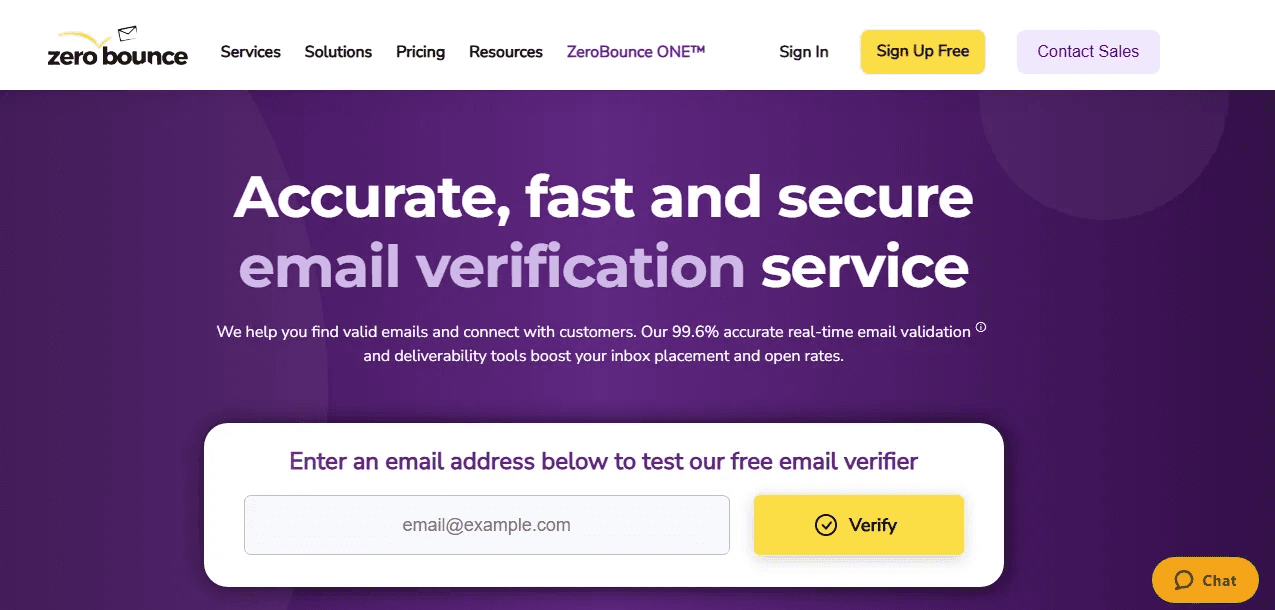
When dealing with massive, aging databases that have sat untouched for months, running a basic server ping is not enough. You need to actively hunt for hidden deliverability threats before you risk your domain.
ZeroBounce acts as a specialized deep-cleaning tool designed to identify email addresses that are technically valid but practically toxic. Instead of just looking for typos, it actively scans your list for known complainers and pristine spam traps (the hidden addresses designed by ISPs solely to catch careless marketers).
What Sets it Apart
Spam Trap and Honeypot Removal: Specialized detection algorithms isolate and remove the hidden trap addresses that can instantly destroy your IP reputation.
AI Email Scoring: Instead of a simple pass/fail, the system grades valid emails from 1 to 10 based on historical activity, telling you exactly how likely a user is to engage.
Continuous Blacklist Monitoring: The platform provides real-time alerts if your domain or IP address ever ends up on a global blacklist.
What’s Great
Extensive compliance certifications (GDPR, SOC 2, HIPAA) make the infrastructure safe for strict enterprise data environments.
Highly accurate at identifying "habitual complainers" and abuse emails before they can drag down your sender score.
Detailed reporting provides a specific technical verdict for every single email in your list.
What to Watch For
The interface is dense with deliverability data, which can overwhelm a user who just wants a simple list scrub.
Pricing
ZeroBounce offers a Free Plan with 100 credits every month. Their Pay-As-You-Go model starts at $39 for 2,000 credits, and the price per credit scales down significantly for high-volume users (e.g., 1 million credits for $3,199).
3. Kickbox
Best for: Real-time verification at the point of entry on your website or app
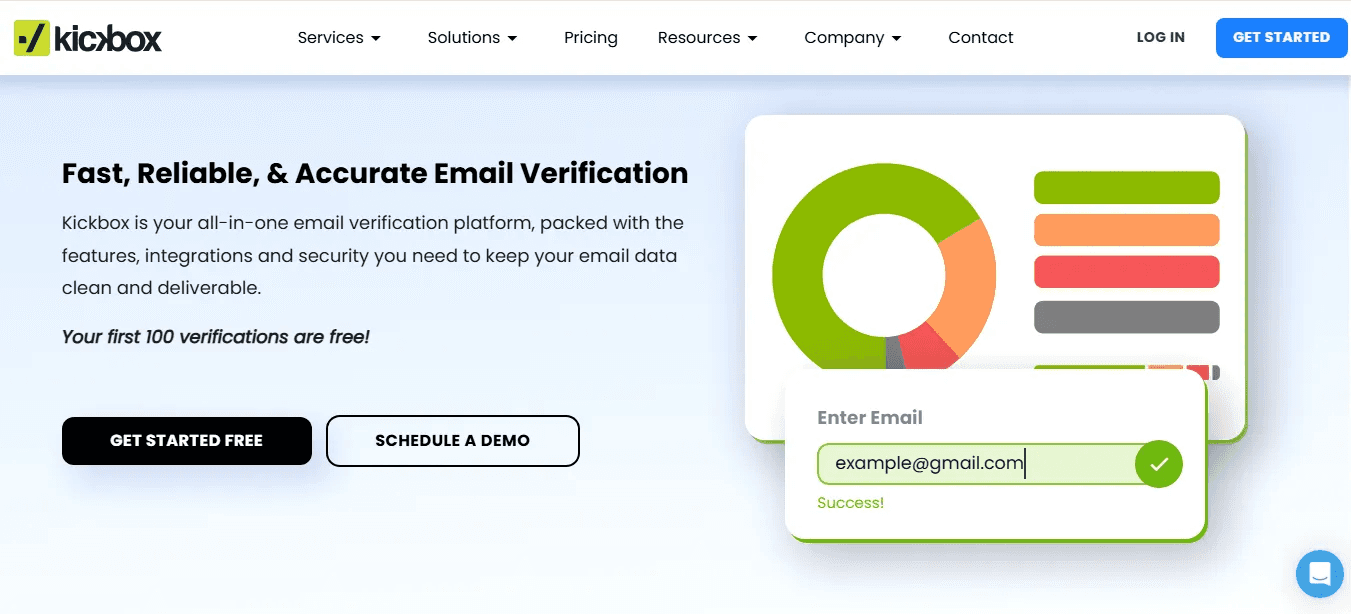
Developers and product teams who want to stop bad data from ever entering their databases typically use Kickbox. Instead of waiting to clean a list right before a campaign, this platform focuses entirely on point of entry verification.
By integrating their API directly into your signup forms, the system runs a real time check the moment a user types their address. It instantly detects typos or fake domains before the user even finishes registering, preventing bot signups and malicious entries from polluting your CRM.
What Sets it Apart
Developer Centric API: The platform provides lightweight code designed specifically to integrate into existing signup and login flows without adding latency.
Sendex Score: Instead of a simple valid or invalid binary, Kickbox uses a proprietary rating system that grades the overall quality and risk level of an address based on billions of historical data points.
Native App Integrations: It features direct connections with platforms like HubSpot, Mailchimp, and Marketo to automatically sync and verify incoming data.
What’s Great
The API is incredibly stable and fast, which is crucial for high traffic websites that cannot afford lag during the registration process.
The interface is clean and modern, focusing strictly on verification execution rather than overwhelming you with unnecessary marketing features.
What to Watch For
The platform is strictly a verification tool and does not offer lead finding or data enrichment capabilities.
Its accuracy guarantee sits at 95 percent, which is slightly lower than some premium competitors that guarantee a 99 percent find rate.
Pricing
Kickbox operates on a straightforward Pay As You Go model starting at $5 for 500 credits. For larger needs, 10,000 credits cost $80, and their highest tier offers 1 million credits for $4,000. Unlike many competitors, these pay as you go credits never expire. They also provide a free 100 credit trial so developers can test the API integration before committing.
4. ClearOut
Best for: Rapid bulk cleaning and lead discovery in one workspace
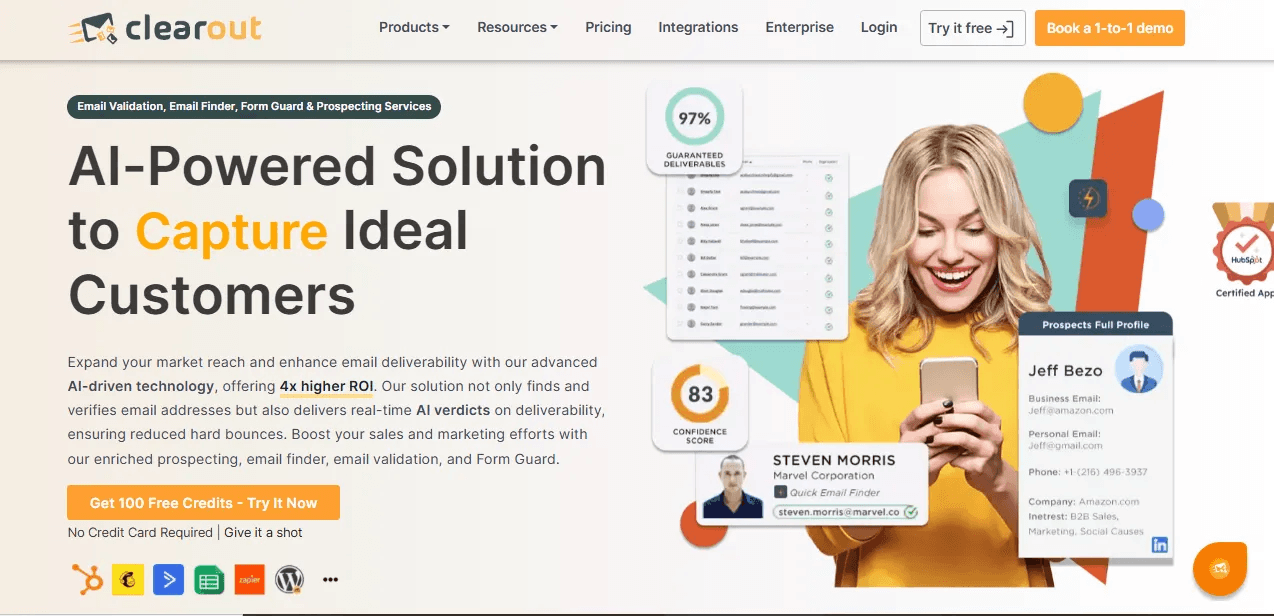
Teams that are actively building new prospect lists while simultaneously trying to scrub legacy databases typically rely on ClearOut. Instead of just performing a standard SMTP ping, this platform applies over twenty distinct validation checks to every address.
B2B marketers specifically use it to detect advanced anomalies, such as isolating "gibberish" emails that might technically pass a server check but are practically useless for engagement, or penetrating risky domains with an aggressive catch-all resolver.
What Sets it Apart
Form Guard: A real time widget that integrates into platforms like WordPress and HubSpot to instantly validate emails, phone numbers, and names, blocking fake leads and bot signups at the point of entry.
AI Verdict: Instead of a simple binary pass or fail status, the system provides an AI generated deliverability score with deep insights into the specific risk factors of an address.
Integrated Email Finder: Allows users to input prospect names and company domains to instantly discover and verify net new email addresses within the same workflow.
What’s Great
Offers extreme cost efficiency with highly competitive per credit pricing.
The Google Sheets integration acts as a massive workflow shortcut for sales teams who manage their prospecting directly in spreadsheets.
The catch all resolver successfully recovers valid addresses from restrictive corporate domains where other tools simply return an "unknown" status.
What to Watch For
While users can toggle the system to a "Fastest Turnaround" mode, switching to the "Highest Accuracy" mode can take significantly longer to process massive bulk lists.
The dashboard interface is highly functional but feels slightly dated compared to newer tools on the market.
Pricing
ClearOut offers both subscription and pay as you go models. Their Starter Plan costs $23/month (or $16/month if billed annually) for 3,000 credits. They also provide 100 free credits upon signup so users can test the validation checks with zero commitment.
5. Findymail
Best for: Exporting verified, ready-to-use leads from Apollo and Sales Navigator
Outbound SDRs who spend their entire day sourcing leads within Apollo or LinkedIn Sales Navigator typically rely on Findymail. Instead of exporting a massive, unverified list and running it through a separate cleaner, this platform acts as a bridge.
It integrates directly with major lead databases to extract and verify contacts simultaneously. The system uses advanced catch all logic to resolve restrictive corporate domains, successfully validating enterprise addresses that standard ping tests immediately flag as risky or unknown.
What Sets it Apart
Apollo and SalesNav Scraper: Effortlessly exports active searches from major lead databases with fully verified emails attached, preventing junk data from ever reaching your CRM.
Verified Only Billing: The platform guarantees a bounce rate under 5 percent by charging exclusively for 100 percent deliverable emails. You never spend a credit on a duplicate or an unverified address.
Catch all Recovery: Features an aggressive algorithm for verifying accept all corporate domains that typically cause high bounce rates in outbound sequences.
What’s Great
Achieves incredible accuracy for B2B domains, with users frequently reporting bounce rates well under 2 percent.
Native integrations with high volume outreach tools like Instantly and Smartlead create a completely seamless workflow.
The pay only for valid model ensures strict budget efficiency.
What to Watch For
It is significantly more expensive on a per credit basis than standalone cleaning tools like ZeroBounce.
Due to strict GDPR compliance, phone number discovery is strictly limited to non EU contacts, creating a bottleneck for global sales teams.
Pricing
Findymail scales its pricing based on verified credit volume. The Basic Plan starts at $49/month for 1,000 credits. The Starter Plan costs $99/month for 5,000 credits. For high volume outbound teams, the Business Plan runs $249/month for 15,000 credits. They also offer higher sliding scale tiers, such as 30,000 credits for $399 or up to 100,000 credits for $849, to support enterprise operations.
6. Leadmagic
Best for: Real-time B2B data enrichment and identifying anonymous website visitors
Instead of just cleaning static lists, LeadMagic integrates real time visitor identification with aggressive email verification. Teams that want to capitalize on inbound traffic use this platform to identify anonymous website visitors and instantly verify their B2B contact data before the prospect ever fills out a form.
To ensure these outbound messages actually land, the system actively resolves tricky catch all domains by bypassing strict Secure Email Gateways (SEGs) like Proofpoint or Mimecast, providing definitive valid or invalid statuses where other tools simply return an unknown error.
What Sets it Apart
Real Time Visitor Verification: Instantly identifies which companies are browsing your site and verifies the contact data of the likely decision makers so you can execute highly targeted outreach.
SEG Bypass for Catch Alls: Utilizes proprietary algorithms to verify individual mailboxes hidden behind strict corporate security gateways, recovering high value enterprise contacts that standard pings miss.
Job Change Tracking: Monitors target companies and alerts you when verified contacts change roles, preventing you from sending emails to dead addresses and triggering hard bounces.
What’s Great
Provides an exceptionally high accuracy rate by combining SMTP verification with live engagement data.
Credits roll over from month to month on their Essential plan and above, preventing wasted budget during slow outreach periods.
Integrates natively into modern outbound data workflows like Clay and Apollo.
What to Watch For
The platform offers a massive suite of enrichment tools, which might feel overly complex if you only want a basic bulk list cleaner.
While it offers unlimited team seats, its pricing scales strictly based on credit consumption, which requires careful budget monitoring.
Pricing
LeadMagic operates on a transparent credit system starting with 100 free credits upon signup. The Basic Plan is $59.99/month for 2,500 credits. The Essential Plan costs $99.99/month for 10,000 credits and unlocks credit rollover. Higher volume tiers include the Growth Plan ($179.99/month for 20,000 credits), the Advanced Plan ($259.99/month for 30,000 credits), and scale all the way up to the Ultimate Plan at $799.99/month for 100,000 credits.
7. EmailListVerify
Best for: High-volume bulk cleaning for businesses on a tight budget
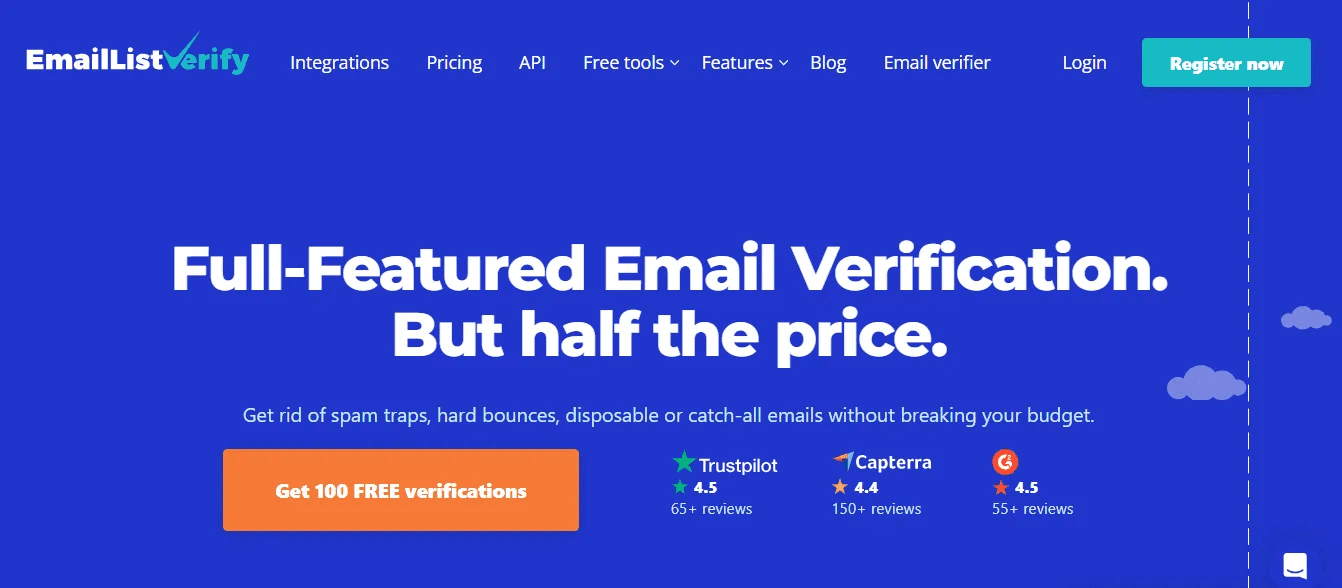
When dealing with a massive legacy list, spending premium rates for deep enrichment features often destroys the overall ROI of the campaign. EmailListVerify acts as a high speed, purely functional list cleaner designed specifically for scale.
Instead of offering complex sales intelligence, it focuses strictly on executing core server level checks at a fraction of the cost of enterprise platforms. The system runs a strict multi step process that includes essential syntax verification, domain validation, and specialized greylisting protection to ensure accurate results when pinging strict anti spam servers.
What Sets it Apart
Greylisting Verification: Utilizes a specialized check that safely bypasses temporary server rejections (greylisting) to accurately verify tricky domains without getting blocked or returning false negatives.
Bulk Deduplication: Automatically identifies and strips out duplicate entries before the verification process even begins, preventing you from wasting paid credits on redundant contacts.
Free Deliverability Tools: Provides a supplementary suite of technical features, including an MX lookup, blacklist checker, and email health monitor, at zero extra cost.
What’s Great
Offers incredible value at scale, allowing teams to verify 10,000 emails for under $30.
Pay as you go credits never expire, allowing you to purchase at a massive volume discount and use the system as slowly as necessary.
The interface is purely functional, allowing you to upload a massive CSV and begin the cleaning process in seconds.
What to Watch For
The accuracy rate for complex catch all domains is generally lower than what you get from premium, multi source platforms like FullEnrich or LeadMagic.
Customer support is reliable during standard business hours but lacks the 24/7 instant response times required by some enterprise operations.
Pricing
EmailListVerify operates on a highly aggressive Pay As You Go model, starting at just $5 for 1,000 credits. For bulk needs, 100,000 credits cost exactly $186. If you require an automated, daily list cleaning schedule, their Subscription Plans offer further discounts, starting at $16/month for 5,000 credits.
Choosing the Right Shield for Your Domain
As we move through 2026, the cost of a "bad" email list is higher than ever. With inbox providers using more aggressive filters, even a small number of bounces can land your most important business messages in the spam folder. The tools we've looked at today are designed to stop that from happening, but each one has its own specific place in your workflow.
If you are running high-stakes sales outreach, our first choice remains FullEnrich because it combines discovery with a "triple-validation" waterfall that others just can't match. If you’re a developer, Kickbox is your best bet for real-time signups. And if you’re just trying to keep your monthly newsletter list clean on a budget, EmailListVerify will save you hundreds of dollars.
The most important thing to remember is that email verification isn't a "one-and-done" task. It should be a recurring part of your marketing hygiene. Pick the tool that fits your current volume and technical needs, and make it a habit to scrub your data before every major send.
Frequently Asked Questions (FAQs)
Why can't I just send a test email to see if it bounces?
Sending "test" emails is the fastest way to get your domain blacklisted. Every bounce is a strike against your sender reputation with providers like Gmail and Outlook. Verification tools "ping" the recipient's server behind the scenes without actually sending a message, protecting your domain while giving you the same answer.
Are free email verification plans actually worth it?
They are perfect for small-scale testing or cleaning a tiny list before a monthly newsletter. Most reputable tools offer 50–100 free credits to get started. However, if you're doing serious outreach, you'll outgrow these in minutes. The real value of paid plans isn't just the volume; it's the advanced checks for spam traps and "catch-all" addresses that free versions often miss.
What exactly is a "catch-all" email, and should I send to them?
A catch-all (or "accept-all") is a server setting that causes a company to receive every email sent to its domain, even if the specific address doesn't exist. Basic tools flag these as "risky" because they can't be 100% sure a person is on the other end. Specialized tools like FullEnrich or Findymail leverage additional data signals to tell you which of these are safe to send to.
How often should I clean my email list?
Email data decays at about 2% to 3% per month as people change jobs or delete accounts. At a minimum, you should do a bulk clean every three months. However, if you’re running cold outreach, the best practice is to verify your list immediately before you hit send to keep your bounce rate below the "danger zone" of 2%.
Can I verify emails directly inside my CRM?
Yes, many top tools, such as ZeroBounce and ClearOut, have native integrations with HubSpot, Salesforce, and Pipedrive. This allows you to "sync and clean" without ever downloading a CSV file.
Will verifying my list stop my emails from going to the spam folder?
It’s a major piece of the puzzle, but not the only one. Verification stops hard bounces, which is the #1 reason for a bad reputation. However, you still need to worry about your content quality and "spammy" keywords.
What is the difference between "syntax" and "SMTP" verification?
Syntax checking is basic; it just looks for typos like "gamil.con" instead of "gmail.com." SMTP verification is the "heavy lifting"; it actually contacts the recipient's mail server to see if a specific mailbox exists. Any tool you choose in 2026 should be doing full SMTP checks as standard.
Can I just use an API to verify emails on my signup form?
Yes, and you should. Using a real-time API prevents fake or mistyped emails from even entering your database. This keeps your list clean from day one and prevents "bot signups" from wasting your marketing budget.



Other Articles
Cost Per Opportunity (CPO): A Comprehensive Guide for Businesses
Discover how Cost Per Opportunity (CPO) acts as a key performance indicator in business strategy, offering insights into marketing and sales effectiveness.
Cost Per Sale Uncovered: Efficiency, Calculation, and Optimization in Digital Advertising
Explore Cost Per Sale (CPS) in digital advertising, its calculation and optimization for efficient ad strategies and increased profitability.
Customer Segmentation: Essential Guide for Effective Business Strategies
Discover how Customer Segmentation can drive your business strategy. Learn key concepts, benefits, and practical application tips.