Apollo and Seamless sell the same thing on paper, B2B contact data (emails, direct dials and cell phones for outbound), but they're built for different teams.
Apollo is an all-in-one prospecting and outreach platform. Prices are public and per seat.
Seamless is a contact search engine built around cell phones. Paid plans are quoted by sales. It was called Seamless.AI until it rebranded in February 2026.
This comparison covers price, credits, contract terms, data quality, features, integrations and compliance. Pricing, credit and contract facts were checked against Apollo's and Seamless's own pages on 24 September 2026. Where users' experience adds something those pages don't, I quote G2 reviews and Reddit threads, with links.
Disclosure: I run FullEnrich, which sells a competing enrichment tool. It gets one section near the end, as a third option.
TL;DR
- Apollo publishes its prices: $49 to $119 per seat per month, billed annually. Seamless paid plans say "Contact sales".
- Pick Apollo for an all-in-one stack (data, sequences, dialer). Pick Seamless if cell phones for cold calling matter most.
- Phones are the real split. Seamless users praise cell numbers that reach the decision-maker. Some Apollo users say its mobiles are missing or outdated, and one Reddit user who tried both says maybe 1 in 10 connected.
- Both share one weakness: outdated or wrong contacts are a top complaint in recent G2 reviews of each tool.
- Seamless contracts auto-renew for 12 months unless you cancel at least 60 days before renewal. Apollo credits don't roll over.
- Need more coverage without another seat license? A waterfall like FullEnrich (25+ sources, you pay only for verified data found) sits on top of either one.
Apollo vs Seamless at a glance
Short answer: Apollo shows its prices and bundles outreach. Seamless leads with cell phones and sells paid plans through sales.
Criteria | Apollo | Seamless | Source (checked 24 Sep 2026) |
|---|---|---|---|
Public prices | Yes: $49 to $119 per seat/month, billed annually | No: Pro and Enterprise say "Contact sales" | Vendor pricing pages |
Entry paid plan | Basic: $49 annual, $65 monthly | Pro: price on request | Vendor pricing pages |
Free plan | 900 credits per seat per year, granted monthly | 1 user, 50 credits that don't replenish | Pricing page; Seamless help center |
Credit rollover | No | Not publicly documented | Apollo credits page; Seamless help center |
Cancellation | Takes effect at the end of the current term | Cancel 60+ days before renewal or it renews for 12 months | Apollo pricing FAQ; Seamless terms |
Database size (vendor's own claim) | 240M+ contacts, 30M+ accounts | 1.8B+ business emails, 414M+ phone numbers | apollo.io; seamless.ai |
Outreach tools | Sequences, dialer, meetings, deals | Connect: email, calls and tasks | Vendor pricing pages |
Built-in waterfall | Yes, on paid plans | Not listed | apollo.io/product/waterfall |
CRM sync | Two-way with Salesforce and HubSpot | 12 CRMs listed; HubSpot page describes an import flow | Vendor integration pages |
Two rows hit your budget hardest: rollover and cancellation. Both get their own section below.
The database rows are marketing claims. Apollo says it has "240M+ contacts and 30M+ accounts". Seamless says it has "1.8B+ verified business emails and 414M+ phone numbers".
Neither number tells you how many of your prospects are in there.
How much do Apollo and Seamless cost?
Apollo costs $49 to $119 per seat per month on annual billing.
Seamless doesn't publish a price for any paid plan.
That's the whole story on day one. The details sit in the credits.
Apollo pricing
Apollo's pricing page lists four plans, all per seat:
- Free: $0, 900 credits per seat per year, granted monthly.
- Basic: $49 per seat per month billed annually, or $65 billed monthly. 30,000 credits per seat per year, granted upfront.
- Professional: $79 billed annually, or $99 billed monthly. 48,000 credits per seat per year.
- Organization: $119 per seat per month, minimum 3 seats. It shows $149 on the monthly toggle, marked "Annual Only". 72,000 credits per seat per year.
Annual billing carries a "SAVE 24%" badge. Basic and Professional offer a 14-day trial, and Apollo's FAQ says trial plans include 100 credits.
Seats add up fast. A five-seat team on Basic pays $2,940 a year before any add-on.
Add-ons cost extra. The Advanced Dialer and Inbound add-ons each list at $119 per team per month, billed annually.
On credits, Apollo says it "never charges more than 1 credit per contact" for emails. Phones cost more. The pricing FAQ says: "Accessing a contact's phone number uses 8 credits."
The big rule: Apollo credits don't roll over. On annual plans, "all credits are unlocked at the beginning of the annual billing cycle" and expire at the end of it.
One catch for current customers. Apollo's pricing page says some features "are only available with our new credit system." New customers get it automatically. Existing teams may still be on the legacy system.
Full plan-by-plan breakdown: Apollo pricing explained.
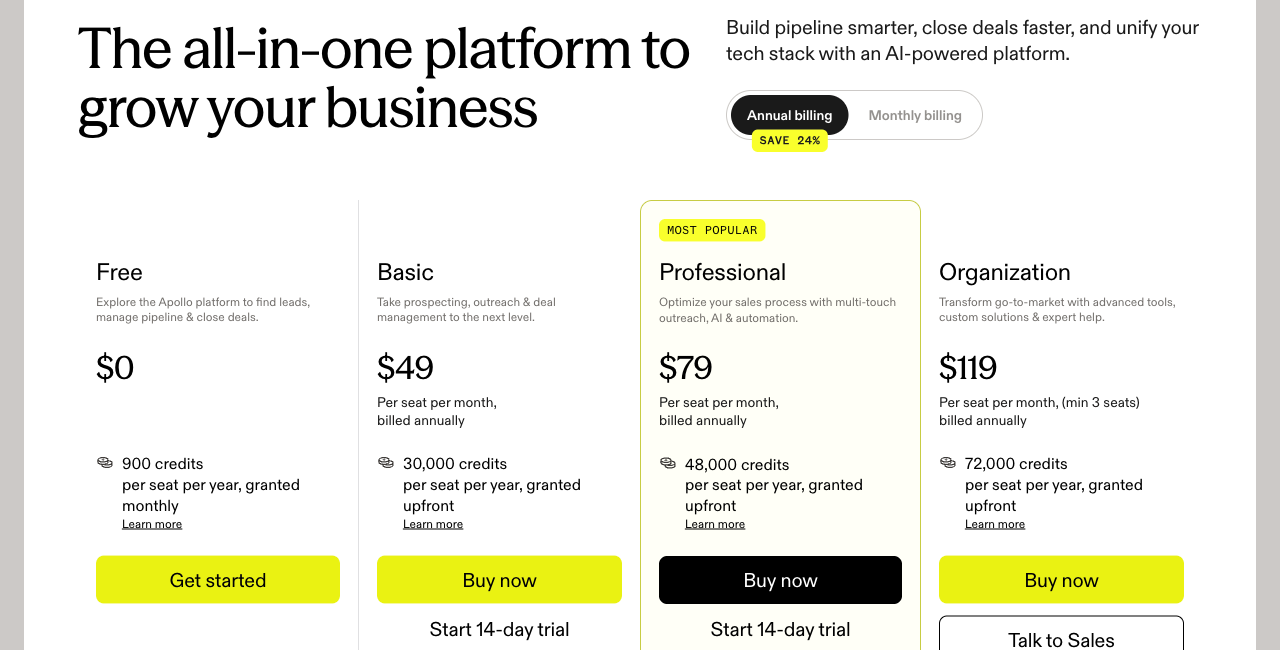
Apollo's pricing page, captured 24 September 2026. Source: https://www.apollo.io/pricing.
Seamless pricing
Seamless shows three plans:
- Free: 1 user, 50 credits.
- Pro: per user, unlimited exports, annual credit packages. "Contact sales".
- Enterprise: unlimited users, custom packages. "Contact sales".
The only volume hint sits in the pricing FAQ: "Pro plans start off at 10,000 annual credits."
Seamless's credit help article tells a slightly different story. It says Pro users receive 10,000 Universal Credits per month, refreshed on the contract date. Free credits "do not replenish".
Annual or monthly? The two pages don't match. Get the number in writing before you sign.
The same article says Universal Credits replaced the older Standard Credits in June 2026. And it says nothing about rollover, either way.
More detail: Seamless pricing explained.
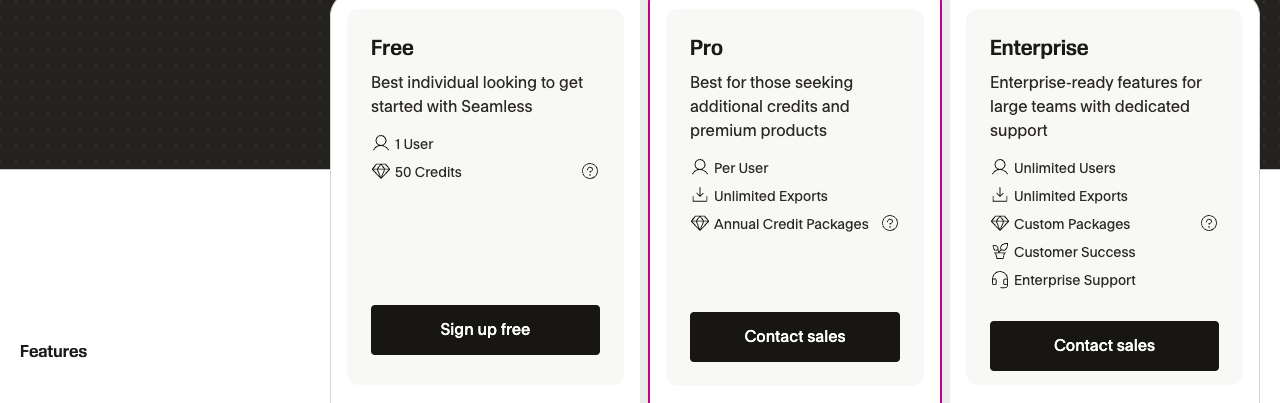
Seamless's pricing page, captured 24 September 2026. Source: https://seamless.ai/pricing.
What reviewers say about price
Price is a recurring complaint from Seamless users, even in 5-star reviews:
"I dislike that there is not a lower cost service for someone who doesn't use the software for downloading mass amounts of contacts."
5-star review, United States, 16 September 2026
Others ask for cheaper packages (Morocco, 5 stars) or fewer credits per lead (United States, 4 stars).
Apollo users grumble less about the entry price and more about limits. One reviewer says it's easy to "burn through your limits quickly" (India, 5 stars). Another warns the pricing "can also become relatively expensive as the team or usage scales" (India, 5 stars).
Contracts: the cost nobody puts on the pricing page
The Seamless renewal clause is the biggest cost risk in this comparison.
Here it is, from the Seamless terms of use, section 6:
"If you wish to cancel your subscription, you must complete the applicable subscription modification in the Seamless.AI platform no later than 60 days prior to the next annual contract renewal date. If the subscription is not modified or cancelled under these Terms more than 60 days before the renewal, the annual contract will automatically renew for an additional 12 months."
Miss the window by a day and you own another year.
Apollo is softer, with limits. Basic and Professional can be billed monthly. Organization is annual only.
Apollo's pricing FAQ says "Cancellations take effect at the end of your current term." It also says "Refunds will not be processed for downgrades mid-term."
On an annual Apollo plan, unused credits vanish at the end of the term. That's a quieter cost, but it's real.
Renewals can move too. In September 2026, someone on a 12-person SDR team posted on Reddit that after Apollo's new-pricing email, their team would be "paying almost 40% more for the same seats starting next billing cycle." That's one team's renewal, not a list price. Ask for your renewal quote early.
The rule:
-> Put the notice date in your calendar the day you sign. Not the renewal date. The notice date.
Data quality: phones, emails and freshness
Short answer: Seamless users praise its cell phones most. Apollo users praise its all-in-one workflow and filters. Users of both flag stale records. Check before you trust them.
Phones: Seamless's strongest card
Phone numbers are the praise Seamless users repeat most on G2, often framed as getting past the gatekeeper:
"...when dealing with larger companies there are multiple layers of gatekeepers, the direct contact info helps bypass all that."
5-star G2 review, United States, 26 August 2026
Apollo users are less happy with its phone numbers:
"Direct phone numbers can occasionally be outdated or land on corporate front desks, requiring manual verification."
5-star G2 review, Malaysia, 21 September 2026
One Reddit poster whose team tried both for a month put it more bluntly in July 2026. On Apollo's mobiles: "maybe 1 in 10 actually connects." On Seamless: "we're seeing like 3x more connects on cold calls."
One team, one month. But it lines up with the reviews. Same poster's verdict: "apollo feels more polished overall but seamless gets us actual phone numbers that work."
Emails and search: Apollo holds its own
Apollo gets credit for accuracy too, including outside the US:
"...it beats other vendors for European accuracy for sure."
5-star G2 review, Ireland, 23 September 2026
And its search is deeper. The same Reddit poster found Seamless's "search filters are pretty basic compared to apollo."
Freshness: the problem they share
Outdated or wrong data is Apollo's most common complaint in its 30 newest G2 reviews (12 of 30). For Seamless it ties with interface complaints as the most common (8 of 30 each). It often sits inside 4- and 5-star reviews.
"It's frustrating when the person is no longer with the company, or the contact numbers are incorrect and reach the wrong person."
5-star G2 review, Seamless user, Philippines, 13 September 2026
Both tools sell mostly from their own database. Every database ages. That's why teams re-check records with contact data enrichment instead of trusting a one-time export.
How fast? Cleanlist's 2026 study re-verified 5,000 anonymized CRM contacts every week for 13 weeks (7 January to 7 April 2026). It measured 2.1% decay per week, which it says compounds to roughly 67% a year. Treat it as one study: Cleanlist sells data-cleaning tools.
A note on star ratings. G2 marks 28 of Seamless's 30 newest reviews as collected by the vendor (one more is marked "vendor"), against 3 of 30 for Apollo. Invited, not fake. But it likely lifts the average: Seamless's sample averages 4.90 stars, Apollo's 4.63. Compare the complaints, not the stars.
Review counts in this section come from the 30 newest G2 reviews per tool, published between 12 August and 23 September 2026 (the two samples' combined window).
Features and workflow
Apollo is an engagement suite: data, sequences, dialer, meetings and deals in one app.
Seamless is a search engine for contacts, with outreach added through Connect.
Feature | Apollo | Seamless | Source |
|---|---|---|---|
Search | Basic filters on Free, advanced filters on paid plans | Prospector search, Job Changes filter | Pricing pages |
Chrome extension | Prospecting, Gmail and Salesforce extensions on every plan | Yes, per Seamless | Pricing page; Seamless integrations page |
Sequences | 2 on Free, unlimited on paid plans | Connect: email, calls and tasks | Pricing pages |
Dialer | US dialer on paid plans (credits apply); Advanced Dialer add-on | Calling inside Connect | Pricing pages |
AI | AI Assistant and AI Research; Agents from Professional up | AI Assistant and Autopilot, listed as add-ons | Pricing pages |
Native waterfall | Yes, on paid plans | Not listed | Apollo product page |
Intent data | Intent topics: 1 on Free, 6 on Basic and Professional, 12 on Organization (with intent filters on paid plans) | Buyer Intent Data, listed as an add-on | Pricing pages |
Deliverability | Deliverability suite and email warmup on all paid plans | Not listed | Apollo pricing page |
A few notes on that table.
Apollo's US dialer uses credits: the pricing page lists 2 credits per minute. Power dialing, parallel dialing and international calls sit in the Advanced Dialer add-on.
Seamless's pricing page says "All Plans Now Include Connect", flagged as limited time. Check it's still there when you buy.
Usability cuts both ways. Apollo's most common G2 gripe after data is the learning curve: it does a lot, so it takes time. Seamless reviewers mention a clunky interface or slow searches about as often as they mention outdated data.
Now the big change. Apollo ships its own waterfall.
Apollo says Waterfall Enrichment "fills each record with Apollo data first", then partner sources fill the rest (more than 20, per Apollo). It's listed on Basic, Professional and Organization, and it runs through the API too.
That changes the old "waterfall vs single database" argument. More on that in the FullEnrich section below.
Integrations: CRM, engagement tools, API and AI agents
Short answer: both connect to the usual CRMs. The documentation differs: Apollo documents two-way sync settings in detail, while Seamless's HubSpot page describes importing leads into your CRM.
CRM sync
Apollo. Salesforce connects through a managed package and a dedicated integration user. Then you set pull and push settings. Pull decides "which CRM records and activities your team works with in Apollo". Push controls "which Apollo contacts, accounts, deals, and activities are written back to your CRM". HubSpot works the same way, with its own push and pull settings: Apollo "automatically pulls all contacts from HubSpot", and deals sync "bidirectionally".
One setup trap: on paid plans, sync switches on automatically 6 hours after you connect Salesforce or HubSpot. Map your fields before that.
Seamless. Its integrations page lists 12 CRMs: Salesforce, HubSpot, Microsoft Dynamics, Zoho, Pipedrive, Close, Copper, Keap, Insightly, Cloze, SugarCRM and Freshsales. Every card on that page is labelled "Powered by Zapier".
Seamless's HubSpot page describes an import flow. You "pick and choose what you want to import", set match scores to avoid duplicate entries and customize import mappings.
If two-way sync matters to you, ask Seamless which CRMs connect natively on your plan before you sign.
One user of each calls out integrations:
"Its integrations with other sales and productivity tools also make it easy to fit into an existing workflow."
5-star G2 review, Apollo user, India, 2 September 2026
"...the integration to Linkedin and Hubspot make things so much faster and easier."
5-star G2 review, Seamless user, United States, 16 September 2026
Engagement tools and automation
Apollo doesn't need a separate sequencing tool. It has its own. Its integrations marketplace lists "50+ tools", including Slack, Clay, Chili Piper and Marketo. It even lists the partners behind its waterfall, such as Hunter.io, ContactOut, Datagma and Findymail. Zapier connects through an Apollo API key.
Seamless connects to Outreach, Salesloft and Mixmax for sequencing, Zapier and n8n for automation, and Greenhouse for recruiters.
API and AI agents
On the API, Apollo's developer FAQ says "All pricing plans include at least basic access to the Apollo API, but more advanced functionality is only available on certain plans." Its pricing FAQ adds that Custom plans get API access "for more advanced integrations". So: basic access for everyone, the deep stuff at the top.
The Seamless API offers "programmatic access to contact search, company search, enrichment, and job-change intelligence". The page's call to action is "Talk to sales".
A detail worth noticing on that page: it claims "2.2B+ verified contacts" and "448M+ verified mobile numbers". The Seamless homepage says 1.8B+ business emails and 414M+ phone numbers. Same vendor, different figures: 448M+ mobile numbers on one page, 414M+ phone numbers on the other.
Both now run MCP servers, so AI assistants can query them directly. Apollo MCP works in Claude, ChatGPT and Perplexity, and needs a work email to sign in. Seamless MCP connects to Claude, ChatGPT or any MCP client, once MCP access is enabled on your account.
Integration | Apollo | Seamless | Source |
|---|---|---|---|
CRM sync | Two-way: pull and push settings for Salesforce and HubSpot | 12 CRMs listed (cards labelled "Powered by Zapier"); HubSpot page describes an import flow | Apollo help center; Seamless integration pages |
Sequencing tools | Built in; marketplace of 50+ tools | Outreach, Salesloft, Mixmax | Vendor integration pages |
Automation | Zapier (via API key), Clay | Zapier, n8n | Vendor integration pages |
API | Basic access on every plan; API enrichment on paid plans; more advanced access on Custom plans | "Talk to sales" on the API page | Apollo developer FAQ and pricing FAQ; Seamless API page |
AI agents (MCP) | Claude, ChatGPT, Perplexity | Claude, ChatGPT, any MCP client | Vendor MCP pages |
Security, compliance and legal history
Short version: both have certifications, and both have history. Here are the dated facts. (For the same questions about us, see FullEnrich's trust and security page.)
Apollo. Apollo says it holds ISO 27001 and SOC 2 certifications from A-LIGN. It says it is GDPR compliant as both a data processor and a data controller.
On 1 October 2018, TechCrunch reported that Apollo, "a sales engagement startup boasting a database of more than 200 million contact records, has been hacked."
Seamless. Seamless says it is SOC 2 Type II certified.
Seamless Contacts, Inc. faced a right-of-publicity class action, Spindler v. Seamless Contacts. It was about using people's names and likenesses to sell subscription access to profile pages. The court denied Seamless's motion to dismiss.
The case was later consolidated into Plowman et al. v. Seamless Contacts, Inc. It's settled: the court gave final approval in April 2026.
Both. On 6 March 2025, LinkedIn removed both companies' LinkedIn pages. It was a page removal, not a lawsuit. On 10 March 2025, Apollo CEO Tim Zheng said Apollo was "actively working with LinkedIn to understand the nature of our brand page restriction and to resolve the matter."
Apollo or Seamless: which one should you pick?
Pick Apollo if you want one tool for data and outreach. Pick Seamless if your team lives on the phone.
Choose Apollo if:
- You want data, sequences and a dialer under one login and one bill.
- You need to see the price before you talk to sales.
- You want monthly billing on Basic or Professional.
Choose Seamless if:
- Cold calling to cell phones is the core motion. That's what its users praise most.
- You like a real-time search approach over a static list.
- You're fine with an annual contract and you'll calendar the notice date.
Neither is enough if one source keeps coming back empty or stale on your list. Users of both flag stale data.
Best test before you sign: run the same list through two or three tools and compare mobile coverage, email accuracy and real connect rates. A Reddit commenter suggested exactly that, and it beats any comparison page, including this one.
Situation | Better fit | Why |
|---|---|---|
Founder testing outbound on a small budget | Apollo | Free plan and published prices |
SDR team cold calling US decision-makers | Seamless | Cell phones are what its users praise most |
One tool for data and sequences | Apollo | Unlimited sequences on paid plans |
You hate annual lock-in | Apollo (monthly Basic or Professional) | Seamless renews for 12 months without 60 days' notice |
Europe-heavy prospecting | Not enough evidence | One Irish reviewer praises Apollo's EU accuracy; that's one data point |
Coverage gaps are the real problem | Neither alone | Users of both flag outdated or wrong data |
Looking at other options? See Apollo alternatives or Lusha vs Seamless.
A third option: add a waterfall layer (FullEnrich)
This section is about our product. Read it with that in mind.
If coverage is the problem, a second single database rarely fixes it.
A waterfall works in three steps:
- It asks one data provider for the contact.
- If that provider has nothing verified, it asks the next one, and so on.
- It stops at the first verified result.
More detail: how waterfall enrichment works.
Apollo now does this too. So the real difference isn't "waterfall or not".
It's who pays for a miss.
Apollo's waterfall docs say: "Some data sources charge only when they return data. Other data sources may consume credits for a lookup even when they don't find an email address or phone number."
FullEnrich's rule is flat: "Credits are spent only when data is found and passes verification. A lookup that returns nothing costs nothing."
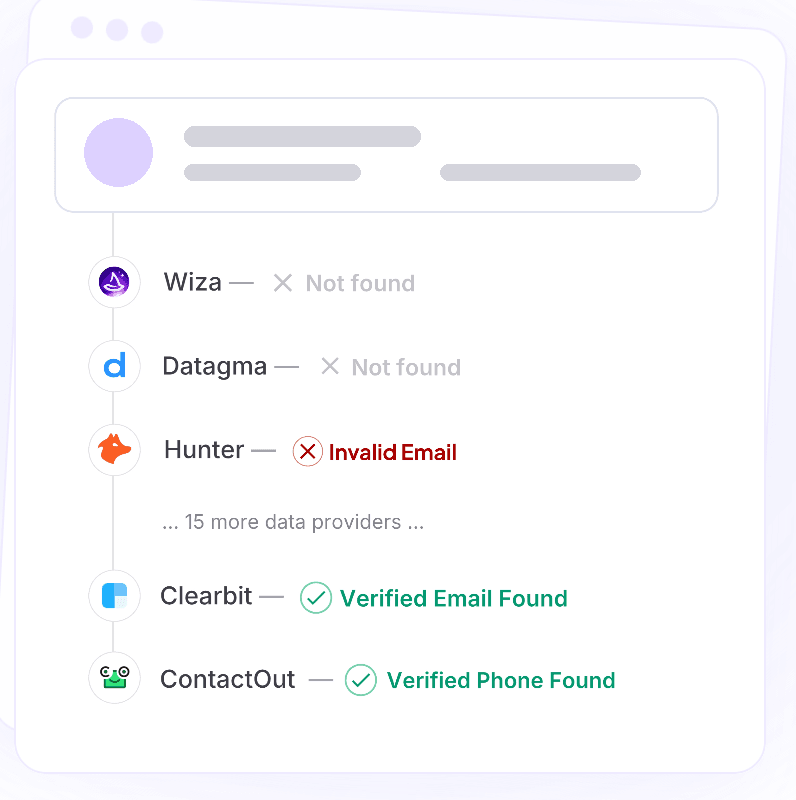
Illustration of a waterfall lookup (contact anonymized). Provider names and counts are illustrative, not live data.
What FullEnrich does:
- 25+ sources: FullEnrich queries 25+ data providers per lookup.
- Own figures, stated as ours: on that page, FullEnrich claims an "80%+ find rate", a "<1% bounce rate" and triple verification (syntax, MX record, SMTP).
- No seats: unlimited users on every plan.
- Rollover: unused credits roll over 3 months on monthly plans, 12 months on annual plans.
- Clear credit costs: 1 credit per work email, 3 per personal email, 10 per mobile. Landlines cost nothing.
- Entry price: Pro starts at $29 a month for 500 credits. See FullEnrich pricing.
One customer result. Deel piloted FullEnrich with over 70 reps. Olivier Elbaz, Global Head of Expansion, reports "2.4x more mobiles found, connect rates that jumped from 6% to 30%, and 5x fewer invalid numbers" (quoted on fullenrich.com).
Where FullEnrich might not be the best fit:
- You need a Chrome extension for your current workflow. FullEnrich no longer offers one. Apollo and Seamless both do.
- You need sequences, dialer and various outreach featured bundled in one tool: It's a data layer, not an engagement suite.
So it doesn't replace Apollo's outreach tools. It sits next to them, or next to Seamless, and fills the records they leave empty. It connects through the API, the MCP server, Zapier, Make and n8n.
The bottom line
- Apollo wins on transparency and breadth: public prices, monthly billing on two plans and a full outreach suite.
- Seamless wins with phone-first cold callers. Watch the 60-day renewal clause and the unpublished prices.
- Both get the same complaint from their users: outdated or wrong contact data.
If that last line is your problem, don't buy a third database. Add a waterfall and pay only when it finds something. Start with 50 free FullEnrich credits, no credit card.
A cheaper seat doesn't fix an empty record.
FAQ
Does Seamless publish its prices?
No. Only the Free plan is priced: it's free, with 1 user and 50 credits. Pro and Enterprise say "Contact sales" as of 24 September 2026. The pricing FAQ says Pro plans "start off at 10,000 annual credits", with no dollar figure.
Do Apollo credits roll over?
No. Apollo says credits "do not roll over into the following billing cycle or upon renewal." On annual plans, you get all credits upfront, and they expire at the end of the term.
Does Apollo have waterfall enrichment?
Yes, on paid plans. Apollo checks its own data first, then partner sources. Its docs say some of those sources can charge credits even when they find nothing.
How do I cancel a Seamless subscription?
Inside the Seamless platform, at least 60 days before your annual renewal date. Miss that window and the contract renews for another 12 months, per section 6 of its terms of use.
Is Seamless the same company as Seamless.AI?
Yes. Seamless.AI rebranded as Seamless in February 2026 and kept the seamless.ai domain. G2 now lists it as "Seamless (formally Seamless.AI)". The legal entity is Seamless Contacts, Inc.