
Apollo has been one of the most preferred platforms for prospecting. It became the default starting point for teams scaling outbound by bundling a massive B2B database with a built-in email sequencer.
But here is the reality in 2026, convenient data is often decaying data.
Despite the fact that Apollo aggregates billions of data points, its core proprietary database still suffers from B2B decay. You export "verified" leads, only to experience 15%+ bounce rates that destroy your domain reputation. Apollo has recently integrated waterfall enrichment to combat this.
But running it rapidly burns through expensive, add-on credits. Add a rigid, per-seat pricing model where mobile numbers are severely capped, and your "affordable" tool quickly becomes an unpredictable expense.
To protect deliverability and budget, modern RevOps teams are moving to specialized infrastructure. Today's top-tier alternatives utilize dedicated multi-vendor waterfall routing to maximize match rates at lower costs, deploy real-time SMTP pinging to eliminate bounces, and offer unlimited-seat pricing structures to scale freely.
So, if you think Apollo falls short in meeting your data enrichment needs, you may want to look into the following 15 best Apollo alternatives in 2026.
15 Apollo Alternatives at a Glance
The comparison table below breaks down the essentials to compare Apollo: pricing, data accuracy, integrations, and what each platform does best. Use it to quickly narrow down your options before diving into the detailed breakdowns.
Tools | Best For | Starting Price | Free Trial | Data Accuracy | G2 Rating |
|---|---|---|---|---|---|
FullEnrich | Teams needing waterfall enrichment from 20+ data sources | $29/month | Yes (First Free 50 Leads) | 95%+ (triple verification) | 4.8/5 |
ZoomInfo | Enterprise teams needing intent data & deep org charts | Custom quoted (~$14,995/year) | Yes | 90-92% | 4.5/5 |
Seamless.AI | Real-time contact discovery with AI-powered search | Custom Quoted | Yes ( 50 Credits) | 85-88% | 4.4/5 |
Lusha | SMBs needing quick LinkedIn prospecting | $49.90/month | Yes (40 Credits) | 80-85% | 4.3/5 |
Cognism | EMEA-focused teams needing mobile numbers & DNC screening | Custom pricing | Limited Demo | 90-93% (phone-verified) | 4.5/5 |
Clearbit | Product-led growth teams need enrichment APIs | $50/month | No Free Trial | 88-90% | 4.4/5 |
RocketReach | Recruiters & researchers needing executive contacts | $49/month | Yes (3 free lookups) | 85-87% | 4.4/5 |
Hunter.io | Finding & verifying email addresses at scale | $49/month | Yes (50 credits per month) | 95%+ email accuracy | 4.4/5 |
LeadIQ | SDRs capturing leads directly from LinkedIn & Sales Nav | $20/month | Yes (Free Tier available) | 85-88% | 4.2/5 |
UpLead | Small teams needing pay-as-you-go data access | $99/month | Yes (7 Day Trial) | 95%+ with real-time verification | 4.7/5 |
LinkedIn Sales Nav | Relationship-based selling with social selling insights | $119.99/month | No Free Trial | Direct LinkedIn data | 4.4/5 |
6sense | ABM teams needing predictive intent & account insights | Custom pricing | Yes but Limited | Intent data-focused | 4.0/5 |
ContactOut | Recruiters sourcing candidates from LinkedIn | $49/month | Yes (Free Tier available) | 90%+ for emails | 4.4/5 |
Skrapp | Budget-conscious teams needing LinkedIn email extraction | $39/month | Yes (100 Email Credits per month) | 80-85% | 4.5/5 |
Klenty | Sales engagement + light prospecting capabilities | $50/month | Yes (14-day trial) | 80-85% | 4.6/5 |
Now, let’s discuss each tool in detail.
1. FullEnrich
Best For: Sales teams and SDRs who prioritize Max Connect Rates and need to eliminate "stale" data from their outbound workflows
Best Features: 20+ Source Waterfall Enrichment and Triple Email Verification.
Pricing: Starts at $29/month (Unlimited Users included).
Ease of Use: Beginner to Intermediate.
FullEnrich is a Waterfall Enrichment platform designed for one specific goal: finding contact data that single-source databases miss. While tools like Apollo rely on their own internal (and sometimes stagnant) databases, FullEnrich aggregates data from 20+ premium data vendors in real time. If the first provider doesn't have the lead, the system automatically cycles through the next 19 sources until a verified result is found.
The platform is built around the "success-only" model, meaning you are charged only when a valid, verified result is found. This eliminates the "maybe" status that often wastes budget in other tools. Beyond just finding data, FullEnrich focuses on the technical health of your sales operations by offering built-in triple verification for confirming email and phone line ownership.
Why FullEnrich is the #1 Apollo Alternative
Despite the fact that Apollo recently bolted a waterfall enrichment feature onto its legacy database to combat data decay, it functions as an expensive add-on. Running it rapidly burns through global credits, meaning you are essentially double-charged to verify data that Apollo failed to provide in the first place.
FullEnrich is built entirely differently. It is not a static database with a waterfall band-aid. It is a native, real-time routing engine. It queries 20+ premium vendors sequentially and operates on a strict "Success-Based" pricing model. If the system does not return a heavily verified email or a direct dial backed by carrier line-ownership verification, you do not pay a single credit.
It completely eliminates the unpredictable "credit burn" trap of Apollo while delivering match rates that single-source databases simply cannot compete with.
Key Features
- 20+ Source Waterfall: Access to a network of 20+ premium data providers to ensure maximum coverage.
- Triple Email Verification: A three-layer deliverability check that keeps bounce rates under 1%.
- Recruiter Mode: Specialized search for personal emails and mobile numbers to bypass corporate gatekeepers.
- Verified Phone Ownership: Matches phone numbers against carrier databases to confirm the line is associated with your prospect.
Pricing Plans
- Start ($29/mo): Includes 500 credits, unlimited users, and a 3-month rollover.
- Pro ($55/mo): 1,000 credits, unlimited users, and priority support.
- Scale ($500/mo): Custom credits, API access, and advanced bulk enrichment features.
Pros:
- Highest match rates in the industry due to multi-source aggregation.
- No annual contracts or hidden "seat" fees; pay only for verified results.
- Excellent for international prospecting (US, EMEA, and APAC coverage).
Cons:
- No "Intent Data" signals, such as company-level browsing behavior.
- Lack of a LinkedIn/Chrome Extension
2. ZoomInfo
Best For: Enterprise organizations with large budgets who need deep "Go-to-Market" intelligence and organizational mapping.
Best Features: Buying Intent Signals and Chorus.ai Conversation Intelligence.
Pricing: Quote-based (typically starts at $15,000+/year).
Ease of Use: Advanced
ZoomInfo is widely regarded as the "gold standard" for B2B data, particularly for large enterprise teams. It operates as a massive, centralized database of company and contact information, with a strong focus on the North American market. Unlike lighter tools, ZoomInfo provides a full "Operating System" for sales, including account-based insights, technographics, and even news-based triggers (called "Scoops") that alert you when a company has received funding or a key executive has moved.
However, the platform is famously expensive. Most users are locked into multi-year contracts with a credit system that can be difficult to navigate. Its aggressive pricing often makes it a poor fit for startups or small-to-medium businesses seeking a cost-effective prospecting tool.
Key Features
- Streaming Intent Data: Identifies companies actively researching your product category online.
- Organizational Charts: Visual maps of company departments to help find every decision-maker.
- Chorus.ai Integration: Records and analyzes sales calls to provide coaching and market insights.
- WebSights: Unmasks anonymous website visitors to show which companies are viewing your site.
Pricing Plans
- Professional: Basic contact and company search with limited export credits.
- Advanced: Includes direct dials, intent data, and CRM workflows.
- Enterprise: Adds custom integrations, advanced intent, and dedicated support.
(Note: All plans require an annual commitment; no monthly options exist.)
Pros:
- Arguably the largest and most accurate database for US-based direct phone numbers.
- Robust "Sales Intelligence" features go far beyond simple email finding.
- Strong security and compliance standards for enterprise-grade data management.
Cons:
- Extremely high entry cost and opaque, quote-only pricing models.
- International data coverage (specifically in Europe and Asia) is often weaker than that of competitors.
3. Lusha
Best For: Individual sales reps and recruiters who need a simple, fast way to find direct dials while browsing LinkedIn.
Best Features: One-click Chrome Extension, Intent Data (Scale plan), CRM Auto-sync, and a specialized Recruitment mode.
Pricing: Starts at $49.90/month (billed monthly)
Ease of Use: Beginner.
Lusha is the go-to tool for simplicity. Its primary strength lies in its browser extension, which allows reps to pull mobile numbers and emails directly from LinkedIn profiles without leaving the page. For sales teams that prioritize speed over deep account planning, Lusha provides a low-friction way to populate a CRM with verified direct dials.
However, the "per-user" pricing model can become a significant hurdle as a team scales. Unlike FullEnrich, which offers unlimited seats, Lusha requires a paid license for every team member. Additionally, because Lusha operates on a single-source database, its match rates can vary significantly by industry and region.
However, in March 2026, they officially partnered with Clay and positioned themselves as the premium data provider that should sit at the top of a Clay waterfall sequence to resolve contacts early and reduce the need to query cheaper, secondary providers.
Key Features
- Proactive Chrome Extension: Instantly reveals contact data on LinkedIn profiles and company websites.
- Intent Data: Higher-tier plans identify companies showing "buying signals" based on web activity.
- Bulk Enrichment: Allows users to update entire lists of contacts within the Lusha dashboard or their CRM.
- Compliance Standards: Fully GDPR and CCPA compliant with a focus on ethical data sourcing.
Pricing Plans
- Free ($0): 40 credits per month (Testing only), 1 seat
- Starter ($49.90/month): Includes 400 credits, 1 seat
- Pro ($69.90/month): Includes 600 credits, 2 seats
- Premium ($399.90/month): 3400 credits, 5 seats
- Scale (Custom Quote): Custom Credits, custom seats
Pros:
- Extremely intuitive; requires zero training for new SDRs.
- High-quality mobile data for North American and European markets.
- Excellent integration with LinkedIn and LinkedIn Sales Navigator.
Cons:
- Expensive "per-credit" cost compared to waterfall enrichment tools.
- Per-seat pricing model scales poorly for large sales teams.
- Credits often expire monthly, without the flexible rollover options available from competitors.
4. Cognism
Best For: Sales teams focusing on the European market (EMEA) who require the highest possible level of GDPR compliance and phone accuracy.
Key Features: Diamond Data®, Intent Data via Bombora, and Browser Extension.
Pricing: Starts at ~$15,000/year (essentially custom quoted).
Ease of Use: Intermediate.
Cognism has built its reputation as the leader in "compliant" data. While many tools operate in a grey area regarding European privacy laws, Cognism invests heavily in manual verification. Their flagship "Diamond Data" feature involves a team of human researchers who manually call and verify mobile numbers to ensure they are active and belong to the correct individual.
For companies targeting the EMEA region, Cognism is often considered essential. It provides deep coverage in countries where US-centric tools like Apollo often struggle. The trade-off is the cost; Cognism is an enterprise-level investment. With high platform fees and an annual commitment requirement, it is rarely the first choice for startups. Still, it remains a staple for established firms that cannot risk compliance violations or low SDR productivity.
Key Features
- Diamond Data®: Human-verified mobile numbers with a 98% accuracy guarantee.
- Global Coverage: Superior data depth for the UK, DACH, and Nordic regions.
- Bombora Intent: Integrated B2B intent signals to help teams prioritize accounts that are currently "in-market."
- Advanced Filtering: Deep search criteria including technographics and specific job-change triggers.
Pricing Plans
- Grow: Starts at ~$1,500/month (Contact sales). Includes verified emails and basic direct dials.
- Elevate: Typically $25,000+/year (Contact sales). Includes the flagship phone-verified "Diamond Data" and full intent signals.
(Note: Cognism does not offer monthly plans; all contracts are annual.)
Pros:
- The gold standard for GDPR compliance and "do-not-call" list scrubbing.
- Highest verified mobile accuracy in the industry for the EMEA region.
- Smoothly merges intent data with high-quality contact info.
Cons:
- One of the most expensive tools on the market; high barrier to entry.
- Requires a long-term annual commitment.
- Smaller database size compared to sheer volume-heavy tools like Apollo
5. Seamless.AI
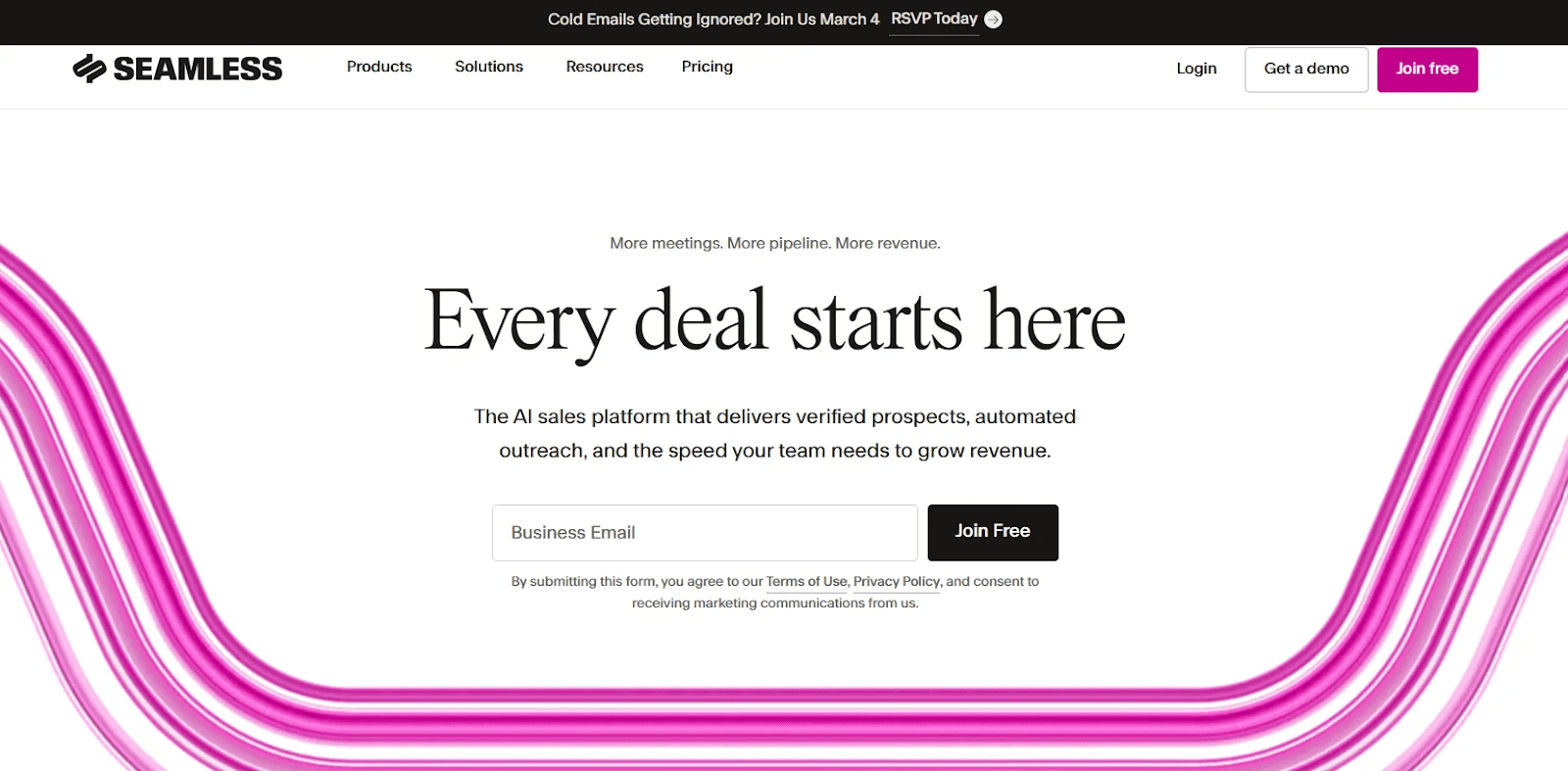
Best For: Sales teams that prioritize high volume and need a real-time search engine rather than a static database.
Key Features: Real-time Search Engine, Writer by Seamless, and Pitch Intelligence.
Pricing: Free plan available; Custom pricing for paid plans.
Ease of Use: Beginner to Intermediate.
Seamless.AI markets itself as a real-time search engine for B2B data. Unlike Apollo, which stores data in a massive repository, Seamless uses AI to crawl the web in real time to find email addresses and phone numbers. This approach is designed to capture job changes and new contact information as they occur.
While the "real-time" aspect is a strong hook, some users find the verification less robust than that of multi-vendor waterfall systems. Because it's building data on the fly, there can be a higher rate of "guessing" email patterns. However, its built-in AI writing tool is a standout feature, helping reps generate personalized scripts based on the prospect's recent news or social activity.
Key Features
- Real-time Search: Crawls the web at the moment of your request to find the most current data.
- Writer by Seamless: An AI-powered assistant that drafts personalized cold emails and LinkedIn messages.
- Autopilot: An automation feature that builds lists based on your ICP (Ideal Customer Profile) while you sleep. It is available as an add-on that you can purchase with pricier plans.
- Prospector: A dedicated tool to build targeted lists by filtering for criteria like job title, company name, industry, revenue, and employee size.
Pricing Plans
- Free: 50 credits to test the search engine.
- Pro (Custom Quote): Unlimited credits and full CRM integrations.
- Enterprise (Custom Quote): Advanced management features and a dedicated success manager.
Pros:
- Excellent for finding "hard to get" leads that aren't in standard databases.
- Integrated AI writing tools save significant time on personalization.
- Very fast user interface designed for high-velocity prospecting.
Cons:
- Pricing is significantly higher than Apollo for a similar number of credits.
- Data accuracy can be inconsistent compared to triple-verified sources.
- Credit policy can be confusing for teams transitioning from unlimited models.
6. UpLead
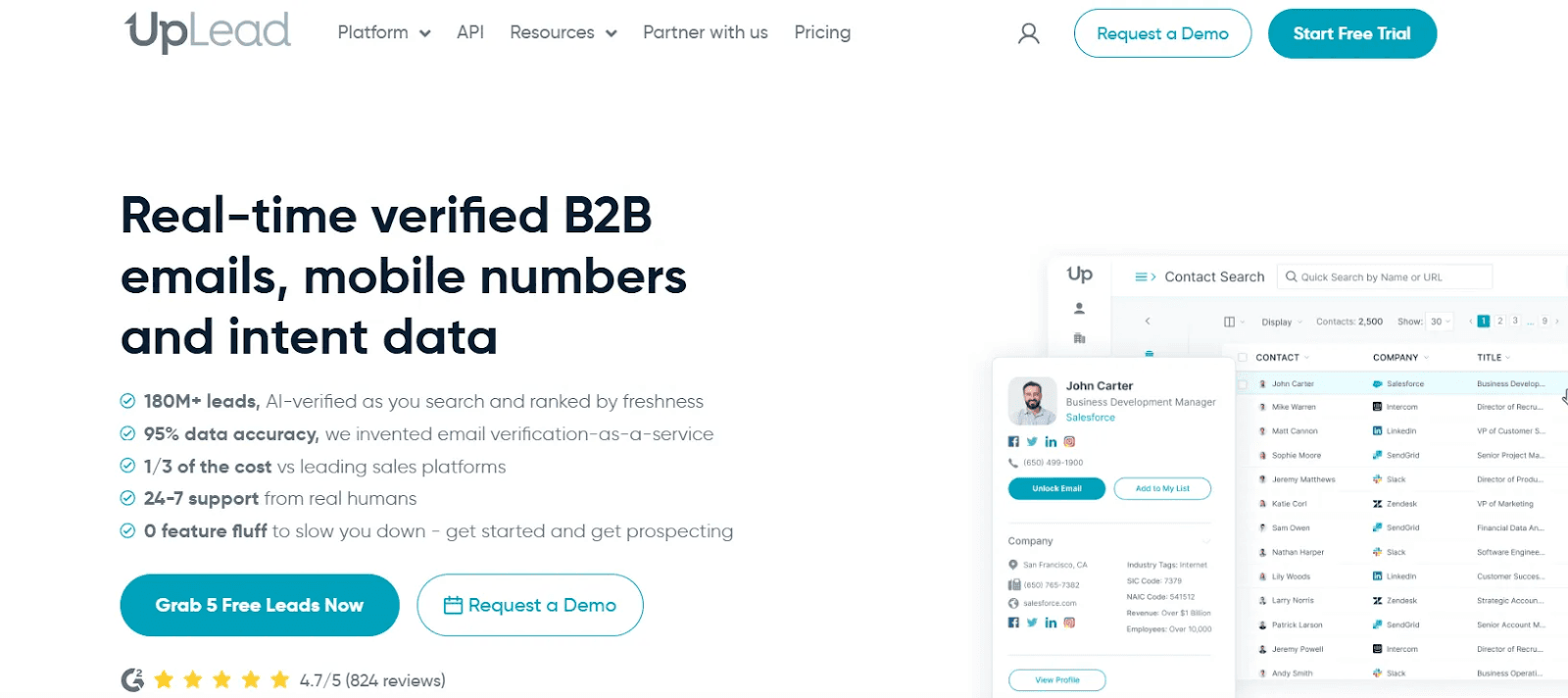
Best For: Companies that care about Data Quality above all else and want a strict accuracy guarantee to protect their domain.
Best Features: 95% Accuracy Guarantee, Real-time Email Verification, Technographics, and Intent Data.
Pricing: Starts at $99/month for 170 monthly credits.
Ease of Use: Beginner.
UpLead is often referred to as the "cleaner" version of Apollo. They have built their entire brand on the promise of 95% data accuracy. Every time you export a lead, UpLead performs a real-time verification to ensure the email is deliverable. If they can't verify it, they won't issue a credit. This makes it an ideal choice for 'just-in-time' prospecting. If you download a massive list but wait weeks to email them, natural data decay may still cause bounces.
The UpLead interface is incredibly clean and focused. It doesn't try to be an all-in-one engagement platform with dialers and sequencers. Instead, it focuses on being the best possible source for clean B2B leads. Its database may be smaller than ZoomInfo's (160M+ vs. 300M+ contacts), but SDRs who are tired of manual list cleaning consistently rate its content quality higher.
Key Features
- Real-time Verification: Every email is checked the second you click "download" or "export."
- 95% Accuracy Guarantee: If your bounce rate exceeds 5%, UpLead will issue a credit refund.
- Technographic Data: Filter companies by the specific software and hardware they use.
- Chrome Extension: Pulls verified data directly from LinkedIn profiles and company websites.
Pricing Plans
- Test ($0): 5 credits for a one-time trial.
- Essentials ($99/mo): 170 credits per month, 1 user, and verified emails/phone numbers.
- Plus ($199/mo): 400 credits per month, 1 user, and technographics.
- Professional (contact sales): custom seats, custom credits.
Pros:
- One of the lowest bounce rates in the industry.
- You only pay for what works.
- Extremely easy to use; requires almost no onboarding.
Cons:
- Database volume is lower than competitors’ for certain niche industries.
- No monthly rollover for unused credits on monthly plans.
- Per-seat costs add up quickly for larger teams.
7. LeadIQ
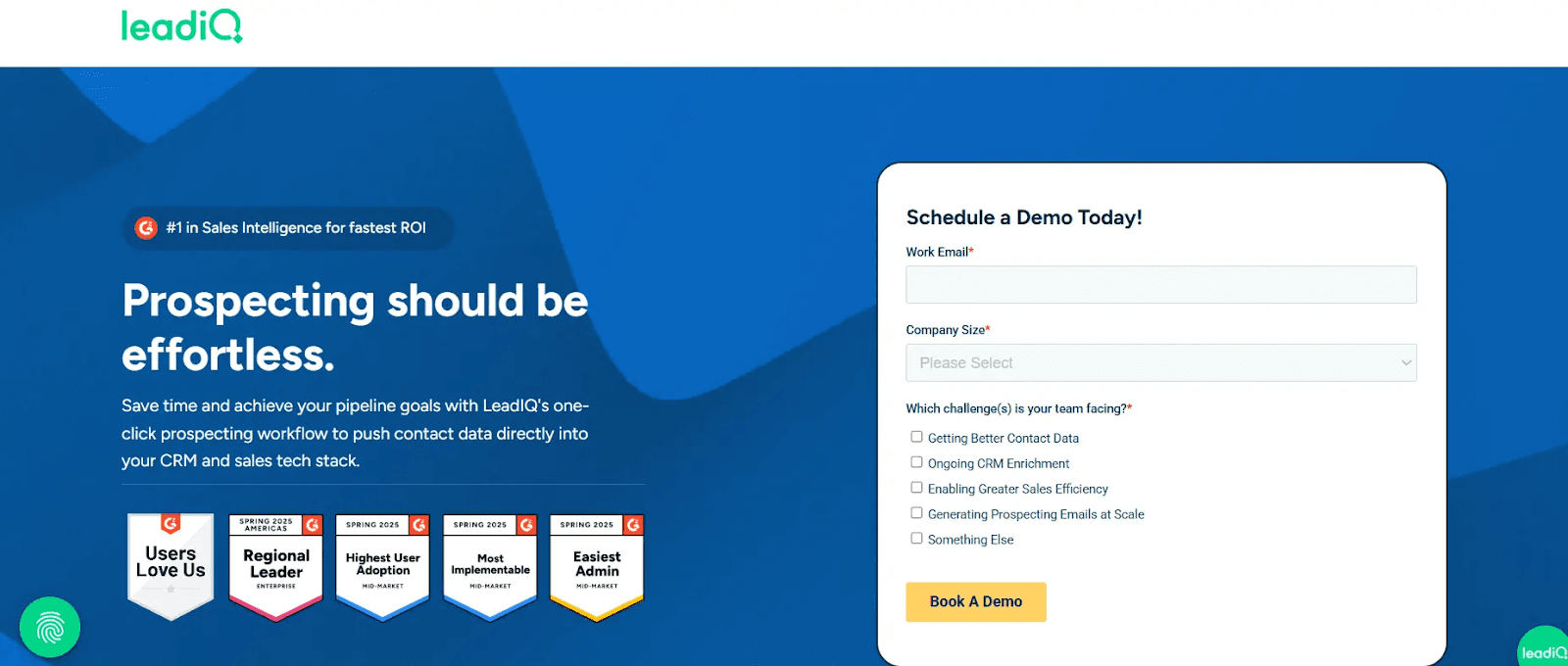
Best For: Sales teams that live in LinkedIn Sales Navigator and want to bridge the gap between social prospecting and their CRM.
Best Features: 1-Click Capture, Governance Tools, Lead Tracking, and Scribe (AI personalization).
Pricing: Starts at $20/month (billed monthly).
Ease of Use: Beginner to Intermediate.
LeadIQ is the ultimate "bridge" tool. It is designed to sit on top of LinkedIn Sales Navigator and help SDRs capture leads into their CRM or sequencer (such as Salesloft or Outreach) with a single click. While Apollo has a browser extension, LeadIQ’s version is much more focused on workflow automation.
Another signature feature of LeadIQ is "Scribe," an AI tool that looks at a prospect's LinkedIn activity and drafts a personalized intro for you. It’s designed for the modern SDR who wants to spend less time "tab-switching" and more time actually starting conversations.
Key Features
- 1-Click Capture: Instantly saves LinkedIn profiles to specific CRM sequences or lists.
- Governance & Duplicate Detection: Prevents multiple reps from contacting the same person.
- LeadIQ Scribe: AI-generated personalized messages based on LinkedIn profile data.
- Contact Tracking: Alerts you when a key prospect or past customer changes jobs.
Pricing Plans
- Free ($0): 50 credits
- Pro ($20/month): 200 credits
- Enterprise (Custom Quote): Unlimited email credits and advanced team management.
Pros:
- Best-in-class workflow for LinkedIn-heavy sales teams.
- Strong duplicate management helps keep CRM data clean.
- AI personalization features are highly relevant and effective.
Cons:
- Mobile data coverage is good, but not as deep as waterfall enrichment tools.
- The per-seat model makes it expensive as your sales team grows.
- Occasional performance lag with the Chrome extension on high-traffic days.
8. RocketReach
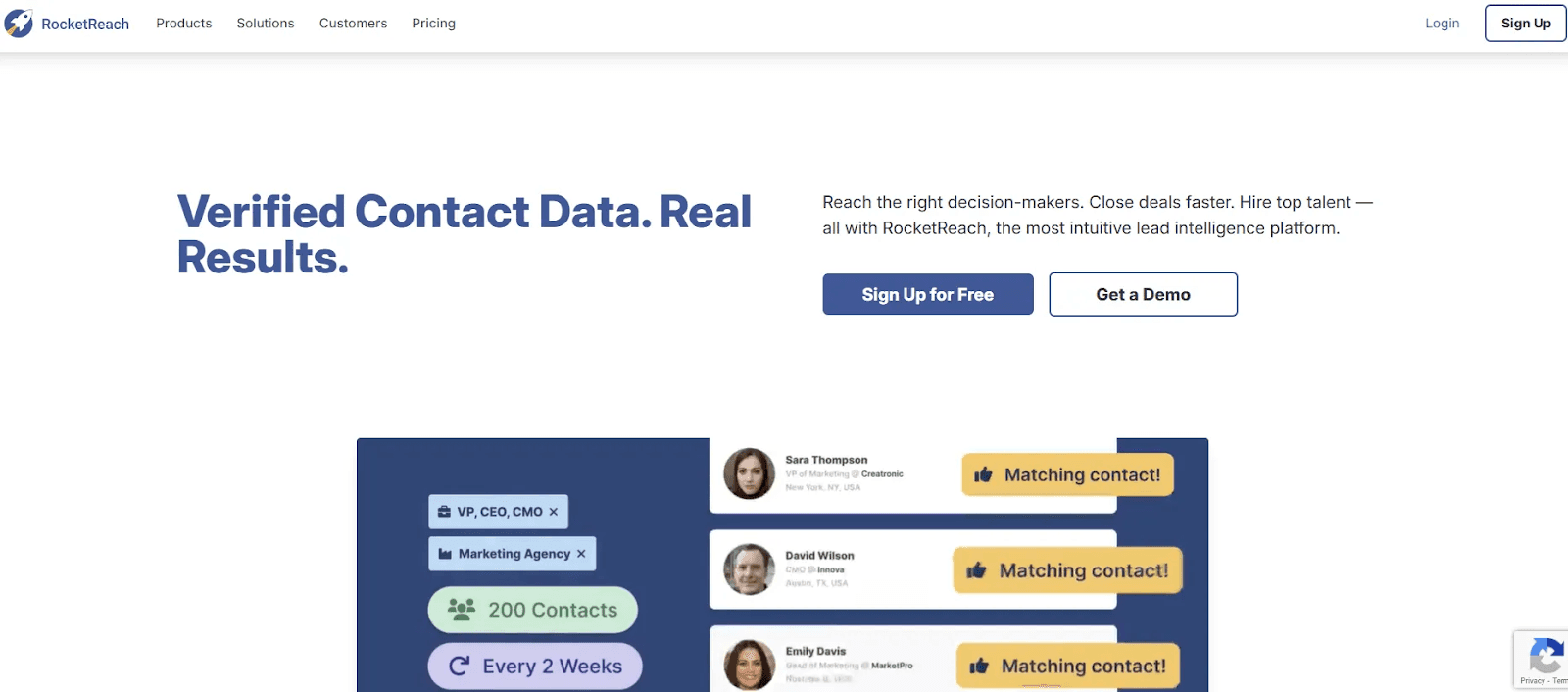
Best For: Recruiters and sales reps who need a massive global database and the ability to find personal email addresses for candidates.
Best Features: 700M+ Profile Database, AI-Powered Recommendations, and an Outreach Suite (Messages).
Pricing: Starts at $49/month (billed monthly).
Ease of Use: Beginner.
RocketReach is a veteran in the contact intelligence space, known for its large professional database (over 700 million profiles). While Apollo is often praised for its filtering, RocketReach is the go-to for sheer volume. It excels at finding contact info for people in niche industries or international markets where smaller databases often come up empty.
It’s particularly popular with recruiters because it successfully identifies personal email addresses, which are crucial for reaching candidates outside of their work hours.
The platform is straightforward and less "feature-heavy" than a full sales engagement suite, which makes it very approachable. However, because it relies on a large-scale web scrape, data accuracy can occasionally fluctuate. While they claim a 95%+ accuracy rate, users often find that mobile data isn't as thoroughly verified as in a waterfall system like FullEnrich.
Key Features
- Massive Global Database: Access to 700M+ professionals across 35M companies.
- RocketReach Messages: An in-app email tool that lets you send sequences without leaving the platform.
- AI Lead Recommendations: Suggests similar prospects based on your previous successful searches.
- Browser Extension: Quickly find contact info while browsing LinkedIn or corporate websites.
Pricing Plans
- Essentials ($49/mo): 100 lookups per month (Email only).
- Pro ($99/mo): 200 lookups per month (email and phone).
- Ultimate ($209/mo): 100 lookups per month and full API/Bulk features.
(Note: Annual billing offers significant discounts, bringing the Essentials plan down to ~$48/mo.)
Pros:
- One of the highest "find rates" for obscure or international profiles.
- Simple, no-nonsense interface that is very easy to navigate.
- Great for recruitment due to strong personal email coverage.
Cons:
- Monthly lookups are quite low for starter plans relative to the price.
- Email-only search on the basic tier feels restrictive for modern SDRs.
- Data can occasionally be outdated for smaller, fast-moving startups.
9. Hunter.io
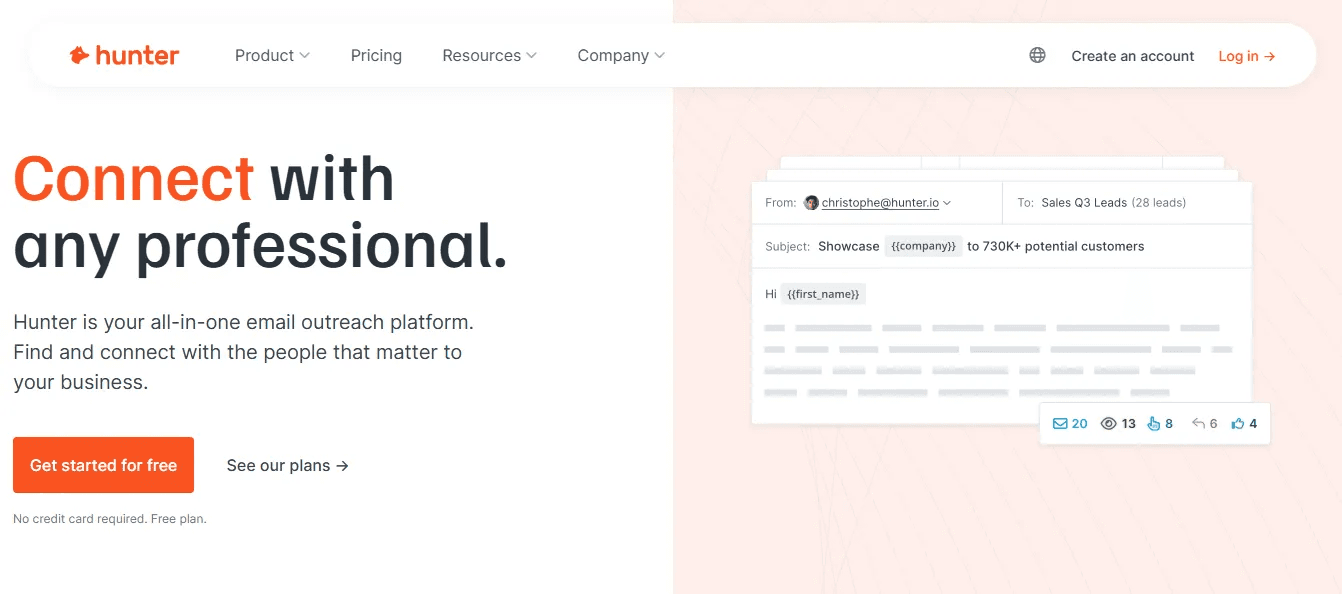
Best For: Marketers and SDRs who focus on Domain-level prospecting and need the most reliable professional email finder on the market.
Best Features: Domain Search, Email Verifier, and a Chrome Extension.
Pricing: Starter starts at $49/month (billed monthly).
Ease of Use: Beginner.
Hunter io is the gold standard for finding and verifying professional email addresses. Unlike Apollo, which aims to be a full database, Hunter is a specialized tool that uses pattern recognition to identify the most likely email format for any company. If you know the company domain, Hunter will show you every email it has found on the web associated with that domain, along with a "confidence score."
While Hunter is unmatched for email, it is not a "people database" in the traditional sense. It’s a precision instrument. Most teams use Hunter as a "layer" in their stack; they might find the lead in one tool, but use Hunter's Email Verifier to ensure the address is safe to send to.
Key Features
- Domain Search: Lists all employees and their email addresses for a specific company URL.
- Email Verifier: Performs a multi-level check (SMTP, DNS, etc.) to confirm an email won't bounce.
- Hunter Campaigns: A built-in cold email sender that is surprisingly robust (and free for basic use).
- Signals: Alerts you to new job changes or company news to help time your outreach.
Pricing Plans
- Free ($0): 50 credits per month.
- Starter ($49/mo): 2000 credits.
- Growth ($149/mo): 10,000 credits.
- Scale ($299/mo): 25,000 credits.
- Enterprise (Custom Quote): Custom Credits
Pros:
- The most accurate "pattern-based" email finder available.
- Extremely generous free tier for small teams and startups.
- High deliverability using Hunter's verified emails almost guarantees a low bounce rate.
Cons:
- No phone numbers: If you need to cold call, Hunter won't help you.
- Limited "people search" filters compared to Apollo’s advanced prospecting.
- Not a "lead discovery" engine; you usually need to know the target company first.
10. ContactOut
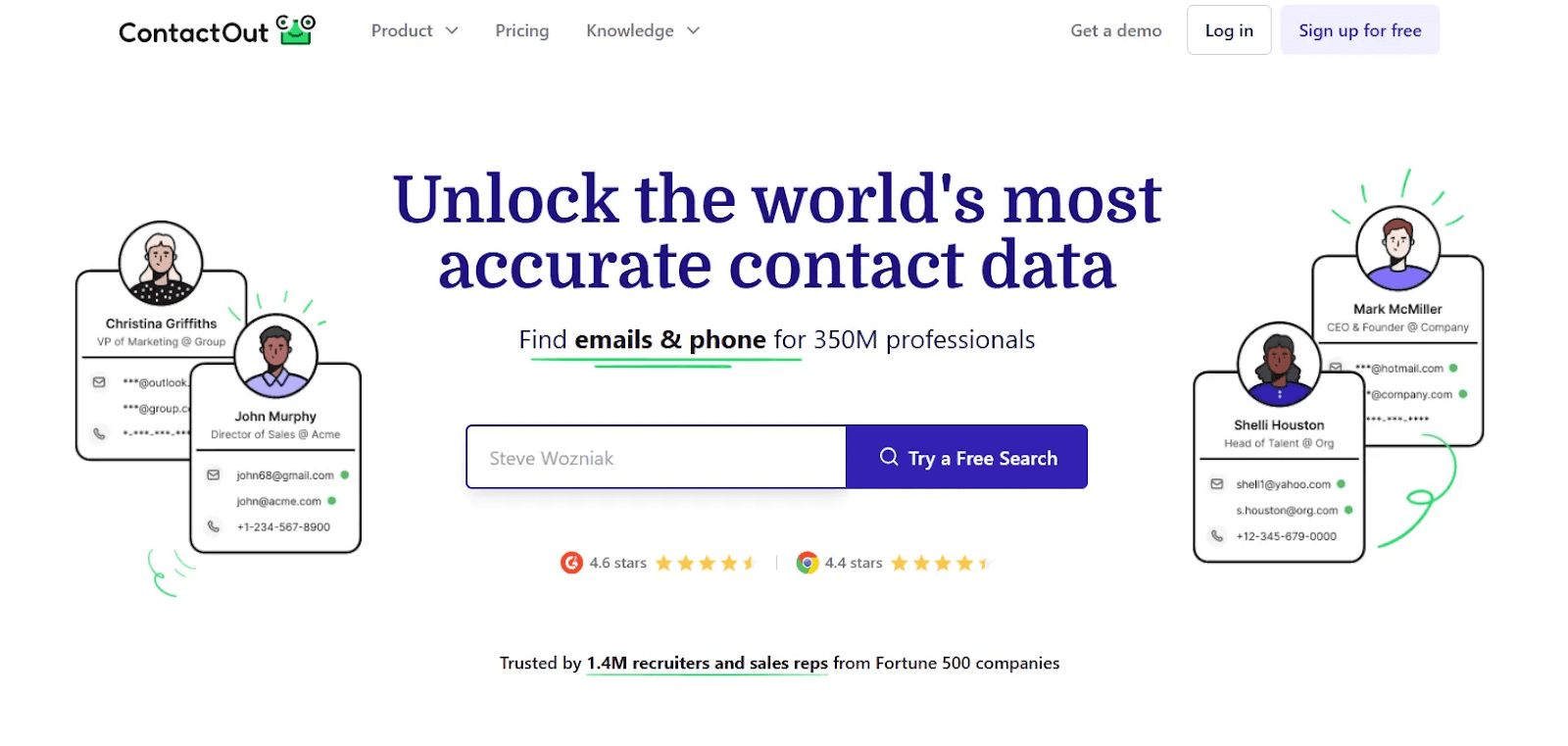
Best For: Recruiters and Headhunters who need personal email addresses and mobile numbers to reach candidates directly.
Best Features: LinkedIn Extension, AI Email Personalizer, and Email Campaigns.
Pricing: Personal plan starts at $49/month (billed monthly)
Ease of Use: Beginner.
ContactOut is often cited as the biggest rival to RocketReach for finding personal contact details due to its sheer database of ~800 million profiles. It is particularly favourite among recruiters at high-end firms. The tool is a Chrome extension that "unmasks" both personal and professional email addresses and phone numbers directly on LinkedIn profiles. While Apollo focuses on B2B email, ContactOut specializes in the "private" side of data, making it more effective for high-touch recruitment.
The platform is very fast, but it is also one of the more expensive options on a "per-credit" basis. Their "unlimited" claims often come with fair-use caps that can surprise heavy users.
Key Features:
- Unrivalled Personal Data: High success rate in finding @gmail, @outlook, and personal mobile numbers.
- Search Portal: A separate database for running searches with 20+ filters.
- AI Personalizer: Drafts messages based on a prospect's career history and achievements.
- CRM Integrations: Direct sync with Greenhouse, Lever, and Salesforce.
Pricing Plans
- Free: 40 emails and 3 phone numbers per month.
- Email ($49/mo): 5 emails/day, 5 phones/day, 5 exports/day
- Email + Phone ($99/month): Unlimited emails, Unlimited phones, 600 exports / month
- Team / API (Custom Quote): Team Plan, API Access
Pros:
- The highest accuracy rate for personal contact information.
- Simple extension that integrates perfectly with LinkedIn and Sales Navigator.
- An AI writing assistant helps increase response rates for cold outreach.
Cons:
- High price point for the volume of data provided.
- "Unlimited" plans have strict monthly caps that are not always clear upfront.
- Less effective for general B2B "company-wide" prospecting compared to Apollo.
11. 6sense
Best For: Large Enterprise teams running Account-Based Marketing (ABM) who need to know which companies are ready to buy.
Best Features: Intent Data, Predictive Scoring, and Website Deanonymization.
Pricing: Custom (Estimated $25,000 - $60,000+/year).
Ease of Use: Advanced.
6sense isn't just an alternative to Apollo; it's a completely different level of sales intelligence. It uses AI to identify the "Dark Funnel", companies that are researching your competitors or your product category but haven't contacted you yet. Instead of just giving you a list of names, 6sense tells your sales team who to call today based on which accounts are showing the highest "buying intent."
This is a high-powered tool for mature sales organizations and requires a significant investment and typically a dedicated RevOps person to manage. If you are a small startup, 6sense is likely overkill. But if you are an enterprise team trying to align marketing and sales on the most valuable accounts, 6sense offers a level of strategic capability that Apollo's basic database can't match.
Key Features
- Intent Data Monitoring: Tracks what prospects are reading across millions of B2B websites to predict buying stages.
- Predictive Scoring: Ranks leads based on their likelihood to convert into a deal.
- Account-Based Insights: Shows you the entire "buying committee" within a target company.
Pricing Plans
- Free: Very limited access to buyer discovery.
- Team/Growth/Enterprise: All plans are custom-quoted based on your data volume and seat requirements. Median deals typically start at $ 25k–$35k per year.
Pros:
- The best "Buying Intent" data in the industry.
- Dramatically improves Sales and Marketing alignment.
- Powerful predictive models help prioritize high-value deals.
Cons:
- Extremely expensive with a steep learning curve.
- Implementation can take weeks or months to get right.
- Contact-level data (emails/phones) is often treated as a secondary feature and may require pairing with an enrichment tool.
12. Klenty
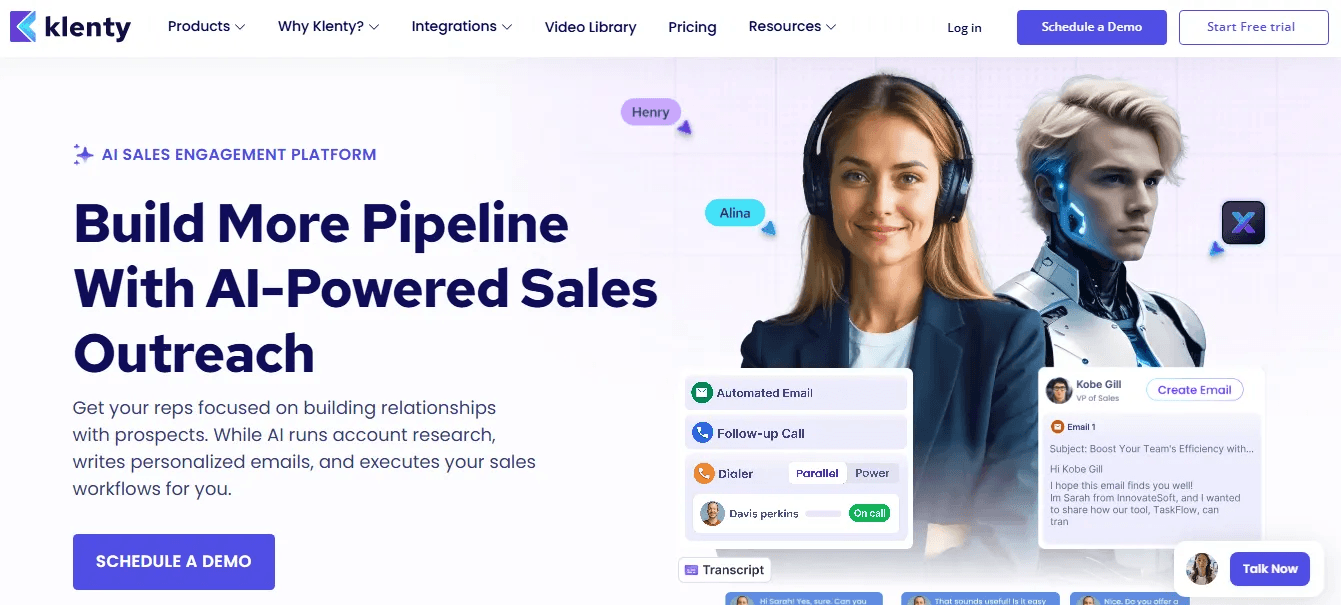
Best For: High-volume outbound teams looking for a tool that combines multi-vendor data (waterfall enrichment) with heavy-duty execution tools like parallel dialing and AI-routed cadences.
Best Features: Prospect IQ (AI List Builder)
Pricing: Starts at $50/user/month (billed annually).
Ease of Use: Intermediate.
Historically, Klenty was strictly a sales engagement platform, meaning teams had to buy a third-party data provider and pipe the leads in. In 2026, that is no longer the case. Klenty has evolved into a direct, all-in-one Apollo alternative by launching its own native B2B data engine: Prospect IQ (The AI List Builder).
Also, Klenty’s data engine operates on a multi-vendor Waterfall Enrichment model instead of using a static database like Apollo. It natively queries over 16 different premium data providers in real-time, ensuring vastly superior data accuracy and mobile number coverage without requiring you to pay for an external tool.
Key Features
Where Klenty truly outshines Apollo is in its execution architecture. Apollo’s sequences often require heavy manual intervention from reps, whereas Klenty leans heavily into AI automation and sheer volume capabilities:
- Agentic Cadences: Klenty’s AI autonomously analyzes prospect behavior (email opens, website visits, intent signals) and automatically routes them to different, highly personalized cadence tracks without the rep lifting a finger.
- Parallel Dialing: For phone-heavy teams, Klenty features a native parallel dialer that allows SDRs to call up to 5 prospects simultaneously, navigating phone trees and dropping pre-recorded voicemails automatically. Reps can easily make 300+ dials an hour.
- Deliverability Hub: Advanced inbox rotation, custom domain tracking, and automated email warm-ups to ensure your outreach actually lands in the primary inbox.
Pricing Plans
- Startup ($50/mo billed annually): Email-only cadences, deliverability tools, and basic CRM integrations. (Warning: No cold calling or LinkedIn automation on this tier).
- Growth ($70/mo billed annually): Unlocks full multi-channel outreach (Parallel Dialers, LinkedIn, SMS) and intent-based cadences.
- Pro ($99/mo billed annually): Adds advanced reporting, team goals, and account-based tracking.
Pros:
- Far superior automation features compared to Apollo.
- Transparent pricing with no hidden implementation fees.
- Top-tier customer support and specialized deliverability coaching.
Cons:
- You pay "per seat," which can get expensive for large SDR teams.
- Requires more setup time to get the cadences running perfectly.
13. Skrapp.io
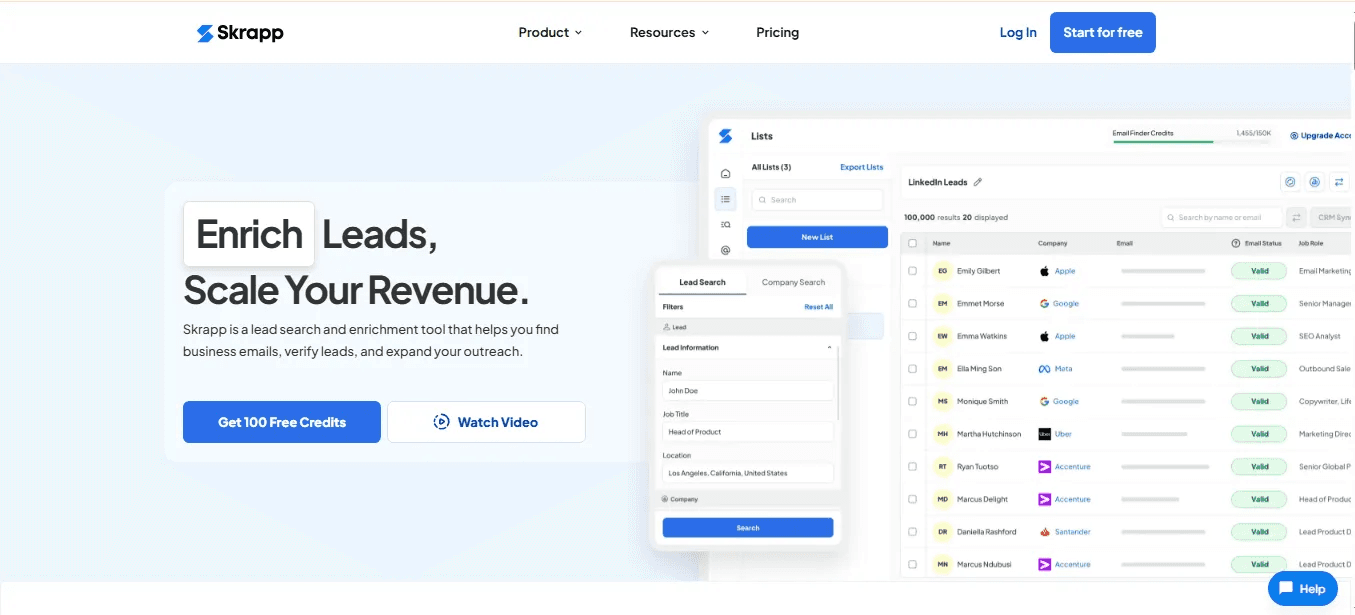
Best For: Marketing teams and small agencies that need a budget-friendly way to find emails from LinkedIn at scale without complex feature bloat.
Best Features: LinkedIn Email Finder, Bulk Email Verification, and "Fair Credit" Policy.
Pricing: Starts at $39/month (billed monthly) for 1,000 credits.
Ease of Use: Beginner.
Skrapp.io is a "no-frills" email finder that has built a loyal following among bootstrapped startups and lead generation agencies. It is specifically designed to work as a lightweight layer on top of LinkedIn and Sales Navigator. If you have a list of LinkedIn URLs and simply need their verified work emails for a low price, Skrapp is the tool for the job. It’s fast, intuitive, and doesn't force you into a complex CRM or dialer ecosystem that you might not need.
One of Skrapp's standout features is its "Fair Credit Policy." Unlike many competitors that charge you for every attempt, Skrapp only deducts credits for emails labelled as "Valid" or "Catch-all." It remains one of the most cost-effective ways to build large-scale email lists, though it lacks the deeper mobile data and waterfall logic found in premium tools like FullEnrich.
Key Features
- LinkedIn Extension: Smoothly turns LinkedIn and Sales Navigator searches into lead lists with verified business emails.
- Bulk Email Finder: Upload a CSV of names and domains to find thousands of emails in minutes.
- Email Verifier: An AI-powered tool that performs a multi-step check, including syntax validation, role-based ID detection, gibberish filtering, and disposable email screening
- Domain Search: Quickly identifies the email patterns and employee lists of entire companies.
Pricing Plans
- Free ($0): 100 credits per month for 1 user.
- Professional ($39/month): 1,000 credits per month and access for 2 users.
- Enterprise ($349/mo): 50,000 credits per month and access for 8 users.
Pros:
- Extremely affordable for high-volume email prospecting.
- Very simple interface with a near-zero learning curve.
- Credits roll over month-to-month on paid plans.
Cons:
- No phone numbers: It is strictly an email-finding tool.
- It relies heavily on algorithmic pattern-guessing when it lacks definitive data, which raises the risk of higher bounce rates.
- Verification is good, but it lacks the triple-layer depth of waterfall providers.
14. LinkedIn Sales Navigator
Best For: Sales reps who need the source-of-truth for job titles, company changes, and social selling before enriching the data.
Best Features: Advanced Lead & Account Search, Real-time Sales Triggers, InMail Messaging, and Relationship Explorer.
Pricing: Starts at $119.99/ month (billed monthly) or $99/ month (billed annually).
Ease of Use: Intermediate.
LinkedIn Sales Navigator is the foundational layer for almost every other tool on this list. It doesn't provide direct contact data, such as email addresses or phone numbers; you’ll need an enrichment tool like FullEnrich for that. If you need to know exactly when a prospect changes their job title or moves to a new company, there is no substitute for Sales Navigator.
Sales Navigator introduced "Account IQ," an AI-powered research assistant that instantly summarizes company challenges and financial reports. It is the ultimate tool for "Warm Outreach." While it is expensive for a tool that still requires a second subscription to access contact information, the precision of its filters (e.g., "Posted on LinkedIn in the last 30 days") makes it indispensable for modern social selling.
Key Features
- 50+ Advanced Filters: Target by specific seniority, function, years at company, and even recent activity.
- InMail Messages: Reach prospects directly outside your network with 50 credits per month.
- Sales Triggers: Get alerted the moment a prospect changes jobs or their company is mentioned in the news.
- TeamLink: Reveals the best path into an account by showing who in your company is already connected to the prospect.
Pricing Plans
- Core ($119.99/mo): Individual plan with advanced search, alerts, and 50 InMails.
- Advanced ($159.99/mo): Adds TeamLink, Smart Links, and basic CRM integrations.
- Advanced Plus (Custom): Includes deep CRM sync with Salesforce and HubSpot (including lead and contact creation).
Pros:
- The most accurate and up-to-date professional profiles on the planet.
- Essential for "Intent-based" social selling and relationship mapping.
- Unlimited profile viewing (no "commercial use limit").
Cons:
- No contact data: Does not provide emails or mobile numbers natively.
- Very high price point for a "search-only" platform.
- The interface can feel cluttered and overwhelming for new users.
15. Clearbit (Breeze Intelligence)
Best For: HubSpot-centric teams who want to automate inbound lead enrichment and de-anonymize website traffic directly within their CRM
Main Functions: Real-time Enrichment, Website Visitor Reveal, and Intent Signals.
Pricing: Starts at $50/month as a HubSpot add-on (plus a required HubSpot paid seat).
Ease of Use: Beginner (for users) to Advanced (for setup).
Clearbit, now rebranded as Breeze Intelligence following its acquisition by HubSpot, is the king of "Inbound Enrichment." While Apollo is primarily used for finding new leads (outbound), Breeze is used for making your existing leads more valuable. When a prospect enters just an email address on your site, Breeze automatically appends over 100 data points, including job title, company size, and technographics.
For teams already inside the HubSpot ecosystem, the integration is now native and smooth. It allows you to shorten your lead-capture forms to ask only for an email, while Breeze fills in the rest behind the scenes. This dramatically increases website conversion rates.
Key Features
- Dynamic Form Shortening: Increases conversions by hiding fields that can be enriched automatically.
- Reveal (IP Intelligence): Identifies which companies are browsing your website, even if they don't fill out a form.
- B2B Enrichment: Appends 100+ attributes to any contact or company record in your CRM.
- HubSpot Native AI: Uses "Breeze" to score and route leads to the right rep instantly based on fit.
Pricing Plans
Since the acquisition, Clearbit features are no longer sold as standalone plans. They now require a HubSpot CRM subscription (Starter, Professional, or Enterprise). The platform has transitioned to a unified HubSpot Credit system. For example, a legacy 100-credit Breeze plan is now 3,000 HubSpot Credits per month.
The 2026 Twist: In a major shift, standard contact and company enrichment is now free for paid HubSpot users. Credits are now strictly reserved for high-value "Intelligence" actions:
- Buyer Intent: Revealing the specific companies visiting your site.
- Breeze Agents: Powering AI agents that research accounts or handle customer queries.
- Workflow Automation: Using Breeze actions to trigger complex database logic.
While the entry cost for additional capacity packs remains roughly $45–$50/month, users must monitor usage carefully. HubSpot Credits reset every month and do not roll over; any unused credits expire at the end of the billing cycle, making over-provisioning an expensive mistake.
Pros:
- The best tool for real-time inbound lead qualification.
- Dramatically improves website conversion rates via shorter forms.
- Deepest integration available for HubSpot users.
Cons:
- No credit rollover: Unused credits are lost at the end of the month.
- Extremely expensive on a "per-lead" basis for outbound prospecting.
- Requires a paid HubSpot account; no longer offers a standalone free extension.
Final Thoughts
Apollo has attempted to patch its aging static database by bolting on third-party waterfall enrichment, but its legacy billing model turns this fix into an expensive trap. This forces teams to burn through add-on global credits just to verify data, enforcing rigid per-seat licenses, and capping direct mobile dials. This ultimately throttles a growing sales team.
The alternatives leading the market in 2026 operate on entirely different infrastructure. Platforms like FullEnrich treat contact data as a dynamic utility. Such platforms align their costs directly with your revenue generation by building native, multi-vendor routing engines paired with success-only billing and unlimited seats.
When evaluating your next outbound data provider, the deciding factor should be simple: Do not commit to a platform that charges you a premium just to find the data it was missing in the first place. Choose an engine built to route, verify, and scale without the hidden credit tax.
Frequently Asked Questions (FAQs)
What is the best Apollo alternative for data accuracy?
If your primary concern is bounce rates and stale information, FullEnrich and UpLead are the top choices. UpLead offers a 95% accuracy guarantee, while FullEnrich uses a waterfall system to cross-check 20+ sources in real-time. This ensures that even if one database is outdated, the system can still find a verified match in another.
Which tool is best for finding mobile numbers?
For direct dials and mobile numbers, Cognism and FullEnrich lead the market. Cognism is known for its manually verified "Diamond Data," which is well-suited to European markets. FullEnrich excels globally by verifying phone line ownership, ensuring you’re actually reaching the person listed and not a corporate landline.
Are there any free Apollo alternatives?
Most premium tools offer a free tier to test their data. Hunter.io and Skrapp.io have generous free plans for email finding. FullEnrich also provides free credits upon signup, allowing you to test their waterfall enrichment logic on your own leads before committing to a paid plan.
How does waterfall enrichment differ from a standard database?
A standard database like Apollo or ZoomInfo relies on its own internal records. If their data is old, your results will be old. Waterfall enrichment, used by tools like FullEnrich, doesn't store data. Instead, it queries multiple top-tier providers sequentially until it returns a verified result. This results in much higher match rates and fresher data.
Can I use these tools with my existing CRM?
Yes. Almost all top-tier alternatives, including FullEnrich, Lusha, and LeadIQ, offer native integrations with major CRMs like HubSpot, Salesforce, and Pipedrive. This allows you to push verified contacts directly into your sales sequences without manual data entry.