So you're building out your sales tech stack. And now you've run into a classic dilemma: Lusha vs ZoomInfo.
Both promise reliable contacts details and pipeline acceleration, but they work in totally different ways (and have wildly different price tags).
Here's the thing: choosing the wrong sales intelligence platform can drain your budget AND hurt your outbound motion. Bad contact data means bounced emails, wasted rep time, and frustrated sales teams who can't hit quota.
Well, you're in the right place. I've dug into both platforms—their pricing structures, data accuracy, integration capabilities, and what real users actually say about them.
Plus, I'm throwing in Full Enrich as a third option because sometimes waterfall enrichment beats both single-source providers.
Let's dig in. 🎯
TL;DR: Quick Take on ZoomInfo vs Lusha
Short on time? Here's the bottom line:
- ZoomInfo = Enterprise powerhouse with 600M+ contacts and killer features like lead routing and Copilot AI. But you'll pay $25,000+/year with annual-only contracts and credit-based pricing traps.
- Lusha = SMB-friendly option at $49-52/user/month with transparent pricing and a Chrome extension that gets you prospecting fast. More affordable, but data accuracy issues are real (7.6/10 vs ZoomInfo's 8.2/10).
- Full Enrich = Waterfall enrichment that queries 15+ data sources sequentially. 80%+ find rates without credit games or annual lock-ins. Starts at $29/month.
Who wins? Depends on your budget, sales and marketing team size, and tolerance for complexity. Keep reading for the full breakdown.
👉 Ready to skip ahead? Get 50 free credits and test FullEnrich's waterfall enrichment against your current provider.
Lusha vs ZoomInfo: Head-to-Head Comparison
Let me save you some time. Here's the quick comparison table:
Feature | Lusha | ZoomInfo | Full Enrich |
|---|---|---|---|
Best For | SMBs, scrappy sales teams, transparent pricing needs | Enterprise teams with big budgets needing advanced RevOps | Teams needing maximum data coverage without credit traps |
Starting Price | $0 (free plan) / ~$49-52/user/mo paid | $0 (Lite plan) / ~$25,000/year minimum | $29/month |
Free Plan? | ✅ Yes (no time limit) | ✅ Yes (~10 downloads/month) | ✅ Yes (50 credit trial) |
Contract | Monthly OR annual (25% discount) | Annual only (strict terms) | Monthly OR annual (30% discount) |
Database | 280M+ contacts | 600M+ people, 100M+ companies | 15+ sources aggregated |
Data Accuracy | 7.6/10 (G2 company data) | 8.2/10 (G2 company data) | 80%+ find rate via waterfall |
Credits Roll Over? | N/A | ❌ No | ✅ Yes (3-12 months) |
Key Features | Chrome extension, Stream daily leads, meeting recordings | Lead routing, dynamic territories, Copilot AI, org charts | Waterfall enrichment, triple verification, unlimited users |
API Access | ✅ Included | Enterprise add-on only | ✅ All plans |
Integrations | Salesforce, HubSpot, Outreach, Zapier, Make, n8n | Deeper enterprise integrations | API, Zapier, Make, Clay, n8n |
Ease of Use (G2) | 4.3/5 ("easiest to use") | 4.5/5 (steep learning curve) | 4.9/5 (32 reviews) |
GDPR Compliant? | Yes (ISO 31700, SOC 2 Type II) | Yes (SOC 2, ISO 27701) | Yes (GDPR/CCPA) |
Looking beyond Zoominfo and Lusha? There are some Lusha alternatives or UpLead alternatives like FullEnrich worth exploring.
Data Quality & Accuracy: What's Real vs. Marketing 📊
Let's get real for a second: no sales intelligence platform delivers 100% accurate data. None. Zero. Zilch.
Contact info decays constantly. People change jobs, companies switch domains, phone numbers get reassigned. So the question isn't if you'll hit bad data—it's how much, and whether the platform helps you catch stale records before they trash your sender reputation.
Quick Data Quality Comparison
Metric | Lusha | ZoomInfo | Full Enrich |
|---|---|---|---|
Database Size | 280M+ contacts | 600M+ contacts, 100M+ companies | 15+ sources aggregated |
G2 Accuracy Rating | 7.6/10 | 8.2/10 | 4.9/5 overall |
Find Rate | Not disclosed | Not disclosed | 80-85% average |
Email Verification | Single verification | Batch updates | Triple verification (3 providers) |
Phone Accuracy | 85% claimed, users report issues | Strong US direct dial (49M mobiles) | Mobile vs landline detection |
Credit Back Guarantee | ❌ No | ❌ No | ✅ Only pay on success |
Best Geography | EU coverage (claimed) | North America dominant | Global via dynamic selection |
The Numbers Don't Lie
According to G2's latest comparison (September 2025), ZoomInfo scores 8.2 out of 10 for company data accuracy versus Lusha's 7.6.
Might not sound like a huge gap, but when you're dialing hundreds of prospects monthly? That difference shows up in your pipeline.
ZoomInfo users consistently report "good accuracy" in reviews. Lusha users? They're dealing with "inaccurate/outdated data" and "numbers not matched to correct prospect" way more often.
Lusha claims 85% phone accuracy and 98% email deliverability. Those are impressive numbers! But user reviews tell a different story—lots of mentions of "missing/wrong information" and "data reliability issues" that force manual verification.
ZoomInfo doesn't publish specific accuracy percentages (smart move, honestly). But their users report fewer data quality complaints overall.
Database Size vs. Data Freshness
ZoomInfo's got the bigger database—600 million people and 100+ million companies. That's more than double Lusha's 280 million verified contacts.
But here's the thing: bigger doesn't always mean better. A bloated database full of stale records can actually hurt your connect rates and sender reputation.
The real test? How frequently each platform refreshes their data. Both companies claim regular updates, but user feedback suggests ZoomInfo's data stays fresher longer. Probably because of their enterprise focus and deeper integration ecosystem capturing more real-time signals.
Full Enrich: The Waterfall Enrichment Alternative
Here's where things get interesting. What if you didn't have to choose between Lusha's affordability and ZoomInfo's accuracy?
Full Enrich takes a completely different approach: waterfall enrichment. Instead of relying on a single database like Lusha or ZoomInfo, Full Enrich queries 15+ premium data providers sequentially until it finds valid contact information.
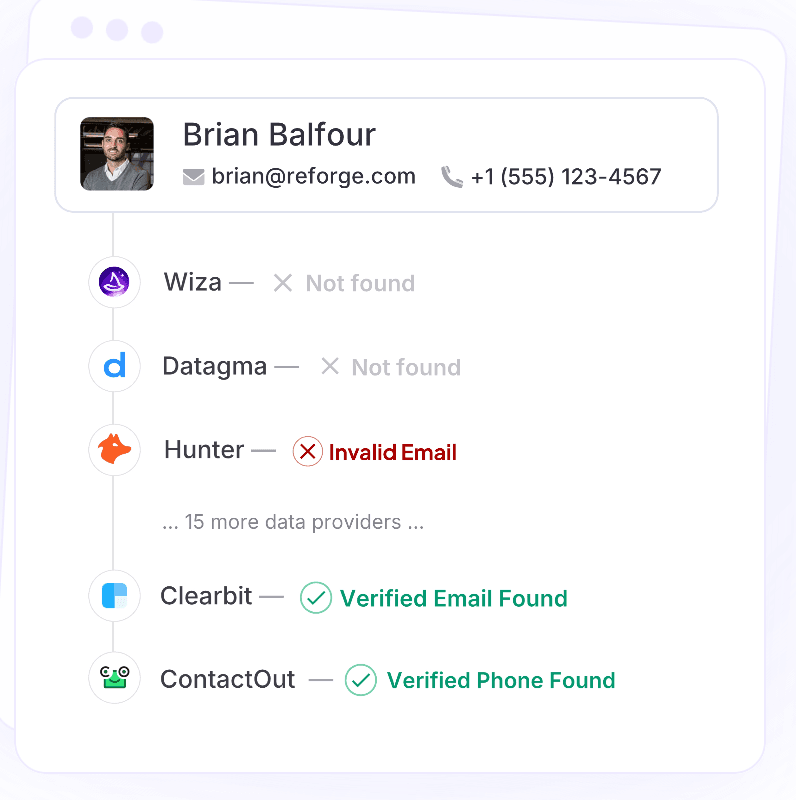
How it works:
- You search for a contact
- Full Enrich checks the first data source
- If nothing found (or invalid), it automatically tries the next source
- Process continues through 15+ providers until valid data is found
- You only pay credits when data is successfully found
The results? Users report finding contact info for 80-85% of leads versus 25-50% with single-source tools.
At $29/month for the starter plan, Full Enrich costs a fraction of ZoomInfo while delivering higher match rates than either platform. And unlike both competitors, you're not locked into annual contracts or paying for data that doesn't exist.
👉 Ready to skip ahead? Get 50 free credits and test FullEnrich's waterfall enrichment against your current provider.
Verdict: Data Quality Winner
🥇 For single-source accuracy in North America: ZoomInfo - If you need the most accurate US data from one provider and have the budget ($25K+), ZoomInfo's 8.2/10 G2 rating and 49M US mobile numbers deliver.
🥈 For overall find rates and global coverage: Full Enrich - Waterfall enrichment across 15+ sources gives you 80-85% find rates versus 25-50% for single-source tools. Best value at $29-55/month.
🥉 For budget-conscious teams needing basic data: Lusha - Free plan and transparent pricing make it accessible, but expect to supplement with other tools for better accuracy.
👉 Start free with 50 enrichments and see how many more verified leads you unlock
Pricing & Contracts: Where Budgets Go to Die 💸
Okay, this is where things get spicy. And where many sales teams get burned.
Lusha and ZoomInfo take fundamentally different approaches to pricing. Understanding these models could save you thousands of dollars and months of contract headaches.
Quick Pricing Comparison
Factor | Lusha | ZoomInfo | Full Enrich |
|---|---|---|---|
Starting Price | $0 free / $49-52/user/mo paid | $0 Lite / $25,000+/year paid | $29/month |
Contract Terms | Monthly or annual (25% discount) | Annual only | Monthly or annual (30% discount) |
Pricing Model | Per-user subscription | Credit-based, quote-based | Credit-based, pay per success |
Free Trial | ✅ Unlimited free plan | ⚠️ 10 downloads/month | ✅ 50 credits (30 days) |
Credit Rollover | N/A | ❌ No | ✅ Yes (3-12 months) |
Hidden Costs | Minimal | ⚠️ Frequent overages reported | None - only pay on success |
Best For Budget | SMBs ($600-2,500/year per user) | Enterprises ($25K-100K+/year) | Startups to mid-market ($348-660/year) |
Lusha: Transparent and Flexible
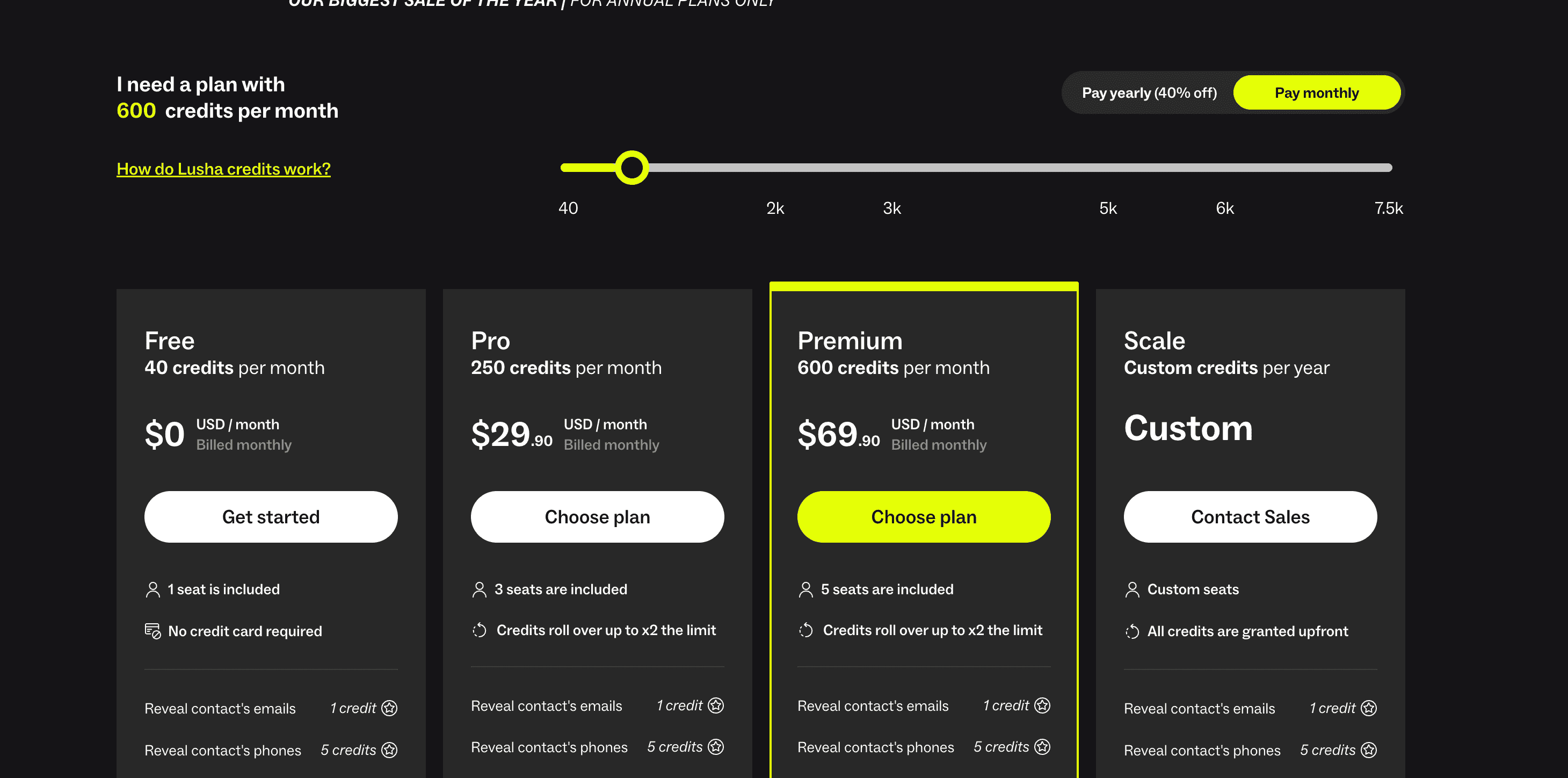
Lusha keeps it straightforward with four clear tiers: Free, Pro, Premium, and Scale.
You can pay monthly or lock in annual billing for a 25% discount. Third-party sources cite paid plans starting around $49-$52.45 per user per month when billed annually.
The free plan? It's actually useful. No time limits, no credit card required, just immediate access to test their data quality. Revolutionary concept, I know.
What you won't find with Lusha:
- Hidden credit overages
- Opaque pricing structures
- Mandatory annual commitments (if you prefer monthly flexibility)
This transparency makes budget planning actually possible. Especially for smaller teams that need predictable costs.
👉 To learn more about Lusha pricing
ZoomInfo: Enterprise Power, Enterprise Price Tags
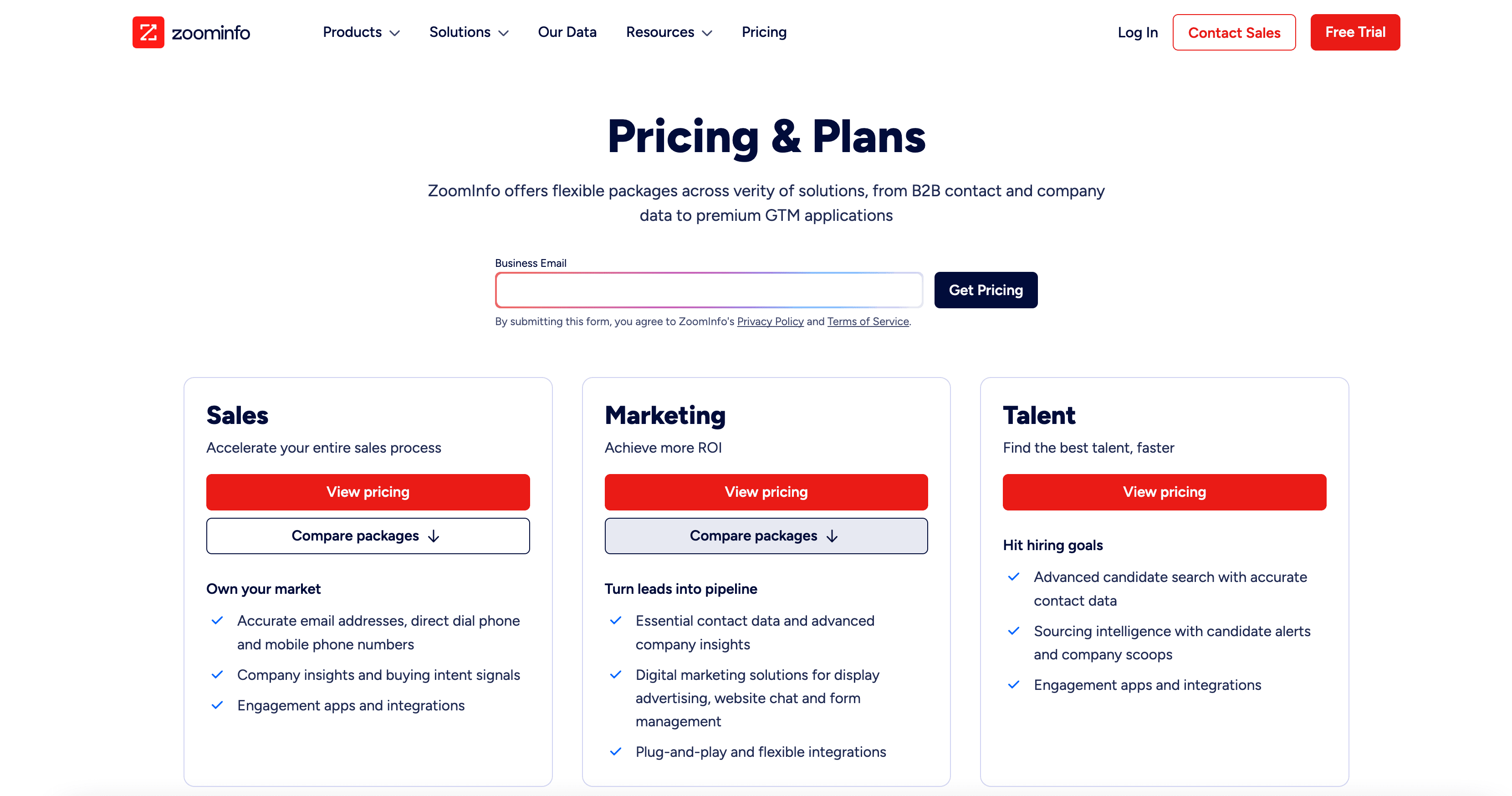
ZoomInfo offers a free Lite plan that lets you search their full database but limits you to around 10 downloads per month. Cool for tire-kicking, not so much for actual prospecting.
Once you need serious volume? You're looking at quote-based pricing that commonly starts around $25,000 annually for small teams.
Everything revolves around credits—how many contacts you can export, enrich, or access. And users frequently report unexpected costs and limitations.
The real pain comes at renewal time. Multiple sources cite:
- Difficult contract negotiations
- Unpredictable price increases
- Credit systems that penalize both overuse AND underuse
You're essentially betting your annual budget on usage patterns you can't predict, with little flexibility to adjust mid-contract. Fun times.
👉 Learn more about Zoominfo pricing & plans here
Verdict: Pricing Winner
🥇 For transparency and flexibility: Full Enrich - Clear credit math ($29-55/month), credits roll over 3-12 months, only pay on success, monthly or annual options. No surprises.
🥈 For SMB accessibility: Lusha - Free plan that actually works, transparent per-user pricing ($49-52/user/month), monthly or annual flexibility. Predictable budgeting.
🥉 For enterprise features (if budget allows): ZoomInfo - You're paying for advanced GTM features, not just data. But expect $25K+ annually with rigid contracts and credit complexity.
Bottom line: If you're budget-conscious and hate surprises, Full Enrich's pay-for-success model wins. If you need predictable per-user pricing, Lusha delivers transparency. ZoomInfo's pricing works if you're enterprise-scale and value their advanced features over cost flexibility.
👉 Start free with 50 enrichments and see how many more verified leads you unlock
Features & Capabilities: What You Actually Get 🧩
Here's where the rubber meets the road.
ZoomInfo and Lusha take fundamentally different approaches to sales intelligence—one built for enterprise complexity, the other for prospecting speed.
The question isn't which has more features. It's which feature set your team will actually use to close deals.
Quick Features Comparison
Feature Category | Lusha | ZoomInfo | Full Enrich |
|---|---|---|---|
Core Function | All-in-one prospecting | Enterprise GTM platform | Data enrichment layer |
Lead Sourcing | ✅ Chrome extension + Stream | ✅ Advanced search + filters | ❌ Bring your own leads |
Email Verification | Single verification | Batch updates | Triple verification (3 providers) |
Phone Numbers | ✅ Included | ✅ 49M US mobiles | ✅ Mobile/landline detection |
Lead Routing | ❌ No | ✅ Dynamic territories | ❌ No |
Intent Data | ❌ No | ✅ Native buyer signals | ❌ No |
Org Charts | ❌ No | ✅ Full buying committees | ❌ No |
AI Features | Basic automation | Copilot AI | Dynamic provider selection |
Sequences | ✅ Built-in | ❌ Requires integration | ❌ Requires integration |
API Access | ✅ All plans | Enterprise tier only | ✅ All plans (even $29/month) |
Unlimited Users | ❌ Per-seat pricing | ❌ Per-seat pricing | ✅ All plans |
ZoomInfo: Enterprise GTM Powerhouse
ZoomInfo is built for sophisticated go-to-market operations.
What you get:
- Lead routing that automatically assigns prospects based on territory rules
- Dynamic territories that adjust as your team scales
- AI-powered scoring that prioritizes accounts by likelihood to convert
- Org charts that map entire buying committees
- Account intelligence that surfaces expansion opportunities
- Copilot—generative AI that helps craft personalized outreach and identify buying signals
For enterprise teams with dedicated RevOps resources, these features can transform chaotic prospecting into systematic pipeline generation.
But here's the catch: Complexity requires adoption. And adoption requires training time most sales teams don't have.
Lusha: Prospecting-First Simplicity
Lusha takes the opposite approach—fewer features, faster value.
What you get:
- Chrome extension lets reps prospect directly from LinkedIn (no tool-switching)
- Stream delivers a daily feed of qualified leads based on your ICP
- Built-in email sequences handle basic nurturing
- Meeting recordings for deal insights
- CRM sync keeps data flowing
- Integrations with Zapier, Make, n8n for workflow automation
- API access for custom builds
It's not as sophisticated as ZoomInfo's enterprise features, but it gets your team prospecting in minutes, not months.
The trade-off? You'll need separate tools for advanced lead routing and territory management.
Full Enrich: Enrichment-First Philosophy
Full Enrich takes a third approach—it's not trying to be your entire sales stack. It's designed to make your existing stack better.
The philosophy? You already have a CRM, sequencing tool, and sales process. Full Enrich just makes sure you have accurate contact data to fuel them—without forcing you to adopt a new prospecting interface or pay for features you'll never use.
Verdict: Features Winner
🥇 For enterprise GTM operations: ZoomInfo - Lead routing, dynamic territories, Copilot AI, org charts, and native intent data. Unmatched for complex ABM and multi-region sales operations.
🥈 For all-in-one prospecting: Lusha - Chrome extension, Stream feature, built-in sequences, and meeting recordings. Get prospecting fast without cobbling together multiple tools.
🥉 For data enrichment without bloat: Full Enrich - Waterfall enrichment, triple verification, unlimited users, API on all plans. Powers your existing stack instead of replacing it.
Bottom line: Need enterprise RevOps features? ZoomInfo delivers (with complexity and cost). Want an all-in-one prospecting tool? Lusha gets you moving fast. Already have a sales stack and just need better data? Full Enrich gives you 80%+ find rates at $29-55/month without feature bloat.
Integrations Ecosystem: Will It Play Nice? 🔌
Your sales intelligence tool is only as valuable as its ability to sync with your existing tech stack.
Both Lusha and ZoomInfo promise seamless CRM integration. The reality? Mapping conflicts, data overwrites, and silent sync failures that can corrupt your pipeline.
Here's what you need to know before connecting either platform to your revenue operations.
Quick Integrations Comparison
Integration Type | Lusha | ZoomInfo | Full Enrich |
|---|---|---|---|
CRM Native | Salesforce, HubSpot | Deeper enterprise integrations | Building (Salesforce, HubSpot, Pipedrive coming) |
Sales Engagement | Outreach, Slack | Extensive enterprise options | Via API/Zapier/Make |
Automation | Zapier, Make, n8n | Enterprise-grade | Zapier, Make, Clay, n8n |
API Access | ✅ All plans | Enterprise tier only | ✅ All plans (even $29/month) |
Data Warehouses | ❌ Limited | ✅ Snowflake, BigQuery | ✅ Via robust API |
✅ Chrome extension | ⚠️ Complex setup | ✅ Sales Navigator integration | |
Implementation | Quick (hours) | Complex (weeks) | Medium (days) |
Integration Issues | ⚠️ Data merging bugs reported | ⚠️ Configuration complexity | ✅ API-first control |
Lusha's Integration Approach
Lusha integrates with the core platforms most sales teams rely on:
- Salesforce
- HubSpot
- Outreach
- Slack (for notifications)
- Zapier, Make, n8n (workflow automation)
- API and MCP integrations for custom setups
This covers the basics for most SMB and mid-market teams who need clean data flowing into their CRM without complex routing rules.
The problems? Users report CRM integration bugs that cause data merging and overriding issues. When Lusha's enrichment process conflicts with existing contact records, you might lose custom fields or see duplicate entries that require manual cleanup.
The integration breadth is also limited compared to enterprise-grade competitors. You won't find deep connections to advanced RevOps tools or complex territory management systems.
ZoomInfo's Enterprise Integration Depth
ZoomInfo is widely recognized for deeper integrations that support enterprise go-to-market workflows, though specific integration lists vary by package.
The platform's strength? Supporting complex routing rules, dynamic territory assignments, and multi-system data flows that enterprise RevOps teams demand.
If you're running sophisticated lead scoring, account-based marketing, or complex sales processes, ZoomInfo's integration architecture is built for that complexity.
The trade-off is implementation complexity and higher risk of configuration errors. Enterprise integrations require more technical expertise to set up correctly. And troubleshooting data sync issues becomes a multi-stakeholder problem involving IT, RevOps, and sales operations teams.
Full Enrich's API-First Approach
Full Enrich takes an API-first approach that gives you maximum control:
Available on all plans (even $29/month):
- Robust API for custom workflows
- Zapier (1000+ app integrations)
- Make (workflow automation)
- Clay (data enrichment workflows)
- n8n (open-source automation)
- LinkedIn Sales Navigator integration
What makes it different:
- You control writebacks and standardization rules
- No forced auto-enrichment that corrupts your CRM
- Clean separation between data enrichment and your sales tools
- Acts as a validation layer before data touches your primary systems
This positioning makes Full Enrich a safety net for data hygiene. You validate and clean data from multiple sources before it touches your CRM, rather than hoping a single provider's integration doesn't mess up your carefully-built database.
Verdict: Integrations Winner
🥇 For enterprise-grade depth: ZoomInfo - Deep native integrations with complex routing, territories, and multi-system workflows. Built for sophisticated RevOps operations.
🥈 For API-first flexibility: Full Enrich - Robust API on all plans (even $29/month), Zapier/Make/Clay/n8n support, and you control data writebacks. Best for teams wanting control.
🥉 For quick SMB setup: Lusha - Fast connections to Salesforce, HubSpot, Outreach. Gets you running in hours, but watch for data merging bugs.
Bottom line: Need enterprise complexity? ZoomInfo's native integrations deliver (with implementation time). Want maximum control and flexibility? Full Enrich's API-first approach wins. Need fast SMB setup? Lusha connects quickly but test data sync carefully.
User Experience: Time-to-Value vs. Complexity 🧭
The best sales intelligence tool is the one your team actually uses.
You can have the world's largest database, but if your reps abandon the platform after a week because it's too complex or buggy, you've just burned budget on digital shelf-ware.
Lusha and ZoomInfo take fundamentally different approaches to user experience—one prioritizes speed and simplicity, while the other delivers enterprise power at the cost of complexity.
Quick User Experience Comparison
UX Factor | Lusha | ZoomInfo | Full Enrich |
|---|---|---|---|
G2 Ease of Use | 4.3/5 ("easiest to use") | 4.5/5 (steep learning curve) | 4.9/5 (32 reviews) |
Time to First Value | Minutes (Chrome extension) | Weeks (complex setup) | Minutes (upload & enrich) |
Learning Curve | Gentle | Steep | Gentle |
Onboarding Required | Minimal | Extensive | Minimal |
RevOps Support Needed | ❌ No | ✅ Yes (dedicated resource) | ❌ No |
Mobile App | ❌ No | Varies by plan | ❌ No (web-based) |
UI Complexity | Simple, intuitive | Complex, 300+ filters | Simple, focused |
Primary User Complaint | Data reliability issues | Overwhelming complexity | Chrome extension removed |
Best For | Reps who want quick wins | RevOps teams with bandwidth | Teams wanting simplicity |
Lusha: Built for Speed, Hampered by Reliability Issues
Lusha earns its "easiest to use" and "fastest implementation" badges for good reason.
The Chrome extension lets reps start prospecting within minutes of signup. The daily Stream feature delivers qualified leads without requiring complex setup or training.
With a G2 rating of 4.3/5, users consistently praise the platform's intuitive interface and quick time-to-value.
But speed comes with trade-offs:
- Users frequently report data reliability frustrations that slow down prospecting workflows
- Nothing kills momentum like discovering half your "verified" phone numbers are disconnected
- No mobile app forces reps to stay desk-bound for prospecting activities
- CRM integration bugs can create data merging nightmares requiring manual cleanup
When your "easy" tool starts requiring workarounds, adoption suffers.
ZoomInfo: Enterprise Power with a Steep Learning Curve
ZoomInfo delivers on accuracy and feature depth, earning a higher G2 rating of 4.5/5.
But users consistently warn about:
- Steep learning curve
- Complex interface
- Some users report buggy campaign delivery and interface issues
The platform's enterprise-grade features like lead routing, dynamic territories, and Copilot AI require significant onboarding time and RevOps configuration.
If your team lacks the bandwidth for proper onboarding and ongoing optimization, you'll end up with an expensive tool that delivers mediocre results.
The "unpleasant" onboarding experience mentioned in user reviews should be a red flag for teams expecting plug-and-play simplicity.
Full Enrich: Simple Interface, Powerful Results
Full Enrich scores an impressive 4.9/5 from 32 reviews, with users highlighting its ease of use and straightforward approach.
What users love:
- Simple setup—start enriching within minutes
- Clear interface without overwhelming complexity
- LinkedIn Sales Navigator integration streamlines prospecting
- Reduced bounce rates (50%+ improvement reported by users)
- No steep learning curve for sales teams
What users mention:
- Chrome extension was removed (some users miss it for quick prospecting)
- Occasional outdated contact info (common in all enrichment tools)
- Limited native CRM integrations compared to ZoomInfo (still adding Salesforce, HubSpot, Pipedrive)
The key difference? Full Enrich doesn't try to replace your existing workflow. It enhances it. Your team keeps using the tools they're already familiar with—Full Enrich just makes sure the contact data feeding those tools is accurate.
Verdict: User Experience Winner
🥇 For simplicity and satisfaction: Full Enrich - 4.9/5 G2 rating, minimal learning curve, works with existing tools. Users call it "brilliant" and "easy to use."
🥈 For speed to first prospect: Lusha - Chrome extension gets reps prospecting in minutes. 4.3/5 G2 rating with "easiest to use" badges. Just manage data quality expectations.
🥉 For enterprise features (despite complexity): ZoomInfo - 4.5/5 G2 rating with powerful features, but steep learning curve and weeks of onboarding required.
Bottom line: If your team hates complexity, Full Enrich (4.9/5) or Lusha (4.3/5) win on ease of use. If you have dedicated RevOps support and need enterprise features, ZoomInfo's complexity might be worth it. For most teams, simpler tools with faster adoption beat feature-rich platforms that sit unused.
Support & Compliance: Safety Net + Trust Layer 🛡️
When your outbound campaigns hit a snag or data privacy auditors come knocking, you need responsive support and bulletproof compliance.
Both Lusha and ZoomInfo check the regulatory boxes. But their post-sale support? Different stories. And neither platform's certifications guarantee your leads will actually convert.
Quick Support & Compliance Comparison
Factor | Lusha | ZoomInfo | Full Enrich |
|---|---|---|---|
Support Quality | ⚠️ Gaps during peak times | ⚠️ Dismissive interactions reported | ✅ "Brilliant" customer service |
Support Channels | Email, chat | Enterprise support tiers | Email, dedicated manager (higher tiers) |
Response Time | Slower during peaks | Varies by tier | Fast, personalized |
GDPR Compliant | ✅ Yes (ePrivacyseal) | ✅ Yes | ✅ Yes |
CCPA Compliant | ✅ Yes (TrustArc) | ✅ Yes | ✅ Yes |
Key Certifications | ISO 31700, SOC 2 Type II | ISO 27701 | GDPR/CCPA |
Data Storage | Stores contact data | Stores contact data | ❌ Doesn't store (cleaner compliance) |
DPA Available | ✅ Yes | ✅ Yes (enterprise) | ✅ Yes |
Best For | Standard compliance needs | Enterprise governance | Privacy-conscious teams |
Support Quality: When Things Go Wrong
Lusha users report frustrating support gaps during peak times—exactly when you need help most.
If your Chrome extension stops working or data exports fail during a critical campaign push, you might find yourself waiting longer than expected for resolution.
ZoomInfo faces its own support challenges. G2 reviews highlight dismissive or unhelpful interactions from both sales and support teams—particularly problematic given their complex feature set that often requires hand-holding.
Full Enrich users praise the customer service as "brilliant" with responsive support that helps teams get set up quickly. The dedicated account manager on higher-tier plans provides personalized assistance.
The reality? Both Lusha and ZoomInfo struggle with support consistency.
ZoomInfo's enterprise-grade features demand more technical assistance, but their support quality doesn't always match the premium pricing.
Lusha's simpler interface reduces support needs, but when issues arise, the lack of immediate help can stall your prospecting momentum.
Full Enrich's smaller scale allows for more personalized support, though their team is still building out comprehensive documentation as they scale.
Compliance Certifications: The Regulatory Foundation
Both platforms take data protection seriously on paper.
Lusha holds:
- GDPR compliance through ePrivacyseal
- CCPA certification via TrustArc
- ISO 31700 for Privacy by Design
- SOC 2 Type II for security controls
ZoomInfo maintains:
- GDPR and CCPA compliance
- ISO 27701 for privacy information management
Full Enrich maintains:
- GDPR and CCPA compliance
- Doesn't store personal data (cleaner compliance profile)
- Enrichment on-demand reduces data retention risks
These certifications provide legal cover for your data processing activities. But they don't address data accuracy or deliverability issues that actually impact your campaigns.
Truth bomb: Compliance certifications protect you from regulatory fines, but they don't fix stale leads or improve your connect rates.
A GDPR-compliant contact that bounces or goes to voicemail is still useless for revenue generation. Focus on compliance for legal safety, but test data quality separately.
An important note on Full Enrich and data privacy: Some users have raised concerns about how their personal contact information ended up in Full Enrich's database. Like all B2B data providers, Full Enrich aggregates publicly available information from multiple sources. If you're concerned about your data appearing in their system or any B2B database, you have the right to request removal under GDPR and CCPA regulations.
Verdict: Support & Compliance Winner
🥇 For support quality: Full Enrich - Users consistently praise "brilliant" customer service with fast, personalized responses. Dedicated account managers on higher tiers.
🥈 For compliance depth: ZoomInfo - ISO 27701 certification plus enterprise DPAs. Built for organizations with strict governance requirements.
🥉 For privacy-by-design: Full Enrich - Doesn't store personal data, cleaner compliance profile. GDPR/CCPA compliant with on-demand enrichment reducing retention risks.
Runner-up for certifications: Lusha - ISO 31700 (Privacy by Design), SOC 2 Type II, ePrivacyseal for GDPR, TrustArc for CCPA. Strong compliance posture.
Bottom line: Need the best support experience? Full Enrich wins on responsiveness and personalization. Need enterprise-grade compliance documentation? ZoomInfo or Lusha deliver certifications. Want minimal data retention risk? Full Enrich's no-storage model is cleanest for privacy.
How to Pick the Right Tool 🎯
Choosing between Lusha, ZoomInfo, and Full Enrich isn't about features—it's about matching your team's budget, complexity tolerance, and growth stage to the right platform.
Here's exactly when each tool makes sense:
Your Situation | Best Choice | Why |
|---|---|---|
Startup or small team (<10 reps) | Lusha or Full Enrich | ZoomInfo's $25K minimum is out of reach. Lusha's free plan or Full Enrich's $29/month starter plan fit the budget. |
Enterprise ABM strategy | ZoomInfo | Native intent data, org charts, and technographic filters support complex account-based selling. Worth the investment. |
API-first workflows | Full Enrich | API on all plans (even $29/month). Lusha includes API. ZoomInfo locks this behind Enterprise tiers. |
International prospecting | Full Enrich | Waterfall enrichment with geographic intelligence delivers consistent results across regions. ZoomInfo and Lusha both struggle outside North America. |
Low match rates on current tool | Full Enrich | 15+ sources means 80-85% match rates vs 25-50% for single-source tools. Solves coverage gaps. |
Compliance-sensitive (GDPR/CCPA) | Full Enrich or ZoomInfo | Full Enrich doesn't store data (cleaner compliance). ZoomInfo provides enterprise DPAs and certifications. |
High-volume phone prospecting (US) | ZoomInfo | 49M US mobile numbers with strong accuracy. Lusha and Full Enrich include phones but ZoomInfo's US coverage is strongest. |
Fast prospecting with Chrome extension | Lusha | Chrome extension gets you prospecting from LinkedIn in minutes. Full Enrich removed theirs. ZoomInfo requires more setup. |
Need monthly contract flexibility | Lusha or Full Enrich | Both offer monthly billing. ZoomInfo requires annual commitments. |
Sales team that hates complexity | Lusha or Full Enrich | Simple interfaces. Quick learning curve. ZoomInfo's complexity creates adoption challenges. |
Need intent data + contact data | ZoomInfo | Only platform with native buyer intent signals. Others require separate tools. |
Budget-conscious with quality needs | Full Enrich | Best cost per valid contact. 80%+ find rates at $29-55/month. No credit traps or annual lock-ins. |
Agency serving multiple clients | Full Enrich | Unlimited users on all plans. Credits pool across team. No seat-based pricing means better margins. |
Need warehouse integration | ZoomInfo or Full Enrich | ZoomInfo integrates with Snowflake/BigQuery. Full Enrich offers robust API for warehouse enrichment. |
All-in-one sales engagement platform | Lusha | Built-in sequences, meeting recording, Stream feature. Full Enrich focuses only on enrichment. |
Data accuracy is non-negotiable | ZoomInfo or Full Enrich | ZoomInfo: 8.2/10 G2 rating, strong US data. Full Enrich: waterfall approach with 80%+ find rates and triple verification. |
The Bottom Line: Lusha vs ZoomInfo vs Full Enrich
Here's my honest take after diving into all three platforms.
ZoomInfo is the enterprise powerhouse. If you have a $25,000+ annual budget, need comprehensive sales intelligence with intent data and org charts, and prospect primarily in North America, ZoomInfo delivers. Just watch those contract terms and credit systems closely. Best for: Large enterprise teams with complex GTM operations and dedicated RevOps support.
Lusha offers better value for SMB sales teams who need to start prospecting fast. The transparent pricing, Chrome extension, and daily Stream feature get you moving quickly. But data accuracy issues outside the US are real, and you'll likely need backup enrichment strategies. Best for: Small to mid-size teams wanting an all-in-one prospecting tool with transparent pricing.
Full Enrich solves the fundamental problem both platforms face: single-source data gaps. By querying 15+ sources sequentially, you get higher match rates (80-85%), better international coverage, and only pay for valid data—all at a fraction of the cost. It won't replace your sales engagement platform, but it'll dramatically improve the data quality feeding into it. Best for: Data-focused teams wanting maximum coverage without platform lock-in or credit games.
My recommendation?
If you're tired of low match rates, bounced emails, and frustrated sales reps who can't reach prospects, give waterfall enrichment a shot.
Start with 50 free credits (no credit card required) and compare the match rates to your current tool. Most teams see an immediate lift in contacts found—which translates directly to bigger pipeline.
One B2B SaaS company put it perfectly: "FullEnrich outclasses every other solution. We send 100k+ outbound emails every month, and using a waterfall enrichment strategy doubled our enrichment rate. Doing outbound without it is absurd."
Happy prospecting! 🎯
Try Full Enrich Free | Compare Pricing
FAQ: Your Questions About Lusha vs ZoomInfo
Which is cheaper in 2025—Lusha, ZoomInfo, or Full Enrich?
Full Enrich is the most affordable at $29/month for the starter plan. Lusha is mid-range at $49-52 per user per month with a functional free plan. ZoomInfo is the most expensive, with quote-based pricing typically starting around $25,000 per year for small teams. For budget-conscious teams, Full Enrich offers the best value with 80%+ find rates at a fraction of ZoomInfo's cost, while Lusha provides a middle ground with built-in prospecting features.
Who has better data accuracy—Lusha, ZoomInfo, or Full Enrich?
ZoomInfo leads in single-source accuracy with a G2 rating of 8.2/10 for company data versus Lusha's 7.6/10. However, Full Enrich's waterfall approach queries 15+ sources sequentially, resulting in 80-85% find rates compared to 25-50% for single-source tools. User reviews show ZoomInfo has fewer accuracy complaints than Lusha, while Full Enrich users report "extremely accurate" data with 90%+ find rates and <1% email bounce rates thanks to triple verification. The key difference: ZoomInfo offers higher single-source accuracy but lower coverage, while Full Enrich trades off slightly lower per-source accuracy for dramatically better overall coverage.
Do all three platforms integrate with Salesforce and HubSpot?
Yes, but with different levels of maturity. Lusha explicitly supports Salesforce, HubSpot, Outreach, Slack, plus Zapier, Make, n8n, and API access. However, users report CRM integration bugs causing data merging issues. ZoomInfo offers deeper enterprise integrations with more sophisticated routing and automation, though implementation is complex. Full Enrich is still building native CRM integrations (Salesforce, HubSpot, Pipedrive coming) but currently offers robust API and Zapier/Make connections for workflow automation. Full Enrich's API-first approach on all plans (even $29/month) gives you more control over data writebacks.
What hidden costs should I watch for?
ZoomInfo: Users frequently report credit limitations, unexpected overages when exports/enrichments/API calls consume different credit pools, difficult renewals with unpredictable price increases (30-50% reported), and the annual-only contract structure that locks you in. Lusha: More transparent with no major hidden fees reported, but validate seat limits and export caps. Some users mention data accuracy issues forcing them to maintain backup enrichment solutions (additional cost). Full Enrich: Most transparent pricing—you only pay when data is successfully found, credits roll over 3-12 months, and phone numbers cost 10x email credits (1 email = 1 credit, 1 phone = 10 credits). No surprise overages or unused credits expiring.
Is there a free plan or trial for each platform?
Yes, all three offer free options with different limitations: Lusha: Free plan with no time limits or credit card required—real database access indefinitely. ZoomInfo: Lite plan lets you search their full database but limits downloads to around 10 contacts per month. Full Enrich: 50 free credits trial (no credit card required) valid for 30 days. Full Enrich's trial offers the most generous testing opportunity relative to their paid plans, while Lusha's free plan works best for ongoing minimal usage.
Which is better for international or EU prospecting?
Full Enrich wins for international coverage. Its waterfall enrichment with dynamic provider selection automatically chooses the best data source based on lead geography (different providers lead in the US, the UK and France). Users report 80%+ find rates globally. Lusha claims stronger EU coverage than competitors and holds ISO 31700 (Privacy by Design) certification, making it the second-best choice for European markets. ZoomInfo struggles outside North America—users targeting Europe report 20-50% bounce rates despite its massive US database. For any global prospecting, Full Enrich's multi-source approach delivers the most consistent results across regions.
Can I cancel early or go month-to-month?
Lusha: Offers both monthly and annual billing with a 25% discount for annual commitments, giving you flexibility to start monthly and switch. ZoomInfo: Requires annual contracts with strict terms and difficult cancellation processes. Users report challenges negotiating contract exits even when dissatisfied. Full Enrich: Offers true monthly billing with no commitment, or annual billing with 30% discount. You can scale up, down, or pause without penalties—the most flexible option. If contract flexibility is important, avoid ZoomInfo's annual lock-in.
How does Full Enrich's waterfall enrichment actually work?
Waterfall enrichment queries multiple data providers sequentially until valid contact information is found. Here's the process: (1) You search for a contact (2) Full Enrich checks the first data source (3) If data isn't found or is invalid, it automatically tries the next source (4) This continues through 15+ providers until valid data is found (5) Each email is triple-verified by 3 different verifiers (6) You're only charged credits when successful data is found. This approach delivers 80-85% find rates versus 25-50% for single-source tools, and uses geographic intelligence to prioritize the best providers for each lead's location. One B2B SaaS startup reported 30% more qualified leads after implementing waterfall enrichment.
Which platform is best for agencies managing multiple clients?
Full Enrich is purpose-built for agencies with unlimited users on all plans (even $29/month), credits that pool across your entire team, and no per-seat pricing. This means better margins when serving multiple clients. The API access on all plans also enables custom client workflows. Lusha charges per-user, making it expensive as your agency scales, though the transparent pricing helps with client budgeting. ZoomInfo's enterprise pricing and per-seat structure makes it prohibitively expensive for most agencies. Full Enrich's combination of unlimited users, credit pooling, and flexible monthly billing makes it the clear winner for agency use cases.