
Contact data enrichment appends missing professional information to existing CRM records using external data sources. It pulls in firmographic attributes, demographic context, technographic signals, direct contact details, intent data, and behavioral signals from external sources.
The result is CRM enrichment at scale: every record contains the job title, company size, industry, verified email, and direct phone number that sales, marketing, and RevOps teams need to act without manual research.
In 2026, contact data enrichment sits at the center of pipeline velocity, ICP matching, account-based marketing, and data hygiene workflows.
Contact information decays at roughly 30% per year, which means a CRM that was clean at implementation drifts toward inaccuracy within 12 months without a continuous enrichment layer.
This guide covers what contact data enrichment is, how it works, the types of data it produces, who benefits and how, common mistakes, compliance requirements, and how to evaluate platforms.
What Is Contact Data Enrichment?
Contact data enrichment is the automated process of appending verified, structured information to existing CRM records, turning partial contact profiles into complete intelligence ready for sales outreach, lead scoring, and GTM execution.
The process validates and enhances records you already captured through forms, imports, or manual entry. Unlike prospecting tools that build contact lists from scratch, enrichment improves data you own by filling gaps that prevent effective outreach.
A marketing qualified lead becomes sales-ready when enrichment adds the context reps need to personalize conversations.
Enrichment runs through three operational modes depending on workflow requirements. Automatic enrichment triggers the moment a new contact enters the CRM, appending available data in real time before the record reaches a rep's queue.
Manual enrichment runs on demand when a rep or analyst initiates enrichment for a specific high-value contact. Bulk enrichment processes hundreds or thousands of existing records simultaneously, used for database cleanups, campaign list preparation, and CRM backfills across stale historical records.
Why Does Contact Data Enrichment Matter in 2026?
Incomplete contact data creates three specific and measurable problems for B2B teams: wasted outreach effort, misaligned targeting, and manual research overhead that pulls reps away from selling.
How Does Incomplete Data Drain Sales Productivity?
Sales reps spend up to 40% of their time searching for contact information instead of actively selling. For an SDR building a 100-contact sequence, that translates to 8 to 16 hours of research that produces zero pipeline.
Enrichment eliminates this overhead by delivering verified contact details, current job title, company size, and technology context before a rep ever opens the record. Conversations start with relevance instead of guesswork.
Beyond research time, dirty CRM data costs companies an estimated 12% of annual revenue through wasted outreach on bad contacts, failed campaigns sent to invalid emails, and poor customer experiences caused by incomplete records.
How Does Missing Data Damage Targeting Precision?
Marketing campaigns fail when contact records lack the attributes needed for segmentation. Without verified job titles, seniority levels, and company size data, account-based marketing cannot identify decision-makers, content personalization cannot match message to role, and lead routing cannot assign contacts to the right rep or territory.
Enriched data is what makes ICP matching operational rather than theoretical.
What Happens to Data Quality Without Continuous Enrichment?
Contact information decays at approximately 30% per year as people change jobs, phone numbers go inactive, and email addresses expire. A CRM that was clean in January becomes unreliable by October without active enrichment.
Automated enrichment detects outdated records, updates changed employment information, and flags invalid contacts before they damage email deliverability or waste calling time.
How Does Contact Data Enrichment Work?
Contact data enrichment operates through three sequential processes: data matching, validation, and field-level appending based on configuration. Understanding the mechanics helps teams optimize match rates and data quality.
How Does Data Matching Work?
The enrichment process starts with an identifier: an email address, LinkedIn profile URL, or name plus company domain. The enrichment engine queries its data sources against that identifier. Strong identifiers, specifically emails and LinkedIn URLs, enable deterministic matching where the record can be confirmed with high confidence.
Weaker identifiers, such as a name alone, require additional context like current employer or location to prevent mismatches that would pollute the CRM with incorrect data.
Match confidence determines what gets returned. A record matched by email or LinkedIn URL returns a comprehensive enriched profile. A record matched by name and company alone returns only fields that can be verified with sufficient confidence. A name with no company context produces no result rather than a speculative one.
How Do Enrichment Platforms Handle Field Selection and Overwrite Rules?
Enrichment configuration determines which fields get populated and whether existing values get replaced. Conservative settings fill empty fields only and never overwrite information a rep or analyst manually entered. Selective overwrite modes let teams choose specific fields to update while protecting others.
Continuous enrichment monitors previously enriched fields for changes, updating employment information as contacts change roles or companies.
These rules prevent enrichment from destroying custom data or verified corrections that the team entered manually.
How Does Data Validation Work During Enrichment?
Quality enrichment platforms validate every appended data point before writing it to the CRM. Email addresses go through deliverability verification against live mail server records, not just format checking. Phone numbers are confirmed against carrier databases. Employment status is cross-referenced across LinkedIn, company websites, and news sources to verify current position before the field is populated.
Failed validation means the data point is not returned and no credit is consumed on platforms with success-only billing. This protects database integrity from the start.
What Types of Data Does Contact Enrichment Produce?
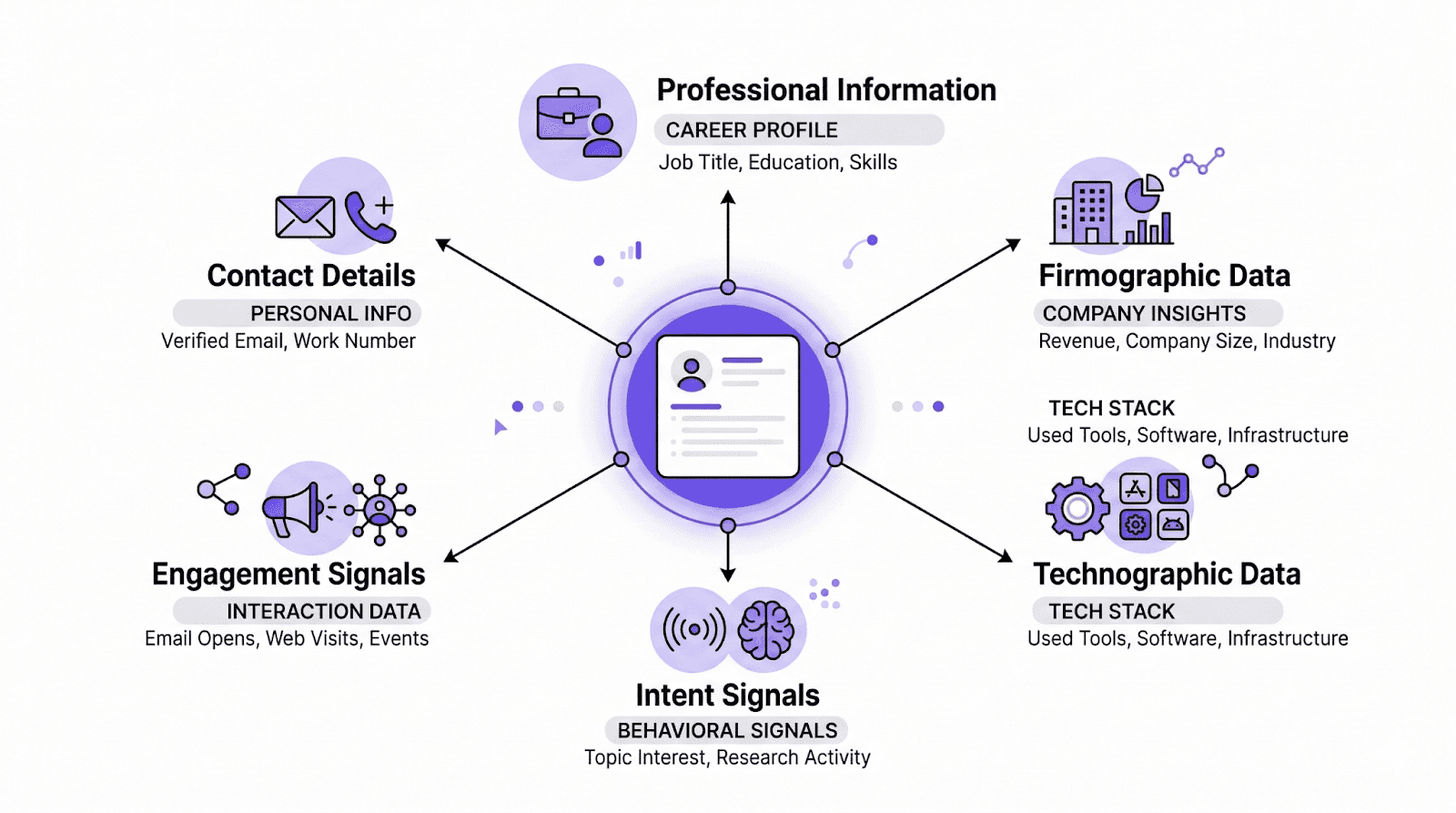
Enrichment covers six categories of data, each serving a specific function in qualifying, prioritizing, and engaging the right contacts.
1. Contact Details
Contact details are the most immediately actionable output: verified work email addresses, personal email addresses, direct phone numbers, and mobile numbers. Work emails follow domain patterns but expire when someone leaves a role.
Personal emails persist through job changes and produce higher response rates for outbound sequences targeting executives whose corporate inboxes are heavily filtered. Mobile numbers increase connect rates dramatically compared to office lines gated through assistants or unmanned extension directories.
2. Professional Information
Job title, department, seniority level, and years in role determine whether a contact is a decision-maker, a technical influencer, or an end-user. This distinction changes the angle of every outreach message, the appropriate CTA, and where the contact sits in the lead scoring model.
A Director of Engineering and a VP of Finance at the same company warrant entirely different message tracks.
3. Firmographic Data
Firmographic data describes the contact's organization: employee headcount, annual revenue range, industry vertical, company type, geographic location, founding date, and company LinkedIn URL. This is the primary input for ICP matching. Firmographic data determines whether an account structurally qualifies as a target before a rep invests any time in outreach.
4. Technographic Data
Technographic data reveals which software tools a company currently uses. Knowing that a prospect runs Salesforce as their CRM and HubSpot for marketing automation tells a B2B platform exactly which integration pain points are most likely to resonate. It also reveals whether a company is a current competitor customer, what their technical sophistication is, and which adjacent tools they are likely evaluating.
5. Intent Data
Intent data surfaces accounts that are actively researching topics related to your product category. It is derived from content consumption signals, third-party research behavior, review site activity, and competitive analysis patterns. An account that has visited comparison pages on G2 multiple times in a recent week is a warmer target than an account that matches ICP criteria but shows no behavioral signal.
6. Engagement and Job Change Signals
Job change alerts identify contacts who recently started a new role, a prime buying window during which they are evaluating vendors and making purchasing decisions. Technology adoption signals show recent software purchases indicating active evaluation cycles. Content engagement data reveals which topics a contact is actively researching, enabling personalized outreach that meets them where their attention already sits.
Who Benefits from Contact Data Enrichment?
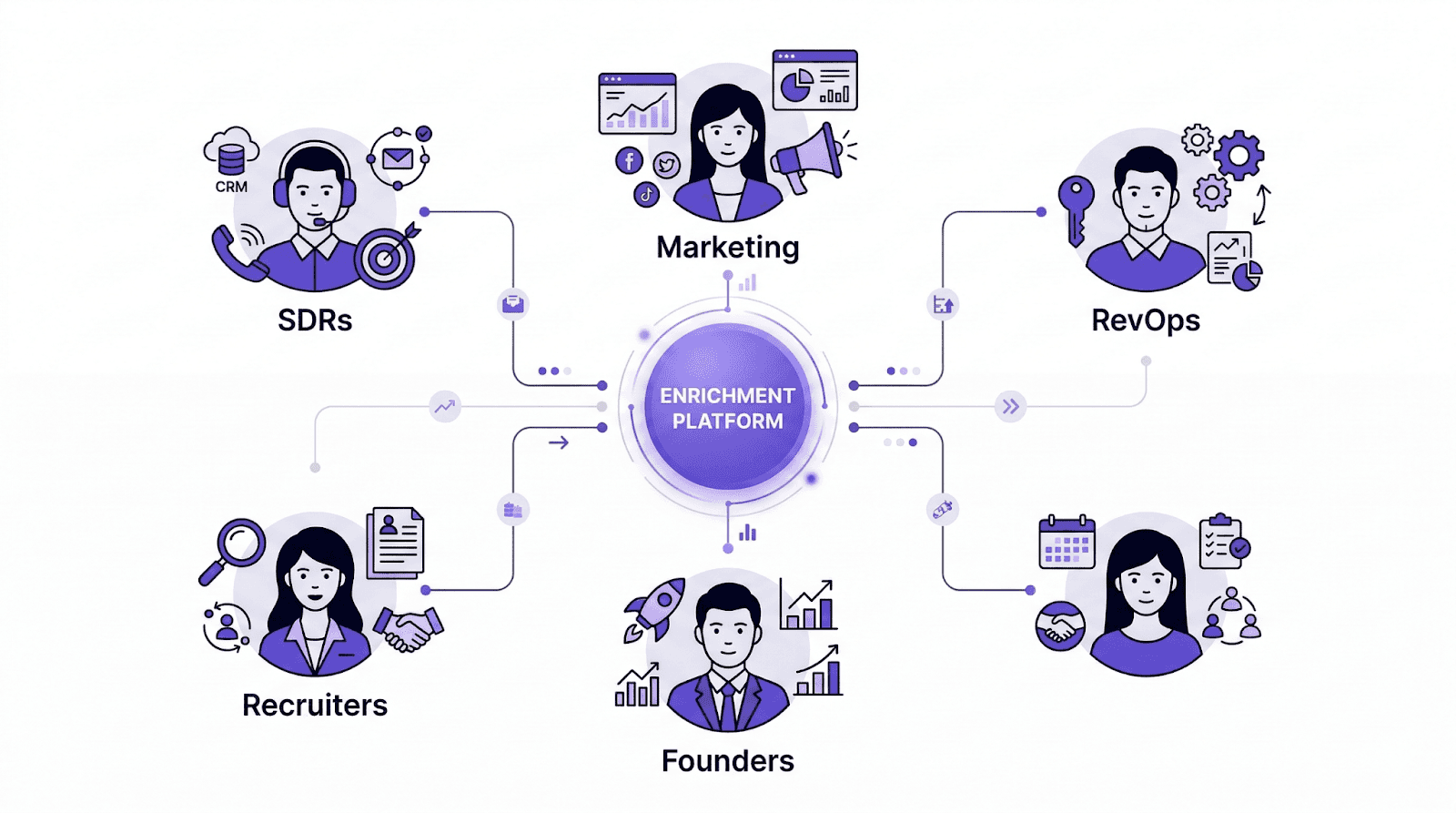
Every function in a B2B GTM organization extracts value from enrichment, but the nature of that value differs by team.
SDRs and BDRs
SDRs use enrichment to eliminate manual research from list building. Without it, finding a prospect's verified email, confirming their current role, and identifying their company attributes takes 5 to 10 minutes per contact. For a rep building a 200-contact sequence, that is an entire workday lost before a single message is sent.
With enrichment, the same rep uploads a CSV of names and domains and returns to a fully populated, verified outreach-ready file. The reclaimed time goes directly into personalized messages and booked meetings.
Enriched profiles also change the quality of outreach. When a rep knows the prospect's seniority, company stage, and technology stack before the first touchpoint, the conversation opens with specific relevance rather than a generic pitch.
Marketing and Demand Gen Teams
Inbound leads arrive with minimal data. A webinar registration captures a name and email. A content download captures even less. Without enrichment, those records reach the CRM incomplete and unscorable, unable to be routed correctly or entered into the right nurture sequence.
Contact enrichment runs automatically when a form is submitted, appending job title, company size, industry, and seniority before the record touches any workflow. The lead arrives fully qualified, scoreable, and routable.
Enriched profiles also allow shorter forms. Instead of asking for 8 fields, marketing teams ask for 3 and let enrichment fill the rest. Shorter forms convert at higher rates while still delivering complete contact profiles on the back end.
RevOps and SalesOps Teams
RevOps teams use enrichment as a CRM hygiene mechanism. As contact data decays, automated enrichment through API integration or scheduled batch runs keeps records current without manual intervention.
It flags records that failed enrichment for review, deduplicates contacts appearing under multiple email formats, standardizes field values to consistent schemas, and enriches new inbound records before they enter routing or scoring logic.
Lead routing rules that assign contacts based on company size and geography require reliable firmographic data in every record. Enrichment ensures those rules fire correctly rather than defaulting to manual assignment when critical fields are empty.
Recruiters
Recruiters use enrichment to reach passive candidates who do not respond to LinkedIn InMails. A candidate's personal email address or direct mobile number bypasses the LinkedIn message queue entirely and produces substantially higher response rates. Enrichment platforms that surface personal contact details alongside professional data serve recruiting workflows in addition to sales and marketing use cases.
Founders and Small Teams
Founders and small teams use enrichment to avoid the multi-tool complexity that larger organizations accept as standard. Instead of managing three or four separate data provider subscriptions, each with its own API and coverage gaps, they run a single platform that handles multi-source coverage automatically. Platforms with unlimited seat models let an entire founding team share one credit pool without per-head licensing fees.
How FullEnrich Approaches Contact Data Enrichment?
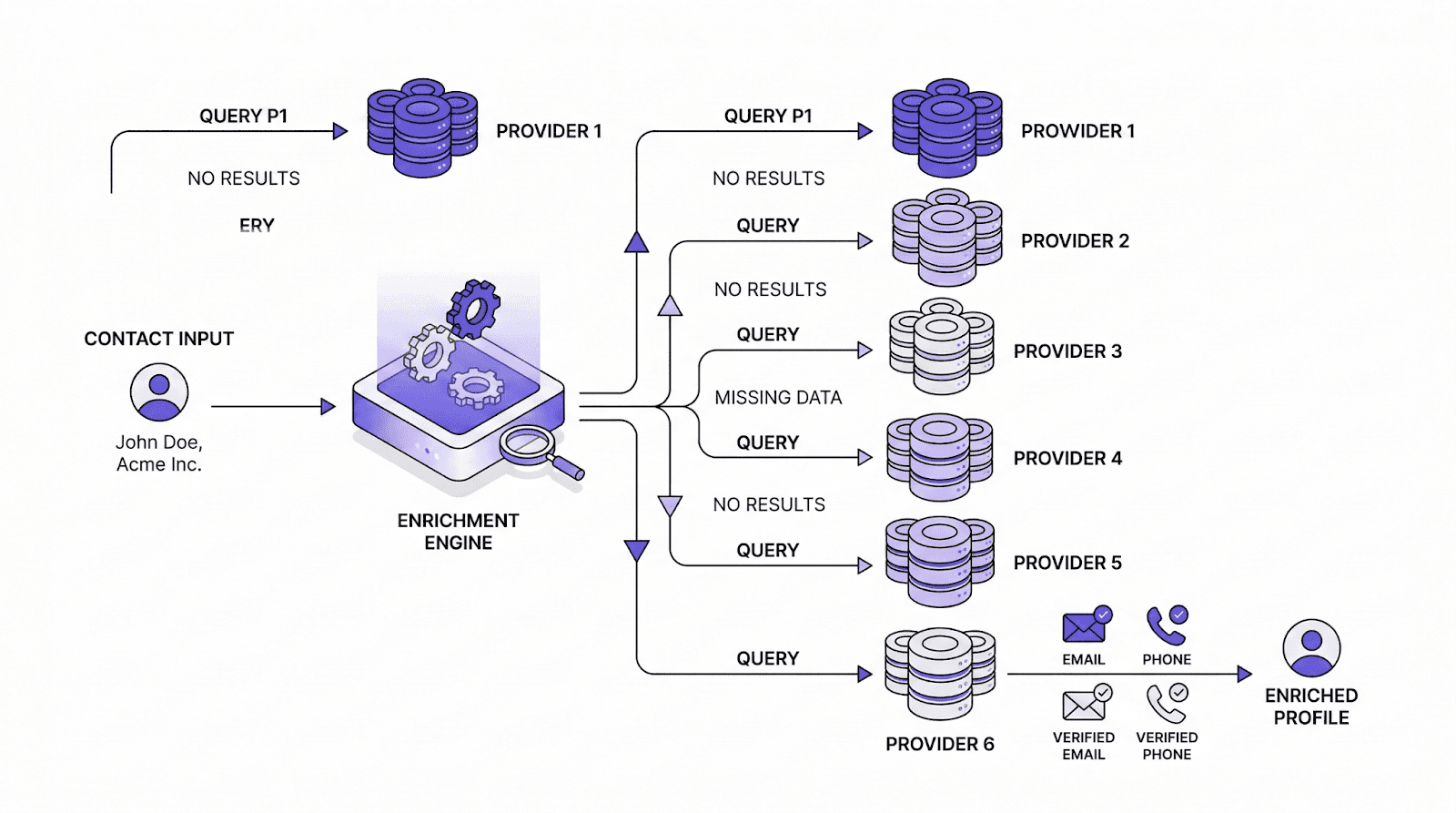
FullEnrich is a waterfall enrichment platform that aggregates 20+ premium data providers and sequences queries through them until it finds and verifies a contact's email, phone, and firmographic data.
Rather than building or maintaining its own static database, FullEnrich fetches data on demand, which keeps match rates high across diverse industries, company sizes, and geographies where single-source tools consistently produce gaps.
Find rates reflect this architecture directly. FullEnrich reaches an 89% email find rate for US contacts and 86% phone find rate, with EMEA at 84% email and 71% phone, LATAM at 78% email and 67% phone, and APAC at 78% email and 66% phone. Triple email verification keeps bounce rates below 1%, protecting sender reputation across all outbound sequences.
The credit model charges only on verified results. Failed lookups cost nothing. Unlimited user seats on all plans mean entire GTM teams share one credit pool without per-head licensing fees. Native integrations with HubSpot, Salesforce, Pipedrive, Google Sheets, Zapier, Make, and direct API access cover every major workflow configuration. Start enriching contacts for free on FullEnrich!
How to Build a Contact Data Enrichment Workflow?
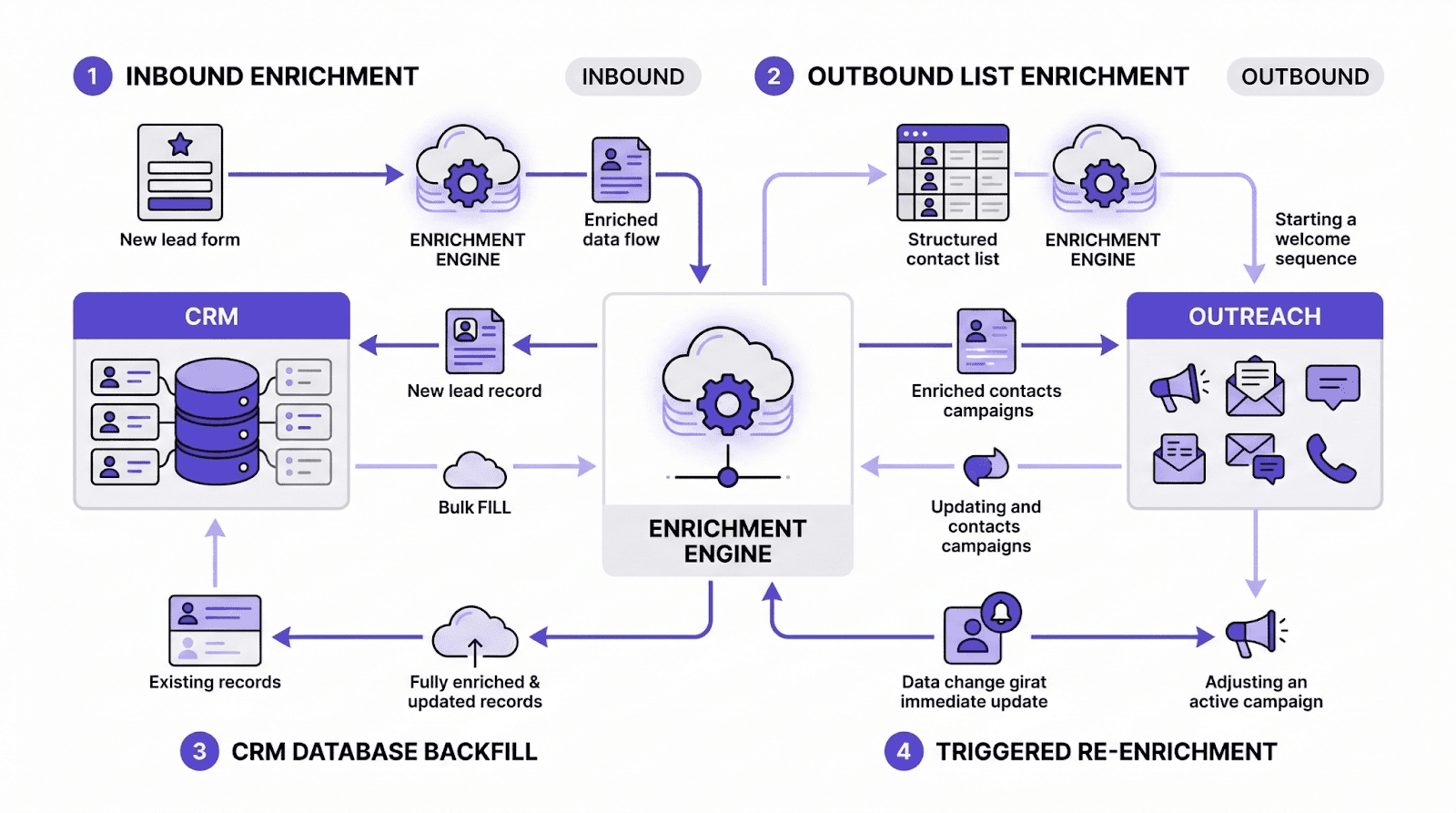
A well-designed enrichment workflow runs in the background continuously without requiring manual intervention per record. Four workflow types cover the full range of GTM needs.
Inbound enrichment: A form submission triggers an API call to the enrichment platform with the contact's name and email. Within seconds, the CRM record is populated with job title, company size, industry, and verified contact details. The lead is scored, routed, and enrolled in the right sequence before any human reviews it.
Outbound list enrichment: A rep or analyst uploads a CSV of target accounts with company domains. Enrichment runs across the list and returns a verified contact file with emails and phone numbers. The enriched file imports directly into the CRM or a sales engagement sequence.
CRM backfill: RevOps identifies all records missing critical fields: phone, job title, company size. A batch enrichment run populates those fields automatically. Records that fail enrichment are flagged for manual review or suppression from active sequences.
Triggered re-enrichment: When a contact reaches a specific pipeline stage or a job change alert fires, enrichment runs again to verify data freshness before the rep makes contact. This matters most for deals with longer sales cycles where contact information may have changed between initial enrichment and close.
Best Practices for Contact Data Enrichment
Most enrichment mistakes happen at the configuration stage, not the data stage. The wrong field priorities, loose overwrite rules, no quality monitoring, and poorly timed triggers all produce the same outcome: credits spent with no improvement to outreach or pipeline. These four practices cover the configuration decisions that matter most.
Field Prioritization by Workflow Impact
Not every enrichable field has equal value. Before configuring enrichment, identify which fields actually drive downstream actions in your workflows. Sales teams need verified phone numbers and current job titles. Marketing requires company size and industry for segmentation.
RevOps needs employment change alerts for CRM hygiene. Lead scoring models depend on seniority and firmographic attributes. Enriching fields that no workflow reads wastes credits and adds noise to records without improving output.
Overwrite Rule Configuration
Automatic overwrite replaces manually entered data with enrichment results, which can destroy custom information or verified corrections your team entered. Conservative settings fill empty fields only, protecting human-entered data. Selective overwrite lets teams update specific fields while leaving others untouched.
For employment fields that go stale quickly, continuous enrichment with update-on-change logic keeps records accurate without manual intervention.
Match Rate and Data Quality Monitoring
Track match rates by identifier type against your actual ICP, not vendor benchmarks. Monitor field fill completion to confirm enrichment is producing usable data in the fields your workflows depend on. Track verification failure rates to catch data quality issues early.
Monitor user corrections to enriched fields as a direct signal of provider accuracy. Low match rates point to weak identifiers in the database. High correction rates point to provider data quality problems worth escalating.
Enrichment Trigger Setup and Credit Management
Automatic enrichment on new contact creation ensures every inbound lead arrives complete. Periodic bulk enrichment refreshes existing databases on a quarterly or semi-annual cadence. Manual on-demand enrichment gives reps the ability to research high-value prospects selectively without burning credits on low-priority contacts.
Setting monthly credit budgets with spend alerts prevents unexpected cost spikes from over-broad automatic enrichment rules.
Common Contact Data Enrichment Mistakes
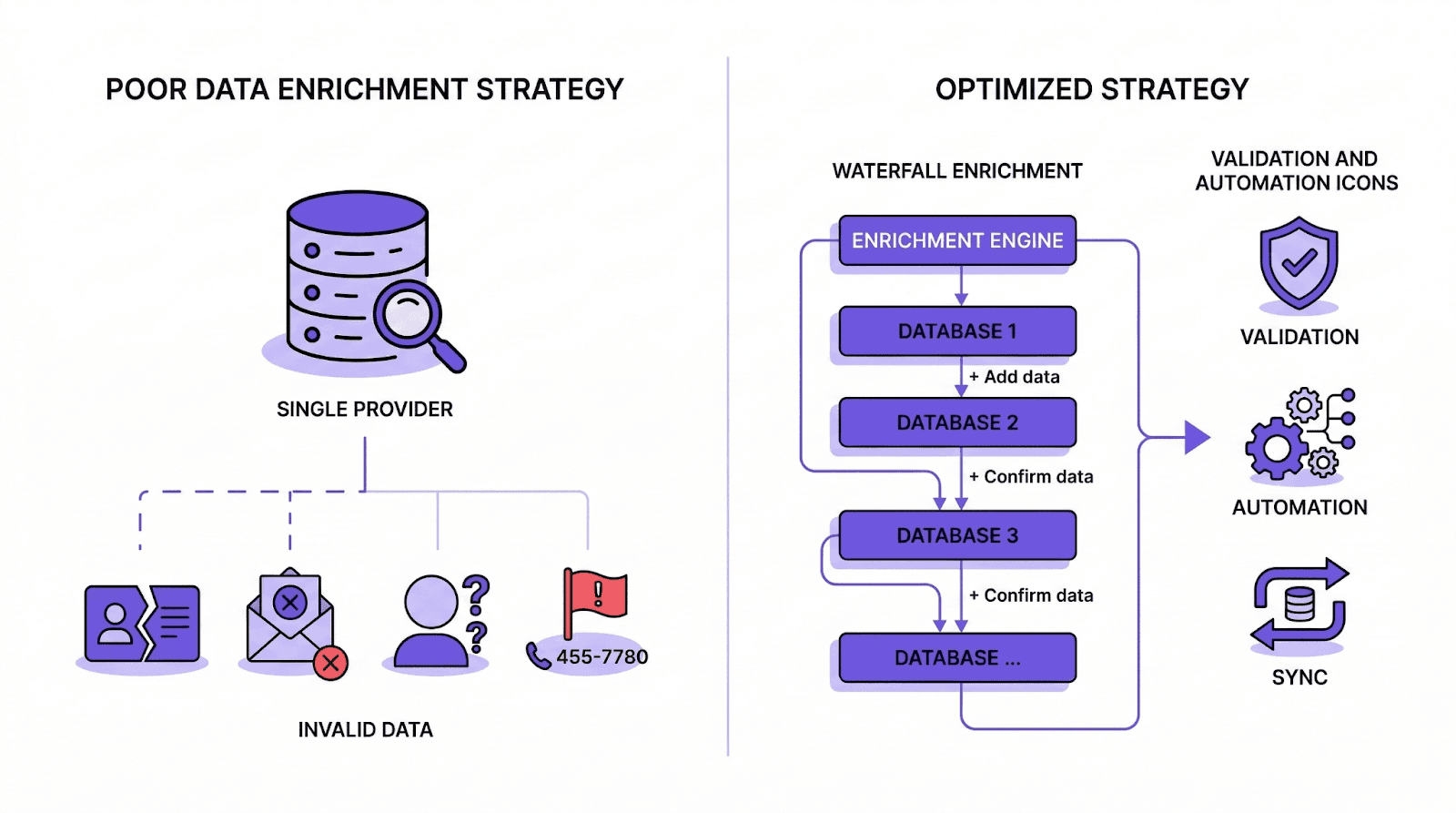
Relying on a single data provider: No enrichment platform covers every prospect with equal depth. A tool with strong US enterprise coverage may miss 40% of contacts in European SMB or APAC markets. Waterfall enrichment, which sequences multiple providers in order, fills the gaps that any single source would leave.
Paying for failed enrichment attempts: Several platforms charge a credit for every query regardless of whether a valid result is returned. At volume, the cost of failed lookups compounds quickly. Platforms that charge only on successful enrichment produce more predictable costs and better economics per verified contact.
Sending without email validation: Finding an email address is not the same as confirming its deliverability. An email that passes format checking may still bounce if the mailbox has been closed, the domain changed, or the address was entered incorrectly at source. Enrichment without validation produces lists that damage sender reputation and reduce inbox placement rates across all future campaigns.
Treating enrichment as a one-time event: Data decays at 30% per year. Running enrichment once and never refreshing produces a database that drifts steadily toward inaccuracy. Continuous enrichment through triggered re-enrichment and scheduled batch refreshes is what maintains data quality over time.
Enriching without connecting to downstream workflows: Enrichment that populates fields no workflow reads produces no pipeline value. Every enriched field should feed at least one downstream action: a lead score attribute, a routing rule, a sequence personalization token, or a segmentation criterion. Map which fields drive which actions before selecting what to enrich.
Ignoring compliance requirements: GDPR, CCPA, and PECR impose specific obligations on how personal contact data is collected, stored, and processed. Enrichment vendors that maintain static databases of personal contact records carry a different compliance posture than platforms that fetch data on demand.
Contact Data Enrichment and Compliance: What Teams Need to Know
GDPR, CCPA, and PECR each impose distinct obligations on B2B teams that use enriched contact data for outreach. Compliance is not optional, and the approach an enrichment platform takes to data handling has direct implications for a customer's own compliance posture.
GDPR (EU/EEA): The General Data Protection Regulation requires a lawful basis for processing personal data. For B2B outreach, legitimate interest is the most commonly cited basis, but it requires a documented balancing test. GDPR also grants the right to erasure: if a contact requests that their data be deleted, the organization must honor that request, which is more complex when personal data sits in a static vendor database rather than being fetched on demand.
CCPA (California): The California Consumer Privacy Act grants California residents the right to know what personal information is collected about them, to opt out of the sale of their data, and to request deletion. B2B contact data falls within CCPA's scope when the contact is a California resident.
On-demand fetching vs. static storage. Platforms that do not store personal data but instead fetch contact information on demand return data directly to the requester without maintaining a central database of personal contact records. This architecture reduces the compliance surface area for both the platform and its customers. Platforms that build and maintain their own contact databases carry a different compliance posture, particularly for data collected from individuals in GDPR jurisdictions without explicit consent documentation. Confirming SOC 2 Type II certification, GDPR compliance documentation, and CCPA alignment before committing to any enrichment platform is a necessary step for any team that handles personal data.
Conclusion
Contact data enrichment is the operational layer that connects raw contact records to productive sales, marketing, and RevOps activity. Without it, every workflow that depends on contact intelligence, including lead scoring, CRM routing, personalized outreach, and ABM targeting, operates on incomplete inputs and produces unreliable outputs.
The teams that build durable pipeline in 2026 act on the best data, fastest. That requires enrichment that is accurate, continuously refreshed, and tightly connected to the tools that drive outreach and conversion.
Single-source platforms will always carry coverage gaps that surface at the worst possible time: when the prospect is real but the contact data is missing. Waterfall enrichment, built on a stack of multiple providers queried in sequence, is the architecture that closes those gaps systematically and at scale.
See how FullEnrich helps B2B teams enrich contacts at scale
FAQs
What inputs does contact data enrichment require?
Most platforms accept a name plus company domain, a LinkedIn profile URL, or a CSV file upload. Advanced platforms also accept direct API calls and support reverse email lookup, which takes an email address as input and returns the full contact profile.
What is the difference between contact enrichment and prospecting tools?
Contact enrichment enhances existing CRM records by filling missing fields. Prospecting tools build new contact lists from scratch using search criteria. The two serve different functions and are often used in combination.
Can enrichment update contacts automatically as they change jobs?
Yes. Continuous enrichment monitors employment changes and updates contact records when people move companies, change titles, or update their profiles. This is particularly important for maintaining CRM accuracy over longer sales cycles.
How often should a CRM database be re-enriched?
Active contacts in current sequences benefit from re-enrichment triggered by job change alerts or pipeline stage transitions. Broader database refreshes on a quarterly cadence balance data freshness against credit consumption. Dormant contacts can be refreshed annually or skipped entirely depending on their pipeline value.
What is waterfall enrichment and why does it improve match rates?
Waterfall enrichment sequences queries across multiple data providers in order. If the first provider returns no result, the query passes to the next, then the next, until a verified result is found. Because different providers have different coverage strengths by geography, company size, industry, and role type, stacking them fills the gaps that any single provider would leave. This architecture consistently produces higher match rates than single-source tools, particularly for international contacts and niche industries.
Does contact enrichment work for international markets?
Yes, but platform selection matters significantly. US-centric single-source databases frequently produce weak coverage in EMEA, APAC, and LATAM. Platforms that aggregate multiple providers, including those with regional coverage strength, produce materially higher match rates for international enrichment.
Will enrichment overwrite data my team manually entered?
This depends on configuration. Conservative settings fill empty fields only and never replace user-entered data. Selective overwrite modes allow teams to choose which specific fields to update while protecting others. Most enterprise-grade enrichment platforms support field-level overwrite rules.