ZoomInfo and Apollo are two of the most widely used B2B data and sales intelligence platforms, but each targets different workflows and team priorities.
ZoomInfo excels in verified contact databases, company insights, and integration-driven sales processes for enterprise and RevOps teams. Apollo emphasizes outreach automation, CRM-linked enrichment, and flexible workflows to support growth-focused SDRs and marketing teams.
Comparing ZoomInfo and Apollo helps sales, marketing, and recruiting professionals determine which platform best aligns with their accuracy, efficiency, and campaign execution goals.
Key Takeaways
- ZoomInfo invests heavily in human researchers to maintain the industry's highest accuracy, particularly for North American direct dials. Apollo offers a massive global reach, but its reliance on automation means you may face slightly higher bounce rates in exchange for a much lower cost of entry.
- Apollo wins on workflow by housing your database, sequences, and dialer under one roof, eliminating the need for extra tools like Salesloft or Outreach. ZoomInfo wins on intelligence, providing "Bidstream" intent data and deep company scoops that give enterprise reps a tactical advantage before they even pick up the phone.
- While choosing a single platform locks you into a data silo, FullEnrich lets you bypass the accuracy-versus-cost debate entirely. By deploying a native waterfall enrichment sequence across 20+ premium vendors.
ZoomInfo vs Apollo: Side-by-Side Comparison
This table breaks down the fundamental split between premium data intelligence and integrated sales execution. While ZoomInfo serves as a high-fidelity intelligence layer for complex organizations, Apollo functions as a centralized command centre for teams that want to prospect and engage within a single interface.
Attributes | ZoomInfo | Apollo |
|---|---|---|
Best For | Enterprise sales, RevOps, and marketing teams need verified contact and company databases | Growth teams, SDRs, and small-to-mid-market sales teams need outreach automation and enrichment |
Core Focus | Accurate contact and company intelligence with workflow integrations | Multi-channel prospecting, CRM-linked enrichment, and automation |
Data Source | Proprietary verified databases, third-party data, and intent signals | Public web sources, CRM inputs, user-contributed data, and company websites |
Primary Users | Enterprise sales teams, RevOps, Marketing Ops | SDRs, growth teams, marketing teams, and small-to-mid-market sales |
Automation | Workflow automation via CRM and RevOps integration | Email sequencing, multi-channel outreach automation, and enrichment triggers |
Technical Complexity | Moderate; UI-driven platform for non-technical users | Low-to-moderate; simple UI with optional CRM integration for automated workflows |
Pricing Model | Subscription-based; annual contracts starting around ~$14,995/year | Usage-based and subscription plans, starting around $49 per month (billed annually) |
Data Compliance | GDPR and CCPA aligned; enterprise-grade controls | GDPR and CCPA are aligned; it relies on user workflow compliance |
Customization Level | Custom dashboards, saved searches, and intent alerts | Custom sequences, outreach templates, and enrichment rules |
Support | Dedicated customer success for enterprise; email and chat support | Email, chat support, and documentation; lightweight CS for smaller teams |
What is ZoomInfo?
ZoomInfo is a B2B sales intelligence and data enrichment platform designed for enterprise and mid-market revenue teams. ZoomInfo provides verified contact and company databases, firmographics, intent signals, and workflow integrations to accelerate pipeline development and improve targeting accuracy.
ZoomInfo helps sales, RevOps, and marketing teams identify high-value accounts, map buying committees, and access insights directly within CRM and marketing automation platforms.
The platform’s strength lies in account-level intelligence combined with individual contact verification, making it ideal for structured campaigns, enterprise outreach, and data-driven decision-making.
What is Apollo?
Apollo operates as a unified B2B growth and sales engagement platform, eliminating the friction between data discovery and outreach automation. It empowers SDRs and marketing teams by natively linking contact enrichment directly to email sequencing and CRM workflows.
Instead of bouncing between disjointed tools, revenue teams can discover prospects, verify records, and launch high-volume campaigns from a single interface.
This intense focus on operational speed and flexibility is a recurring theme across Apollo's G2 reviews, where lean startups and mid-market organizations consistently praise its ability to execute scalable outbound without bloating the tech stack.
What Services Does ZoomInfo and Apollo Offer?
ZoomInfo and Apollo offer distinct services that align with their target audiences and use cases. ZoomInfo emphasizes verified data, intent signals, and workflow integrations for enterprise teams, while Apollo focuses on outreach automation, enrichment, and CRM-linked prospecting for growth teams. Understanding their service offerings helps revenue, marketing, and recruiting teams align tools with workflows.
Services Offered By ZoomInfo
While ZoomInfo’s data is its backbone, the platform’s real power lies in the proprietary tools that turn that data into a functional sales weapon. For enterprise teams, these features act as the "connective tissue" between a massive database and a closed deal, providing the automation and visibility required to manage complex market territories.
- Chorus.ai Conversation Intelligence: By integrating Chorus directly into the platform, ZoomInfo enables you to record, transcribe, and analyze every sales call in real time. This feature uses AI to flag specific keywords, such as a competitor's name or a pricing objection.
- FormComplete Optimization: This tool solves the "leaky bucket" problem in marketing by shortening your website forms. When a prospect enters just their email address, ZoomInfo automatically maps their identity to its database and fills in the rest (company size, industry, revenue) behind the scenes.
- WebSights Visitor Tracking: This feature de-anonymizes your website traffic by identifying the specific companies visiting your pages, even if they never fill out a form. It allows your SDRs to reach out to "invisible" prospects who are currently browsing your high-intent pages, such as pricing or case studies.
- Workflows & GTM Plays: ZoomInfo lets you create "automated triggers" that fire when specific data changes. For example, if a high-value account gets a new round of funding or hires a new VP of Sales, the "Workflows" feature can automatically export that contact to your CRM and drop them into a specific email sequence.
- Enrichment for Salesforce & HubSpot: Instead of a one-time data pull, this feature acts as a persistent "auto-correct" for your entire CRM. It runs in the background, constantly scanning your existing records for "data rot" like people leaving jobs or companies moving headquarters and updating them instantly.
- The "ReachOut" Chrome Extension: This tool puts the entire ZoomInfo database at your fingertips in your browser. Whether your reps are on a prospect’s LinkedIn profile or their corporate website, they can click the extension to reveal direct dials and email addresses without ever leaving the page.
Services Offered by Apollo
Apollo is designed as a comprehensive execution layer for revenue teams, merging broad data intelligence with a native outbound engine. Rather than simply acting as a phone book, the platform provides a unified environment where growth teams can discover, verify, and engage prospects without the friction of exporting lists to a third-party dialer or sequencer.
Database-as-a-Service (DaaS): Apollo provides direct access to a global network of over 275 million contacts and 30+ million companies. This service goes beyond static lists by allowing teams to filter the market, including job changes, specific technographics, and funding rounds to identify high-potential targets in real time.
Native Outbound Engagement: The platform provides a complete environment for launching multi-channel sales sequences. Instead of just sending emails, this service lets you coordinate automated touchpoints across email, phone calls, and LinkedIn.
Waterfall Contact Verification: To maximize deliverability, Apollo executes a multi-step verification process for every email and mobile number revealed. This service cross-references multiple data points and provides a "confidence score" for each record.
GTM Strategy Playbooks: Apollo offers "Plays," automated workflow templates that trigger specific actions based on prospect behavior. For example, if a contact opens your email three times but hasn’t replied, this service can automatically move them into a "high-priority" call task for your SDRs.
Bi-Directional CRM Syncing: The platform serves as a real-time data bridge for HubSpot, Salesforce, and Pipedrive. This service ensures that all prospecting activity, including clicks, replies, and new contact discoveries, is logged instantly in your system of record.
Key Features of ZoomInfo vs Apollo
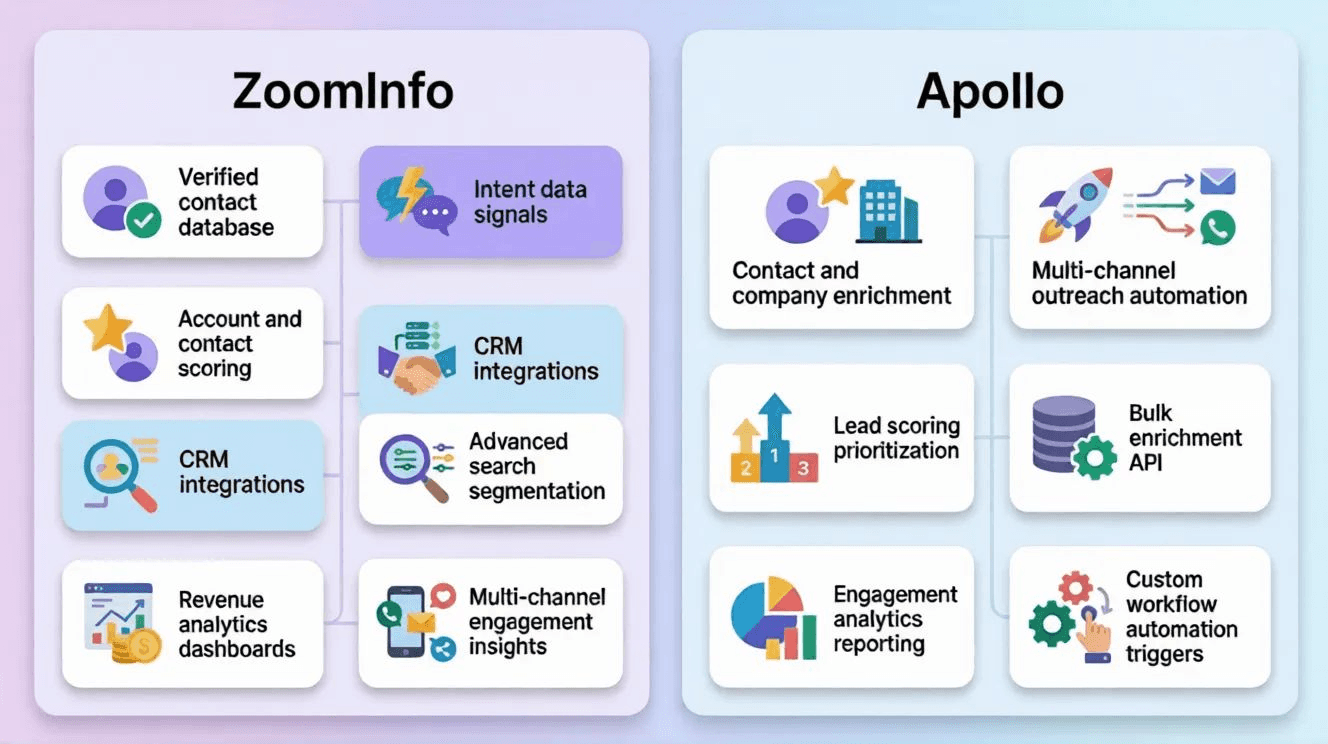
ZoomInfo and Apollo offer distinct features that enhance usability, insights, and workflow efficiency. Unlike services, features focus on platform capabilities, product-level tools, and user experience improvements for revenue and growth teams.
Key Features of ZoomInfo
ZoomInfo operates as the foundational intelligence layer for enterprise sales and RevOps teams, moving beyond simple contact lists to provide deep organizational insights. Rather than just handing reps a phone number, it maps out the entire buying committee and flags exactly when they enter an active purchasing cycle.
- Contact and company database: ZoomInfo maintains verified profiles with job titles, email addresses, phone numbers, and company information. By employing a massive team of human researchers alongside their automated data collection.
- Intent data monitoring: Tracks buying signals from accounts showing interest in relevant topics or solutions. This allows your outbound team to prioritize prospects actively researching your competitors.
- Account and contact scoring: Ranks accounts and leads based on engagement, fit, and intent signals. By automatically surfacing the warmest targets to the top of the daily queue, the platform prevents sales reps from burning energy on unqualified accounts.
- CRM and marketing automation integration: Smoothly syncs data with Salesforce, HubSpot, Marketo, and Outreach. This bi-directional connection keeps your core infrastructure clean and up to date in real time.
- Advanced search and segmentation: Enables targeted prospecting by industry, geography, company size, or job function. Revenue teams can slice the database using granular technographic and funding filters to build highly specific outreach campaigns.
- Pipeline and revenue analytics: Provides insights into how engagement impacts opportunities and closed deals. RevOps leaders rely on these dashboards to identify exactly which outreach behaviors are actually driving revenue.
- Multi-channel engagement insights: Tracks email, call, and website activity to inform outreach strategy. By centralizing this activity data, reps gain the full context of a prospect's journey.
Key Features of Apollo
Apollo functions as a high-velocity execution engine, designed to eliminate the invisible "tax" of switching between a database and an outreach tool. While legacy platforms force you to export CSVs and manually upload them into a separate dialer or sequencer, Apollo merges these steps into a single, continuous motion.
- Contact & company enrichment: Apollo provides real-time data injection for leads, including verified job titles, company firmographics, and direct professional emails. By refreshing the data at the moment of discovery, the platform prevents your reps from wasting time on "ghost profiles" or sending sequences to prospects who changed roles months ago.
- Multi-channel outreach automation: The system supports a coordinated "blitz" strategy by housing email sequences, automated calls, and LinkedIn task reminders under one roof. This allows you to build persistent cadences that follow a prospect across multiple touchpoints until they either opt out or book a meeting.
- Lead scoring and prioritization: Apollo uses a dynamic ranking engine to sort your prospects based on their engagement history and firmographic fit. Instead of guessing which leads to call first, your team is handed a prioritized daily "hit list" of the accounts most likely to convert right now.
- Bulk and programmatic enrichment: This feature allows teams to process massive, raw data dumps or automate enrichment via API and platform-wide workflows. Whether you're cleaning up a messy trade show list or building a custom growth loop, the platform fills in the missing data gaps at an industrial scale.
- Engagement analytics and reporting: The platform provides a transparent "scoreboard" for your sales messaging, tracking opens, clicks, replies, and conversions, and linking them to actual revenue. It moves beyond vanity metrics to tell you exactly which subject lines and call scripts are generating revenue.
- Customizable workflows: Apollo enables you to build sophisticated "if/then" triggers that dictate how your sales machine reacts to prospect behavior. For example, if a high-value lead clicks your pricing link three times in an hour, the system can automatically trigger an urgent Slack notification for the assigned rep to pick up the phone.
How Accurate Is the Data from ZoomInfo and Apollo?
Data accuracy is crucial for SDR productivity, campaign efficiency, and recruiting success. Inaccurate or outdated information can waste outreach efforts and lower conversion rates. ZoomInfo and Apollo take different approaches to ensure reliability, depending on their data sources and verification processes.
ZoomInfo Data Accuracy
ZoomInfo employs a large team of human researchers who cross-verify millions of records to ensure that direct-dial phone numbers and executive titles are up to date. This means fewer hours wasted on "ghost profiles" and a significantly higher chance of reaching a decision-maker on the first attempt, especially within large North American enterprises. Even with this rigorous oversight, the reality of "data rot" remains a factor. Because people change jobs and roles every day, users typically find that real-world accuracy for mobile numbers and direct emails ranges from 75% to 85%.
The primary value here isn't 100% perfection, which is impossible in B2B data, but rather the reliability of the "verified" badge. When you see a contact marked as verified in ZoomInfo, it means the record has passed a triple-layer check of AI, automated handshakes, and human research, making it the most dependable source for high-stakes enterprise outreach.
Also Read: 15 Best ZoomInfo Competitors & Alternatives
Apollo Data Accuracy
Apollo takes a fundamentally different approach, prioritizing massive scale and real-time speed over manual verification. Its database is built on a crowdsourced contributor network, meaning the data is constantly being refreshed by the millions of users who sync their own email accounts and CRMs with the platform. This creates a "live" ecosystem where new leads and job changes appear almost instantly.
However, from a user’s perspective, this reliance on automation and user-submitted data creates a wider quality gap. While its "Verified" emails are generally safe for outreach, the phone data is notoriously less reliable than its competitors. Many numbers labeled "direct" actually route back to the company's general headquarters. Ultimately, Apollo is designed for teams that value quantity and workflow over surgical precision.
Also Read: 15 Best Apollo Alternatives & Competitors
Which Platform Offers the Most Intuitive User Experience?
User experience affects adoption speed, efficiency, and overall team productivity. ZoomInfo and Apollo deliver different experiences because they cater to distinct audiences.
ZoomInfo User Experience
ZoomInfo offers a marketer and sales-friendly interface with dashboards for accounts, contacts, and intent signals. Users can perform advanced searches, segment target accounts, and track engagement metrics without technical expertise. Built-in CRM and marketing automation integrations reduce manual data entry, while predictive scoring and intent alerts guide campaign priorities.
Apollo User Experience
Apollo provides a streamlined interface for creating email sequences, multi-channel outreach campaigns, and real-time contact enrichment. Most interactions occur via sequence builders, dashboards, and automated task management. API access enables developers to embed enrichment directly into workflows. Apollo emphasizes efficiency and flexibility, allowing teams to rapidly execute campaigns without complex setup.
Pricing and Plans
Pricing is a critical factor when choosing between ZoomInfo and Apollo. Each platform structures costs differently, reflecting its target audience, feature set, and workflow focus.
ZoomInfo Pricing Plans
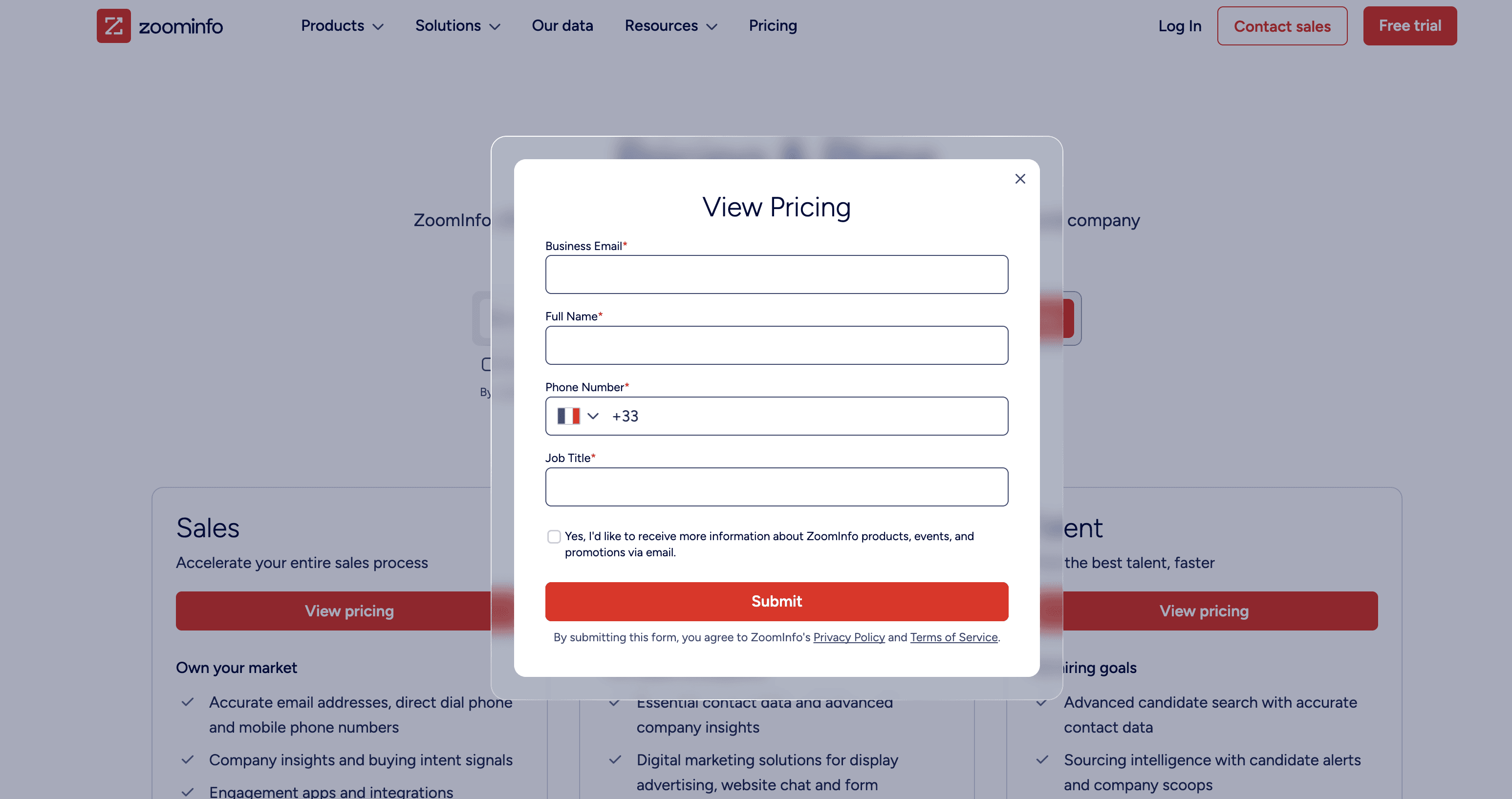
ZoomInfo does not offer monthly subscriptions; all plans require an annual or multi-year contract. Pricing is typically negotiated based on seat count and credit needs.
- Professional Plan (Estimated ~$14,995/year): This entry-level tier provides the core building blocks for smaller sales teams. It includes essential access to the B2B contact database and company profiles.
- Advanced Plan (Estimated ~$24,995/year): This mid-level package is designed for teams shifting toward a proactive, insight-driven strategy.
- Enterprise Plan (Estimated ~$39,995+/year): The flagship enterprise edition offers the complete technological stack for high-scale organizations.
Also Read: Zoominfo Pricing & Plans (2026): Is it worth it?
Apollo.io Pricing Plans
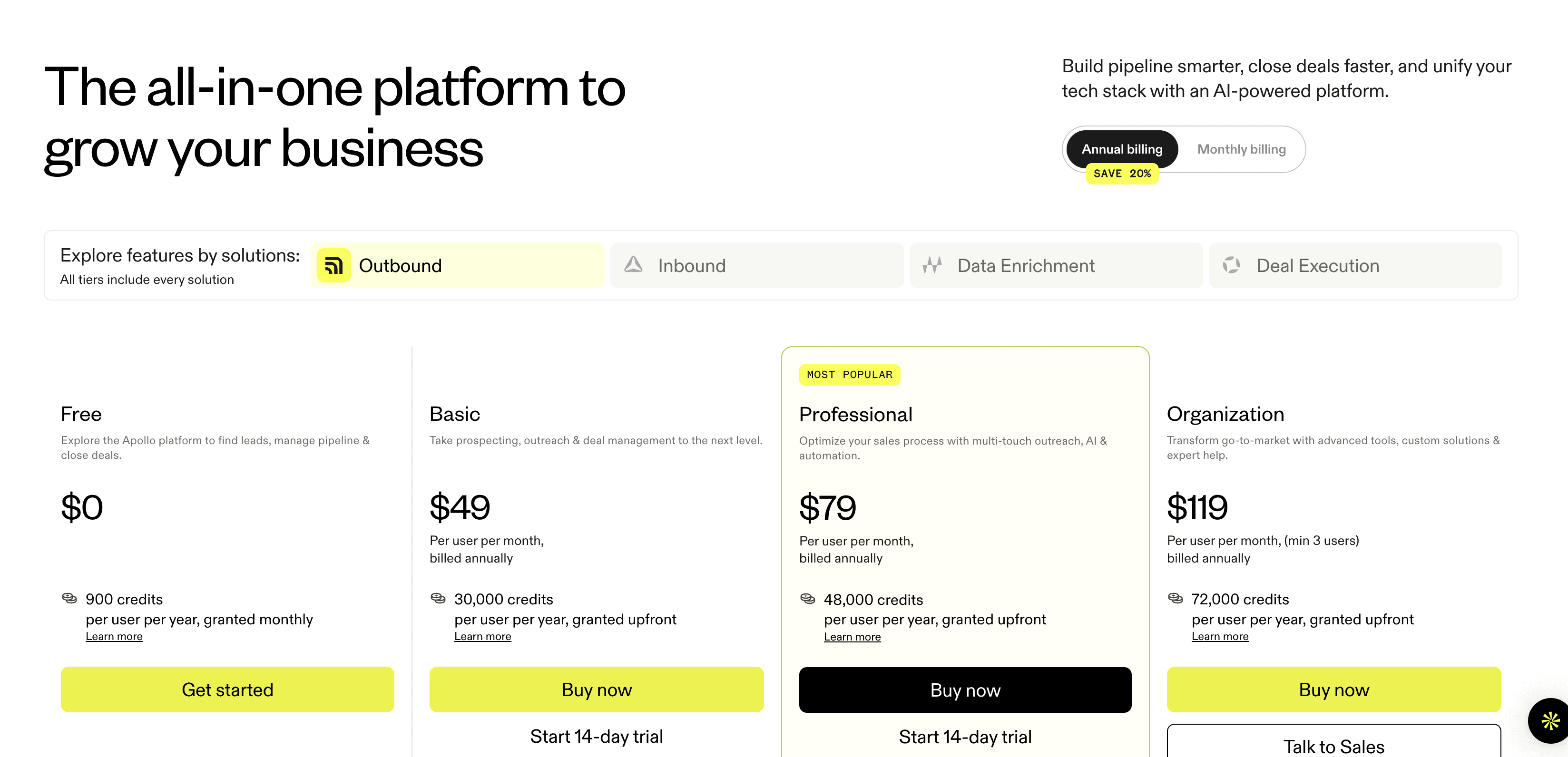
Apollo offers a self-service model that allows teams to scale their investment as their outbound volume grows.
- Free Plan: An ideal starting point for solo prospectors or startups testing the market. It offers a base set of search filters and the Chrome extension, providing a limited number of monthly email and mobile credits to sample the data quality.
- Basic Plan ($49/user/month billed annually): It features unlimited email sends, advanced search capabilities, and native integrations with HubSpot and Salesforce to streamline your daily prospecting.
- Professional Plan ($79/user/month, billed annually): This plan includes a built-in US/Canada dialer, call recording, and A/B testing for your email sequences to optimize conversion rates.
- Organization Plan ($119/user/month billed annually): The enterprise-ready solution for teams requiring at least three users. It includes the full international dialer, advanced administrative security controls, and customizable reporting dashboards for deep performance analysis.
Also Read: Apollo Pricing & Plans (2025): Is it worth it?
Who Should Use ZoomInfo vs Apollo?
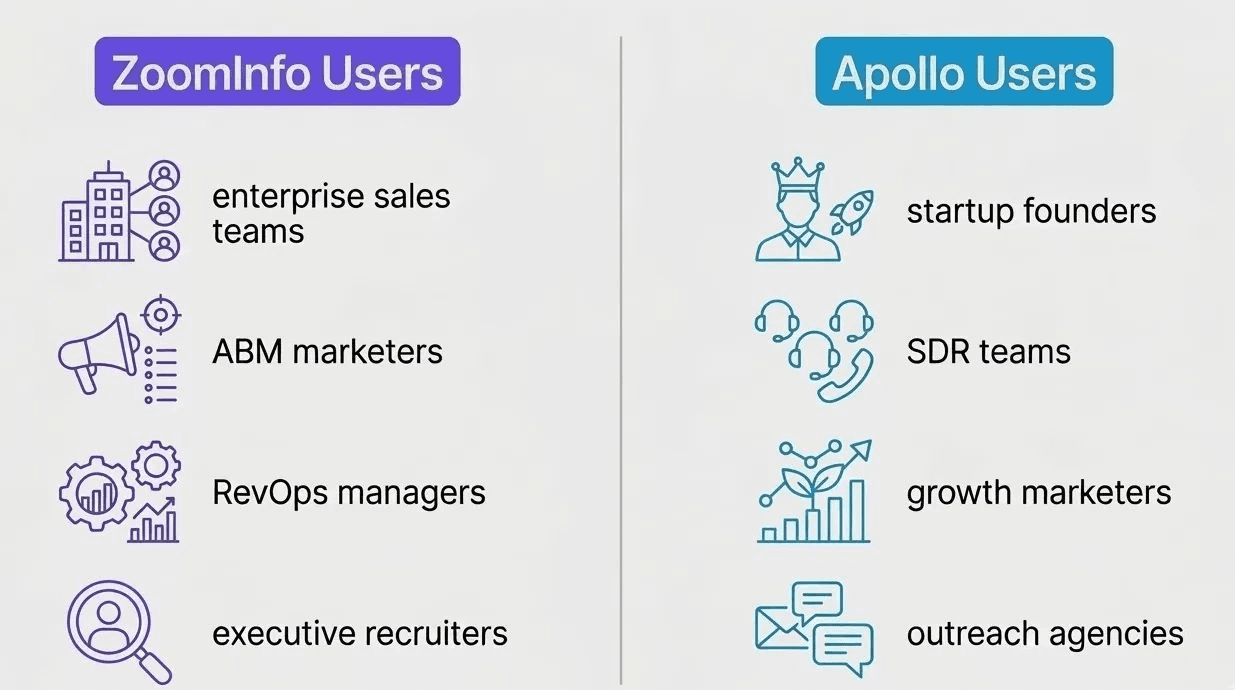
ZoomInfo is where you go when you have a large sales team that needs a reliable, "ready-to-eat" database. Clay is for the growth hackers and researchers who want to "cook" their own data by pulling the best pieces from everywhere at once.
Who should use ZoomInfo?
ZoomInfo is the engine for established sales teams that need a "ready-to-eat" database. It is designed for the "set it and forget it" leader who wants their reps focused on calling rather than on data engineering.
- Enterprise Sales Teams: Ideal for large organizations with 20+ reps who need deep organizational charts and parent-subsidiary mapping to navigate complex, multi-stakeholder deals.
- Account-Based Marketing (ABM) Leaders: Best for teams that rely on high-level intent signals to identify exactly which companies are currently researching their specific software category.
- High-Touch RevOps Managers: Perfect for those who want a single source of truth that automatically cleans and updates CRM records.
- Executive Search & Recruiting: Used by high-level headhunters to track executive leadership changes and find direct mobile numbers for candidates who aren't active on job boards.
Who should use Apollo?
Apollo is the go-to for growth-stage startups, individual contributors, and lean SDR teams that prioritize execution speed over an enterprise-grade database. It acts as a centralized command center for those who want to find a lead and launch a sequence in the same tab.
- Startups & Solo Founders: Best for lean teams that need a "one-stop shop" to manage prospecting, email sequencing, and calls without paying for three different software subscriptions.
- High-Volume SDR Teams: Ideal for outbound teams that prioritize speed and automation, allowing a single rep to manage thousands of monthly touchpoints with minimal manual effort.
- Budget-Conscious Growth Marketers: Perfect for those who need a generous free tier or transparent, monthly pricing to test new markets before committing to a major annual contract.
- Email-First Outreach Agencies: Designed for teams that focus on scale and deliverability, contributing to its impressive 4.8/5 rating on G2 for its ease of use and integrated workflow.
Pros and Cons of ZoomInfo vs Apollo
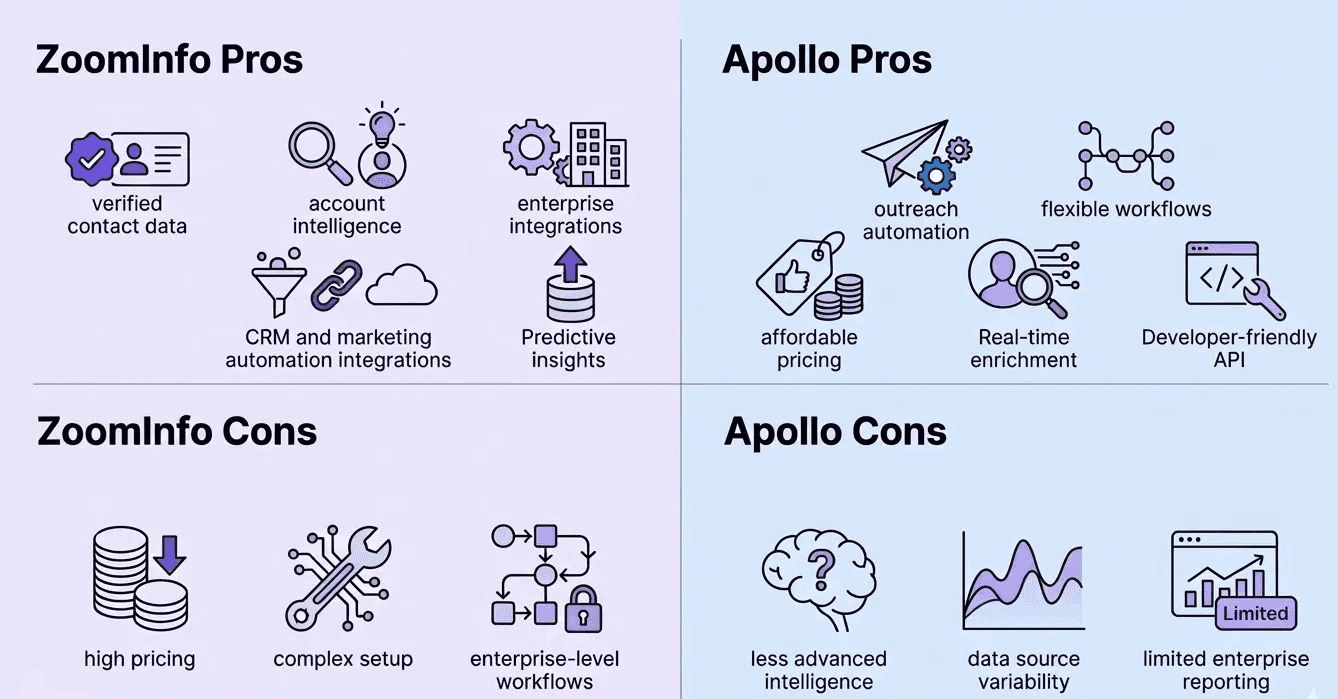
ZoomInfo and Apollo excel in different areas, so understanding their pros and cons helps clarify which tool aligns with specific workflows and team needs.
ZoomInfo Pros and Cons
Best for enterprise teams prioritizing verified data, ABM insights, and structured outreach.
Pros
- Verified and accurate data: High-quality contact and company information with firmographic validation.
- Account-level intelligence: Provides intent signals, buying committee visibility, and advanced segmentation.
- CRM and marketing automation integrations: Syncs seamlessly with Salesforce, HubSpot, Marketo, and Outreach.
- Predictive insights: AI-driven scoring and engagement analytics improve targeting efficiency.
- Enterprise scalability: Suitable for global teams with large account lists.
Cons
- High cost: Entry-level packages start around $12,000–$15,000 per year, making it less accessible for small teams.
- Contact-level limitations: Focused more on verified accounts and less on direct contact outreach flexibility.
- Complexity for smaller teams: Full value realized with multiple integrations and ABM campaigns active.
Apollo Pros and Cons
Optimized for growth teams and SDRs focused on automation and outreach efficiency.
Pros
- Outreach automation: Email sequences, multi-channel campaigns, and task management.
- Real-time enrichment: Provides up-to-date contact and company data on demand.
- Flexible workflows: Customizable pipelines and CRM-linked sequences for rapid campaign execution.
- Affordable and scalable: Subscription-based pricing with entry plans around $49–$79 per month (billed annually).
- Developer-friendly API: Enables embedding enrichment into internal systems or automation workflows.
Cons
- Limited ABM and account intelligence: Does not provide intent signals or enterprise-level segmentation.
- Data completeness depends on sources: Accuracy varies with public or CRM-sourced data.
- Advanced reporting is less robust: Smaller reporting and analytics capabilities compared to enterprise tools like ZoomInfo.
Which One Is a Better Option?
Deciding between ZoomInfo and Apollo depends on team priorities, workflow complexity, and budget. For enterprise sales, RevOps, and ABM-focused marketing teams that require verified contacts, firmographics, and intent signals, ZoomInfo is the better fit. For SDRs, growth teams, or mid-market organizations seeking automated multi-channel outreach and flexible enrichment workflows, Apollo offers the right balance of usability and affordability.
Some teams, however, need accurate contact and company data without the enterprise-level costs or complex setup of ZoomInfo, or the need to build custom automation pipelines like Apollo. In such cases, FullEnrich subtly fills that gap, offering more than 20 provider waterfall enrichment options on a pay-for-results basis.
Frequently Asked Questions (FAQs)
Which platform is better for ABM campaigns?
ZoomInfo is better suited for ABM because it provides verified contacts, account intelligence, intent signals, and segmentation tools. Apollo focuses more on automated outreach and enrichment, making it less ideal for ABM at scale.
Which tool is easier for non-technical teams?
ZoomInfo provides a user-friendly interface with dashboards, segmentation, and predictive scoring, ideal for marketing and RevOps teams. Apollo requires minimal technical skills but works best with CRM integrations and some workflow configuration.
How accurate is the data from each platform?
ZoomInfo offers verified contact and company data with high accuracy at both account and contact levels. Apollo provides real-time enrichment, but accuracy depends on public sources and CRM inputs.
Are these platforms scalable for growing teams?
Yes, in different ways. ZoomInfo scales for enterprise and mid-market teams with large account lists. Apollo scales through subscription tiers and automation, supporting growth teams and SDRs handling high-volume outreach.
What are the pricing expectations for each?
ZoomInfo typically starts around $12,000–$15,000 per year for mid-market packages. Apollo starts at $99–$149 per month, depending on outreach volume and enrichment usage.
Can these platforms integrate with my CRM?
Yes. ZoomInfo offers native integrations with Salesforce, HubSpot, Marketo, and Outreach. Apollo integrates with Salesforce, HubSpot, Pipedrive, Gmail, and Outlook to enable automated outreach sequences.
Is there an alternative for teams needing accurate data without a complex setup?
Yes. Data enrichment tools like FullEnrich provide verified contact and company data from 20+ providers, using a pay-for-results model, ideal for teams seeking reliable enrichment without enterprise-level complexity or custom automation.
Which tool is better for SDRs and outreach teams?
Apollo is more suited for SDRs and growth teams due to its automated sequences, CRM-linked enrichment, and multi-channel outreach capabilities. ZoomInfo is better for targeting high-value accounts and ABM initiatives.