
person-data-enrichmentB2B lead enrichment is the process of enhancing basic contact records with verified business intelligence from external data sources. It appends job titles, firmographics, technographics, direct phone numbers, and buying intent signals to incomplete CRM entries, transforming minimal contact details into sales-ready prospect profiles.
The core workflow involves contact matching, waterfall enrichment across multiple providers, email and phone verification, and CRM field mapping. For revenue teams running outbound, inbound, or account-based programs, lead enrichment determines whether your pipeline can actually execute.
What Is B2B Lead Enrichment?
B2B lead enrichment starts where lead capture ends. A prospect submits a form with their name, email, and company. Enrichment takes those three fields and automatically returns job title, seniority level, department, company size, revenue, technology stack, LinkedIn URL, verified phone number, and intent signals.
The difference between basic and enriched lead data determines whether a sales rep can act on a record immediately or spend the next 20 minutes manually researching before making first contact.
Basic Lead Data | Enriched Lead Data |
|---|---|
Name: Jennifer Martinez | Name: Jennifer Martinez |
Email: jmartinez@techsolutions.com | Email: jmartinez@techsolutions.com (verified, deliverable) |
Company: TechSolutions | Company: TechSolutions Inc |
Job Title: VP of Sales | |
Seniority: Executive | |
Department: Sales | |
Company Size: 250–500 employees | |
Revenue: $50M–$100M | |
Industry: Software | |
Location: Austin, TX | |
Direct Phone: +1-512-555-0123 | |
Mobile: +1-512-555-0124 | |
LinkedIn: linkedin.com/in/jennifermartinez | |
Technology Stack: Salesforce, HubSpot, Outreach | |
Intent Signals: Researching sales engagement platforms |
In B2B, this transformation matters more than in B2C. Purchase decisions involve multiple stakeholders, longer sales cycles, and higher deal values. A contact record without job title, buying authority, or verified contact details is functionally unusable for qualification or personalization.
What Types of Data Does B2B Lead Enrichment Cover?
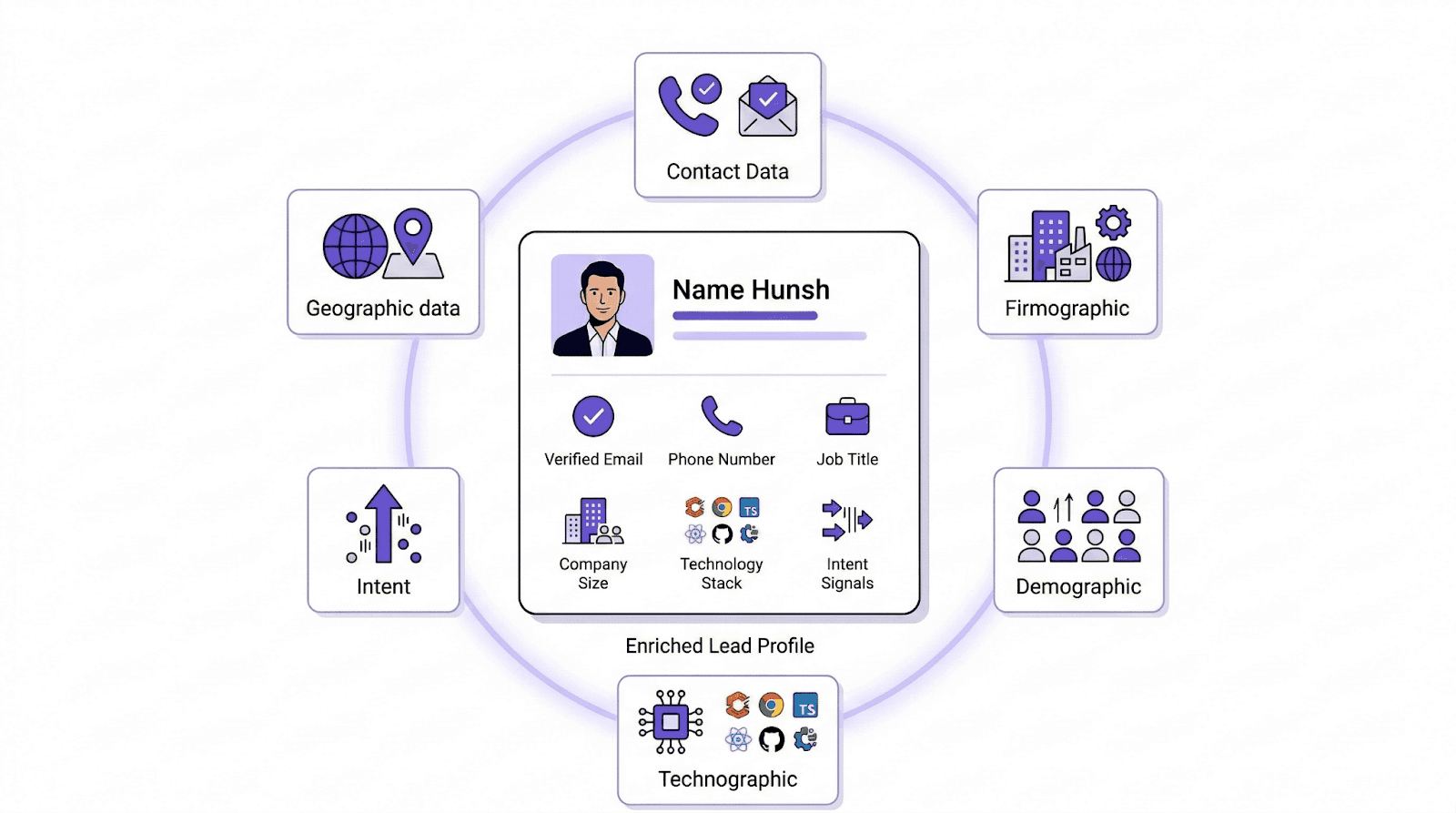
Enrichment combines six data categories into complete prospect intelligence.
Data Type | What It Includes | How It Powers Sales |
|---|---|---|
Contact Data | Verified emails, direct dial phones, mobile numbers, LinkedIn profiles | Enables actual outreach without guessing contact methods |
Firmographic Data | Company size, revenue, industry, location, structure, growth stage | Powers ICP matching, account prioritization, deal sizing |
Demographic Data | Job title, seniority, department, function, years of experience | Identifies decision makers vs. influencers, buying authority |
Technographic Data | Current technology stack, software usage, cloud platforms | Reveals competitive displacement and integration plays |
Intent Data | Research behavior, content consumption, competitor visits, buying signals | Separates hot prospects from contacts needing nurture |
Geographic Data | Office locations, regional HQ, market presence | Enables territory routing, localized messaging, timezone optimization |
Contact data is foundational. Without verified emails and working phone numbers, even well-qualified leads remain unreachable. Enrichment platforms verify deliverability before appending contacts, preventing bounce rates that damage sender reputation.
Firmographic data enables ICP matching at scale. Enriched company size and revenue data automatically filters prospects against your ideal customer profile criteria, letting enterprise reps focus on accounts above 1,000 employees while SMB reps engage smaller ones.
Demographic data reveals buying authority. A Director-level contact requires different messaging than a VP or C-suite executive who controls budget. Department context determines whether the contact evaluates your solution from an IT, finance, or operations perspective.
Technographic data shapes positioning. A prospect running a competitor's platform is a displacement opportunity. One using complementary tools is an integration play. One on legacy systems is a modernization conversation. Without technographics, every rep approaches every prospect with the same pitch.
Intent data adds timing precision. Not every ICP-fit prospect is ready to buy today. Intent signals identifying research behavior separate accounts actively evaluating solutions from those requiring long nurture cycles. High-intent prospects get immediate sales attention. Low-intent contacts stay in marketing programs until signals change.
Geographic data powers intelligent routing. European prospects route to reps familiar with GDPR compliance and regional business practices. Timezone data ensures outreach arrives during business hours, not midnight.
How Does B2B Lead Enrichment Work?
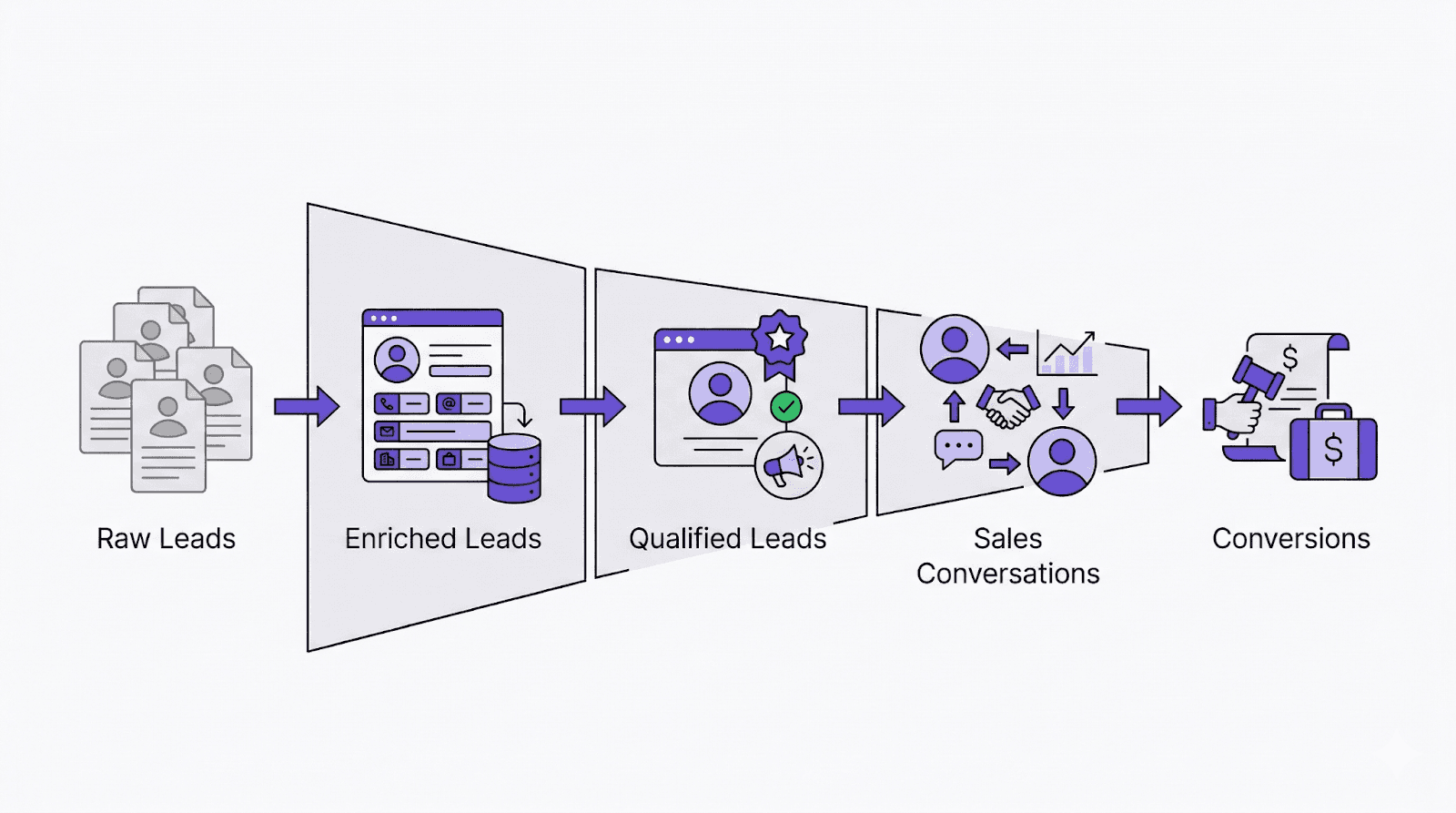
B2B lead enrichment work through 4 interconnected processes and understanding the enrichment workflow enables teams implement it effectively and diagnose coverage gaps when results fall short.
1. Lead Capture and Data Matching
The process begins when prospects submit basic information through forms, event registrations, content downloads, or sales interactions. At capture, you typically have a name, email, and sometimes a company name. This is enough to trigger enrichment but insufficient for qualification or personalized outreach.
Enrichment platforms match your record against their databases using whatever identifiers are available. Email domain matching links contacts to company records. When a lead's email shows @techcorp.com, the platform identifies TechCorp's firmographic profile and appends company size, revenue, industry, and location.
Name-plus-company matching locates specific individuals within organizations. LinkedIn URL matching provides the highest confidence match when profiles are available from social campaigns or Chrome extension captures.
Fuzzy matching handles name variations, calculating confidence scores so teams know match reliability before accepting enriched attributes.
2. Waterfall Enrichment Across Multiple Providers
Single-source enrichment queries one database and stops. If that provider lacks your contact, the record stays incomplete even though other sources may have full data.
Waterfall enrichment solves this. The platform sequences multiple providers until it finds a verified match or exhausts available sources. Submit 200 leads: Provider A returns data on 80.
The remaining 120 route automatically to Provider B, which finds 50 more. Provider C gets the remaining 70 and returns 35 additional matches. This continues across 20+ premium sources. The result: 165 enriched records at an 82% match rate versus 40% from a single source.
Geographic routing improves results further. European contacts route to providers with superior EU coverage. North American prospects hit databases strongest for that region. This intelligent sequencing maximizes match probability before exhausting the waterfall.
3. Verification and CRM Appending
Finding data is half the process. Platforms must verify accuracy before appending to your CRM because incorrect data corrupts campaigns faster than no data at all.
Email verification runs multiple checks: syntax validation, domain confirmation, live mailbox existence checks, catch-all server detection, and spam trap flagging. Only addresses passing all layers get appended. Phone verification confirms active carrier assignment, detects line type (mobile vs. landline vs. VoIP), and flags disconnected numbers.
After verification, platforms append enriched attributes through CRM integrations or API connections using field mapping rules. Smart mapping prevents enrichment from overwriting accurate manual data.
Enriched job titles only update when existing title fields are blank or visibly outdated. Enriched emails populate dedicated fields separate from primary contact fields reps have verified manually.
Real-time enrichment fires automatically when new leads enter the CRM. A prospect submits a form and within seconds, the record shows a complete profile. Batch enrichment handles existing CRM records in bulk, useful for database refresh projects or cleaning legacy data accumulated over years.
4. Continuous Data Refresh
Contact data decays at approximately 2.1% per month as people change jobs, companies get acquired, and phone numbers change. Without regular re-enrichment, even initially accurate records become unreliable within 6 to 12 months.
Quality enrichment platforms offer scheduled refresh cycles. Every 90 days, the system re-checks contacts against current databases, updating changed fields and flagging contacts who have moved to new companies.
Job change alerts notify sales teams when a champion at an existing account moves to a new organization. That transition is simultaneously a risk (losing an advocate) and an opportunity (expanding into a new account through an existing relationship).
Why Does B2B Lead Enrichment Improve Conversion?
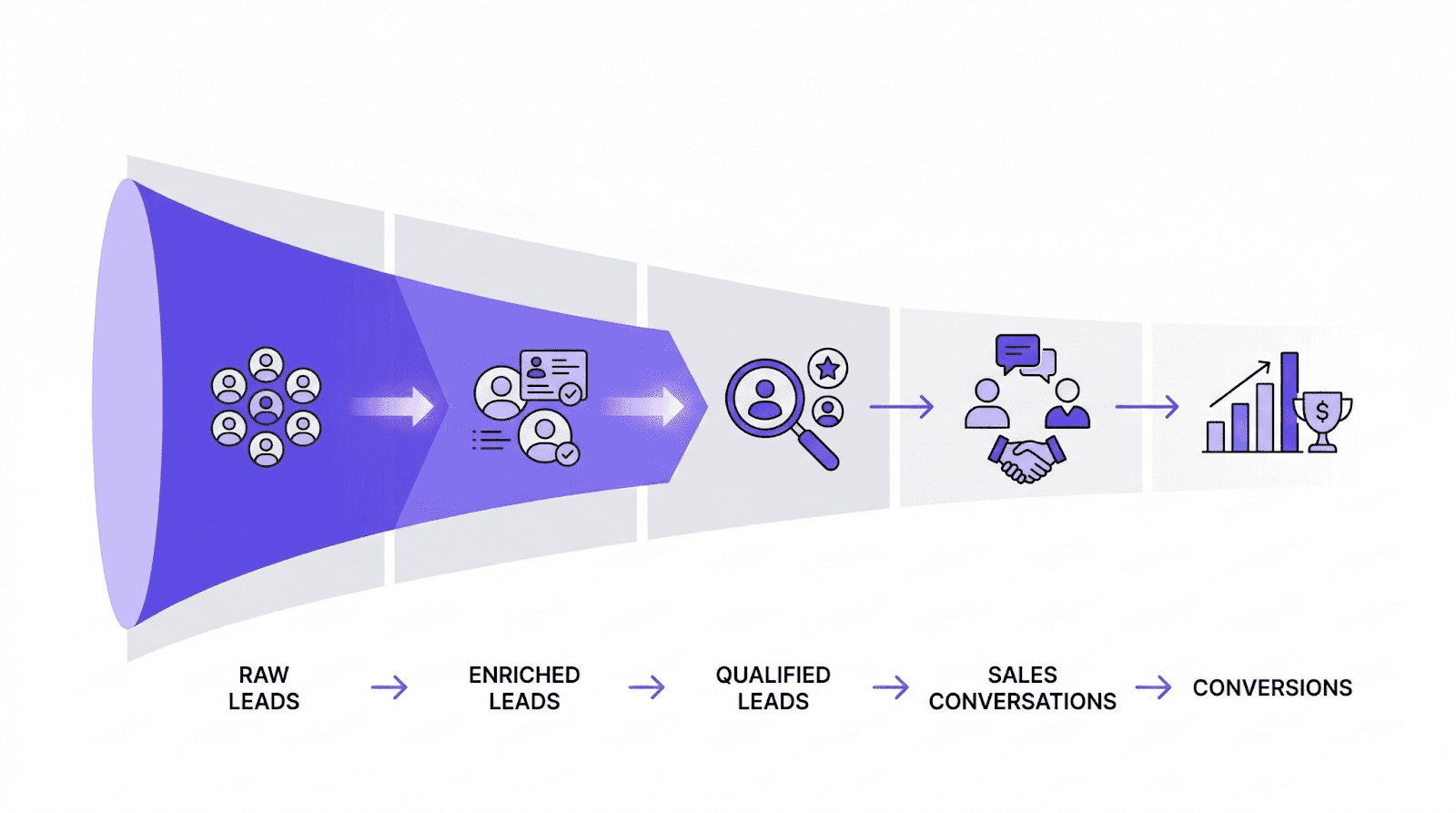
Higher response rates, better lead qualification, reduced manual research, better marketing and sales alignment are the results of B2B lead enrichment and they, in conjunction, improve conversion.
Higher Response Rates Through Personalization
Personalized emails deliver transaction rates six times higher than generic outreach, according to Experian research. Campaigns with advanced personalization beyond first-name insertion see reply rates up to 18%, compared to 9% for generic templates.
The gap exists because personalized outreach references specific technology stacks, recent company events, role-specific challenges, and buying signals that generic messaging cannot.
Enrichment provides the underlying data that makes this personalization possible. Without verified job titles, technographics, and firmographics, dynamic email templates have nothing to insert.
Better Lead Qualification and Scoring
Enriched firmographic and demographic data feeds lead scoring models with accurate inputs. Instead of scoring based on form fields alone, scoring rules incorporate company size, job title, seniority, industry, and intent signals. This precision routes high-value opportunities to sales immediately while keeping unqualified contacts in nurture programs.
Reduced Manual Research Burden
Sales professionals spend 70% of their working hours on tasks other than selling, according to Salesforce research. A significant portion of that time goes to manually researching prospects before outreach.
Enrichment eliminates this bottleneck by delivering complete intelligence automatically when a lead enters the CRM. Reps redirect that time toward conversations, demos, and follow-ups.
Improved ABM Campaign Performance
Account-based marketing depends entirely on accurate firmographic data, complete buying committee mapping, and intent signals. Without enrichment, ABM programs cannot identify target accounts at scale, map all relevant stakeholders within those accounts, or time engagement to match active buying windows. Enriched data transforms ABM from a theory into an executable program.
Better Marketing and Sales Alignment
Enriched data creates shared vocabulary between marketing and sales. Marketing segments campaigns using the same firmographic and demographic fields that sales uses to qualify leads.
Both teams operate from identical prospect intelligence rather than assumptions or incomplete data. Handoff quality improves when the criteria for "qualified" are grounded in verifiable attributes rather than subjective judgment.
How to Build an Effective B2B Lead Enrichment Workflow?
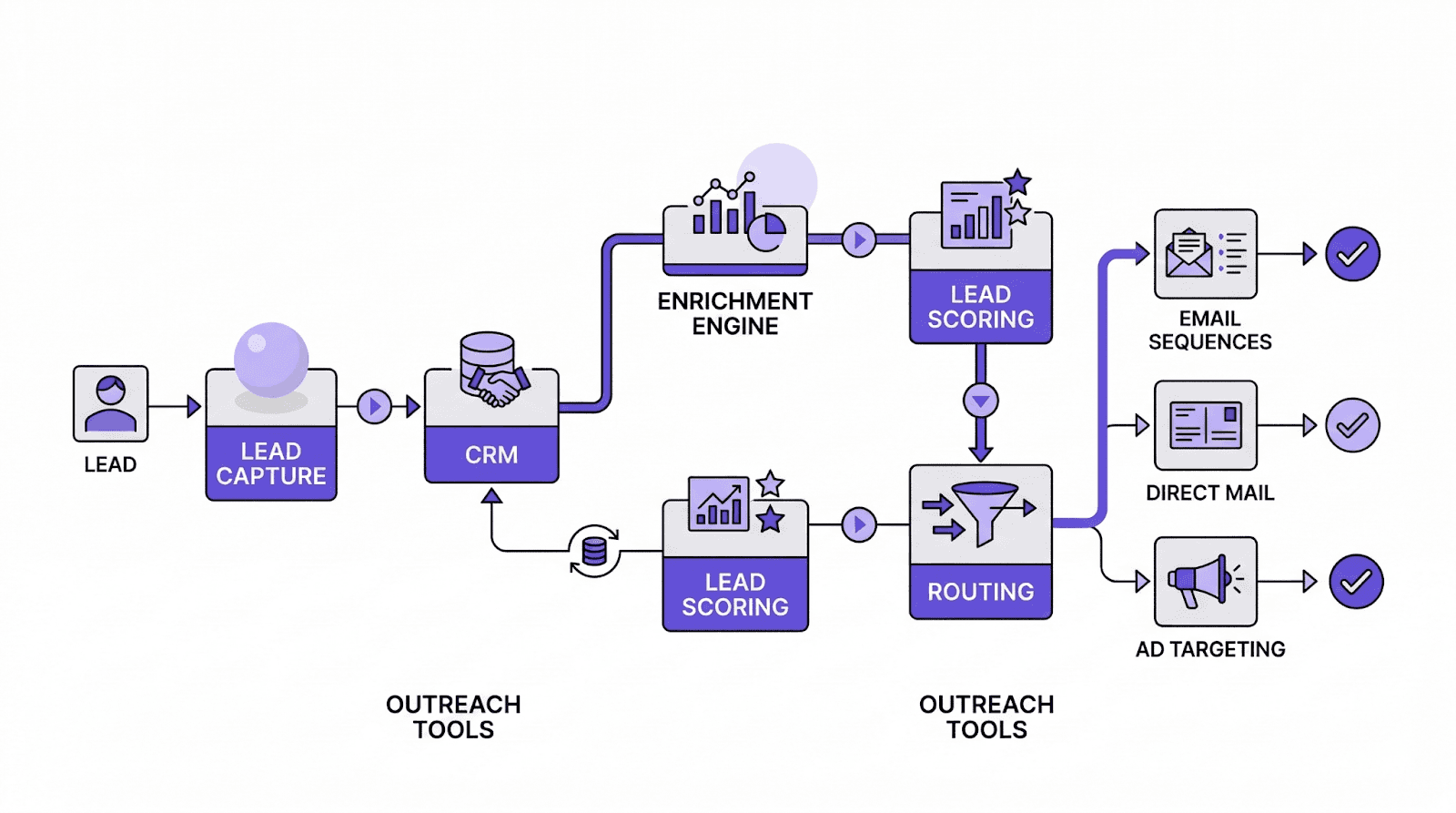
Most enrichment failures are configuration failures, not data failures. The wrong field priorities, loose overwrite logic, no quality thresholds, and poorly timed triggers all produce the same outcome: credits spent with no improvement to pipeline execution.
Configure Real-Time Enrichment First
Set enrichment to trigger automatically when new leads enter the CRM. Real-time enrichment enables immediate qualification and routing. Batch-only processing creates gaps between capture and action, and in competitive markets, slow follow-up loses deals. Real-time should be the default; batch processing handles backfill and refresh operations.
Set Data Quality Thresholds
Establish minimum confidence scores before accepting enriched attributes. Require 95%+ email deliverability and 90%+ phone connectivity before appending. Reject low-confidence matches to protect database quality. Enrichment platforms that charge only on verified, successful results make threshold enforcement economically straightforward.
Refresh Records Every 90 Days
At 2.1% monthly decay, a contact database loses a meaningful portion of accuracy within a quarter. Schedule automated refresh cycles for active contacts and high-priority accounts. Dormant contacts can refresh biannually. High-priority accounts merit quarterly re-checks.
Connect Enrichment to Routing and Scoring
Enrichment provides data. Qualification applies the logic. Connect enriched firmographics and demographics directly to scoring rules that route enterprise leads to senior reps, SMB leads to inside sales, and technical contacts to solutions engineers. Without this connection, enrichment improves data quality without improving revenue outcomes.
Protect Manual Data From Overwrite
Configure field mapping to preserve manually entered information when it contradicts enrichment output. If a rep verified a contact's job title through a direct conversation, automated enrichment should not overwrite it with a potentially outdated database record. Set overwrite rules to populate only blank or flagged fields.
Monitor Match Rates by Segment
Track enrichment success rates by lead source, geography, company size, and industry. Coverage gaps by segment reveal where additional providers or a waterfall architecture would improve match rates. Match rates consistently below 70% for a specific segment indicate that the current provider set is not optimized for that population.
How FullEnrich Handles B2B Lead Enrichment?
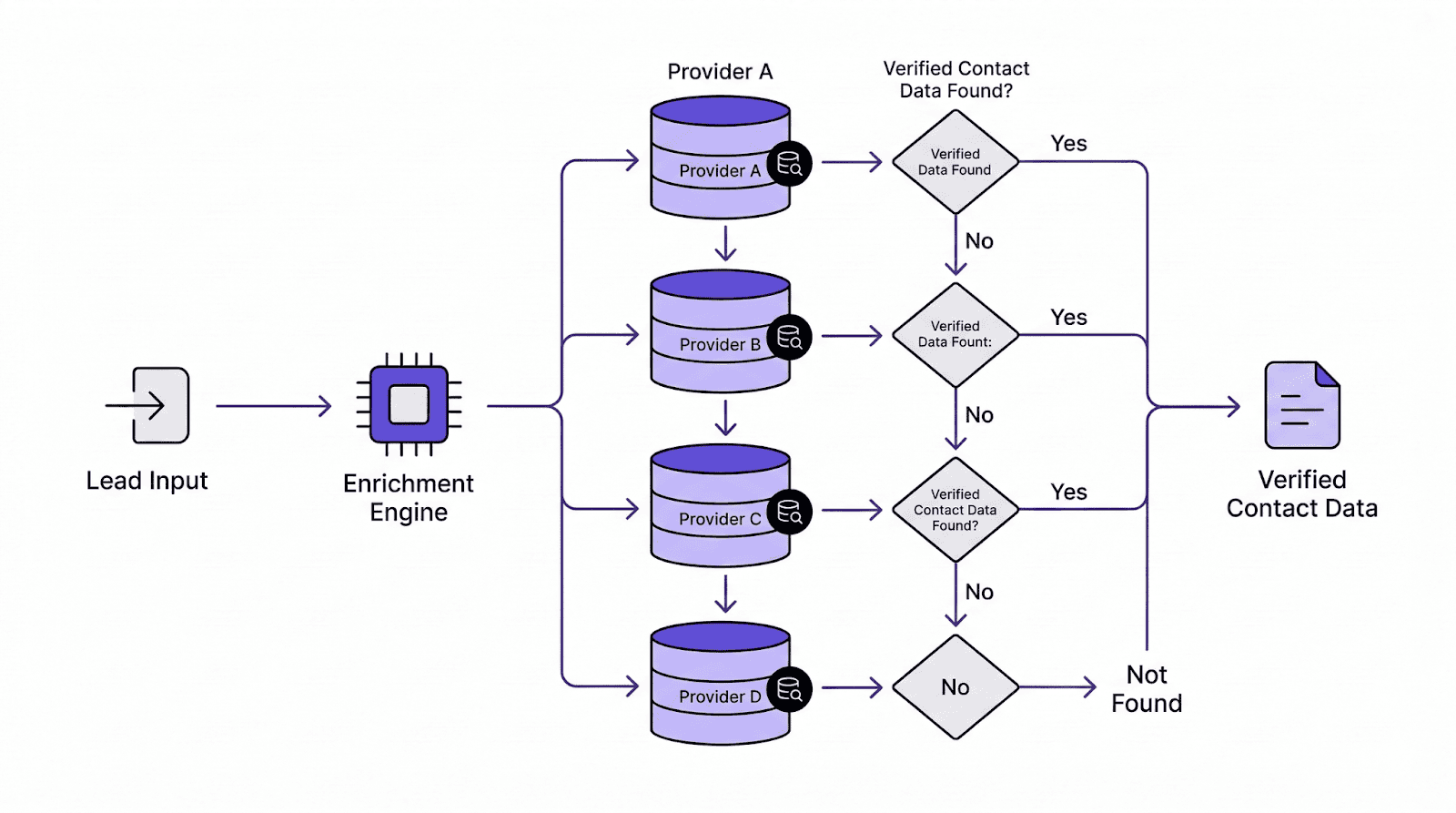
FullEnrich aggregates 20+ premium data providers in a waterfall sequence, querying each source until it returns a verified contact or exhausts available coverage. Find rates reach 89% for US emails and 86% for US mobile phones. EMEA coverage delivers 84% email and 71% phone match rates. LATAM reaches 78% email and 67% phone. APAC delivers 78% email and 66% phone.
Triple email verification checks live mail server records directly, producing bounce rates under 1%. Credits are charged only on successful enrichment, so failed lookups consume no budget. There are no seat fees, no per-user licensing costs, and no charges for enrichment attempts that return no result.
FullEnrich enriches via LinkedIn URL, name-plus-company, domain, CSV upload, or API. Reverse email lookup is available through the API for teams running inbound workflows. Native integrations cover HubSpot, Salesforce, and major sales engagement platforms.
Data is fetched on demand with no persistent storage of personal contact records, keeping operations aligned with GDPR, CCPA, and SOC 2 Type II compliance requirements.
Conclusion
B2B lead enrichment converts incomplete CRM records into actionable sales intelligence. It enables personalization that generic outreach cannot match, supports accurate lead scoring, and eliminates the manual research burden that keeps sales reps from selling.
The workflow requires real-time triggering, quality thresholds, scheduled refresh cycles, and tight integration with routing and scoring systems to translate data quality into revenue outcomes.
Frequently Asked Questions
What is the difference between lead enrichment and data enrichment?
Lead enrichment specifically targets sales and marketing contact records, appending attributes that enable qualification and personalized outreach. Data enrichment is a broader category covering any process that enhances existing data with additional information, including customer data, product data, or transactional records outside sales contexts.
How often should lead data be refreshed?
Active contacts should refresh every 90 days. Contact data decays at approximately 2.1% per month, meaning a contact database loses meaningful accuracy within a quarter without re-enrichment. High-priority accounts merit quarterly refresh. Dormant contacts can refresh biannually. Real-time enrichment should fire automatically when new leads enter the CRM.
What is waterfall enrichment and why does it matter?
Waterfall enrichment sequences multiple data providers until a verified match is found, rather than querying one database and stopping. Single-source platforms achieve 40–50% match rates. Waterfall platforms consistently reach 80–85% by routing unmatched contacts through additional providers automatically.
What inputs does B2B lead enrichment require?
Most platforms accept email address, name-plus-company, LinkedIn URL, or domain as matching inputs. CSV upload handles bulk operations. API access enables programmatic enrichment for product-embedded workflows. The minimum viable input for most providers is an email address or a full name with a company name or domain.
How do I diagnose a low match rate?
Low match rates are usually a geographic or segment mismatch between your ICP and your enrichment provider's database. Break match rates down by region, company size, and industry. European SMBs, APAC companies, and highly specialized industries typically underperform on US-centric single-source databases. Waterfall architecture and provider selection optimized for your target geography resolve most coverage gaps.
Does B2B lead enrichment support ABM programs?
Yes. ABM depends on accurate firmographic data for account selection, complete contact maps for buying committee coverage, and intent signals for timing. Enrichment delivers all three. Without it, ABM programs rely on manual research that does not scale beyond small target account lists.
Is lead enrichment GDPR compliant?
Compliance depends on the platform's architecture. Platforms that maintain static databases of personal contact records carry higher GDPR exposure. Platforms that fetch data on demand without persistent storage align more closely with data minimization principles. Confirm SOC 2 Type II certification, GDPR compliance documentation, and CCPA alignment before committing to any platform that handles EU personal data.