ZoomInfo and 6sense are two leading B2B platforms, but they serve distinct purposes.
ZoomInfo is primarily a comprehensive contact database with verified emails, direct dials, and company intelligence.
6sense is an account engagement and revenue intelligence platform, focused on predictive analytics, intent data, and multi-channel account orchestration.
While ZoomInfo excels in direct contact data and lead-level enrichment, 6sense excels in account-level insights, intent scoring, and predictive targeting.
ZoomInfo is generally faster to deploy for SDR and sales team prospecting, while 6sense requires more setup to integrate intent signals, predictive scoring, and campaign orchestration.
Key Takeaways
- ZoomInfo serves as the definitive Sales Intelligence engine for teams that prioritize direct access and outreach velocity. Its primary strength lies in its vast, searchable directory of verified mobile numbers and professional email addresses.
- 6sense functions as a sophisticated Account-Based Marketing (ABM) Orchestration platform. Unlike a standard database, it focuses on the "Dark Funnel" by uncovering anonymous research behavior and predicting which accounts are in-market.
- FullEnrich provides a high-efficiency Data Waterfall solution that bridges the gap between these two enterprise heavyweights. By querying over 20 premium data providers in real time, it offers a cost-effective alternative for teams that require the same (or superior) mobile hit rates as ZoomInfo.
ZoomInfo vs 6sense: Side-by-Side Comparison
Here’s a detailed comparison of ZoomInfo and 6sense across key attributes, highlighting their differences and ideal use cases:
Attributes | ZoomInfo | 6sense |
|---|---|---|
Best For | SDRs, sales reps, and marketing teams need verified contact data and company intelligence | ABM teams, marketing ops, and revenue operations teams need predictive account engagement and intent insights |
Core Focus | B2B contact database, lead enrichment, and outbound prospecting | Account engagement, intent data, predictive analytics, and multi-channel campaign orchestration |
Primary Users | Sales teams, SDRs, marketing teams | ABM specialists, marketing ops, revenue operations, and sales leaders |
Data Source | Proprietary B2B datasets, verified emails, phone numbers, and company intelligence | Behavioural data, intent signals, predictive analytics models, and historical account activity |
Automation Level | Moderate; automation mostly in enrichment and CRM sync | High; AI-driven account scoring, intent alerts, and multi-channel engagement |
Pricing Model | Custom Pricing: Estimated around ~$15,000 yearly platform fee + ~$1,500 per user starting price | Custom Pricing: Estimated around $50K–$80K per year |
Integration | CRM integration (Salesforce, HubSpot, etc.), APIs | CRM integration, marketing automation platforms, ABM tools, and analytics platforms |
Data Compliance | GDPR, CCPA, and global data compliance for contact outreach | GDPR and CCPA compliant; |
Support | Email, chat, knowledge base, and dedicated account managers for enterprise | Email, chat, knowledge base, and dedicated customer success for enterprise clients |
What is ZoomInfo?
ZoomInfo is a B2B contact and company intelligence platform that provides verified emails, direct dials, and detailed company profiles. It helps sales and marketing teams identify prospects, enrich lead data, and improve the efficiency of outbound outreach. ZoomInfo is ideal for teams focused on lead-level prospecting, CRM enrichment, and data-driven outreach.
What is 6sense?
6sense is an account engagement and revenue intelligence platform that leverages AI, predictive analytics, and intent data to prioritize high-value accounts and orchestrate multi-channel campaigns. It provides predictive scoring, intent signals, and engagement insights to accelerate pipeline conversion. 6sense is ideal for teams running strategic ABM campaigns across multiple channels and markets.
What Services Do ZoomInfo and 6sense Offer?
ZoomInfo and 6sense serve different purposes in B2B growth strategies. ZoomInfo focuses on direct contact data, lead enrichment, and outbound prospecting, while 6sense focuses on predictive account engagement, intent data, and ABM campaign orchestration.
Services Offered by ZoomInfo
ZoomInfo operates as a comprehensive "Go-To-Market" (GTM) intelligence platform. Its service model is centered on providing a deep, 360-degree view of corporate structures and market movements, allowing enterprise sales and marketing teams to coordinate their outreach with extreme precision.
- ZoomInfo SalesOS: Their flagship service for sales teams. It provides a centralized hub for finding prospects, mapping out organizational charts, and using "Copilot," their AI-led service, to summarize accounts and suggest the best time to reach out based on real-time buying signals.
- ZoomInfo MarketingOS: A dedicated service for demand generation. It focuses on turning cold data into warm leads by de-anonymizing website visitors and triggering cross-channel advertising campaigns specifically targeting accounts already showing interest.
- ZoomInfo OperationsOS: A specialized data management service. It acts as a "cleaner" for your company’s internal records, providing automated deduplication, lead routing, and continuous data enrichment to ensure your CRM stays accurate and actionable.
- ZoomInfo TalentOS: A dedicated recruitment service. This helps HR and talent acquisition teams find candidates based on specific professional history, skill sets, and even "hiring signals."
Services Offered by 6sense
6sense provides a "Revenue AI" service model. Instead of just giving you a list of names, their services are built to predict which accounts are in a buying cycle and provide the orchestration tools to capture that revenue.
- Predictive Intent & "Dark Funnel" Discovery: The core service of 6sense is identifying anonymous research behavior across the web. They provide a "Signalverse" service that monitors billions of data points to find the 3% of your market that is actually looking to buy right now.
- Account-Based Marketing (ABM) Orchestration: 6sense acts as a strategic execution service for ABM. They provide the infrastructure to launch hyper-targeted display ads and personalized web experiences aimed specifically at the high-value accounts their AI has identified as "ready to buy."
- 6sense Sales Intelligence: A specialized service for sales development. It delivers "Prioritization Dashboards" to reps, telling them exactly which accounts to call today and providing the specific keywords those accounts have been researching.
Key Features of ZoomInfo vs 6sense
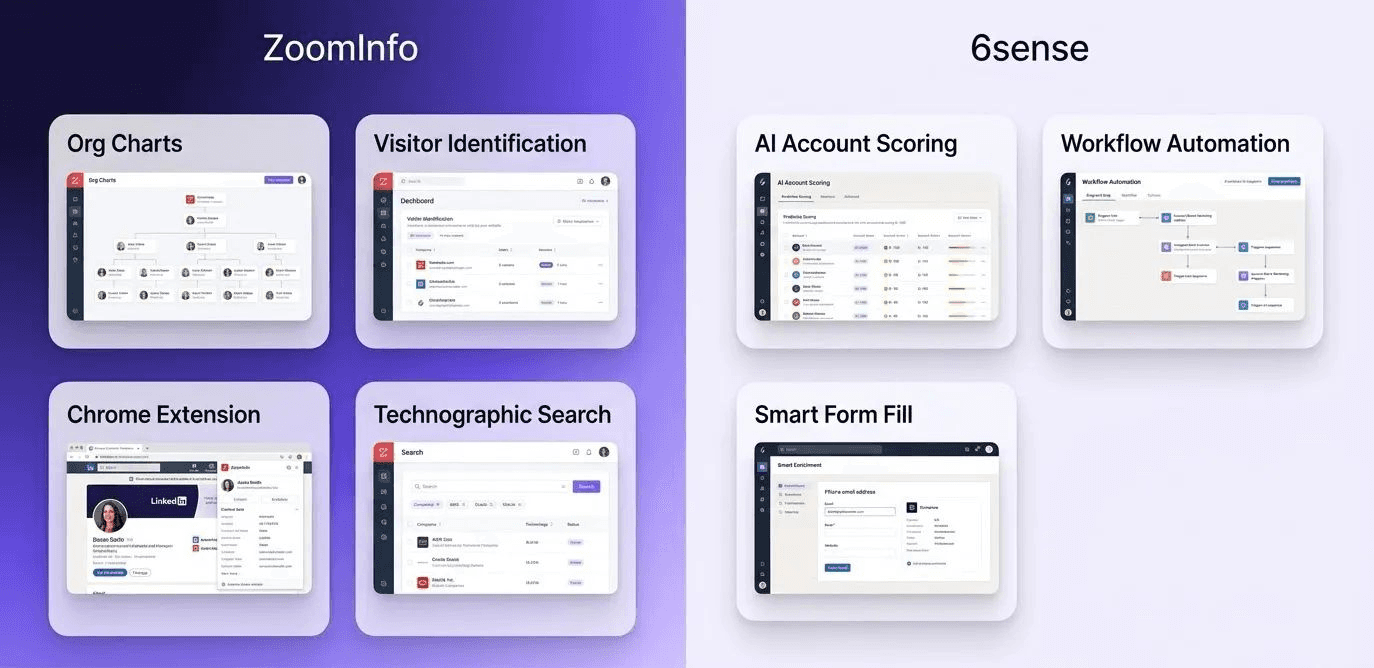
ZoomInfo and 6sense focus on different aspects of B2B growth. ZoomInfo emphasizes verified contact data and lead enrichment, while 6sense emphasizes predictive account engagement, intent signals, and multi-channel ABM orchestration.
Key Features of ZoomInfo
ZoomInfo’s technical features are designed to provide granular control over how your team interacts with its massive database. While the services focus on high-level "Operating Systems," these features are the specific, functional components that allow a rep to filter through millions of data points to find the exact person they need.
- Dynamic Org Charts & Reporting Lines: This visual mapping feature reconstructs a company's internal structure. It doesn't just list names; it shows you exactly who reports to the VP of Marketing or who the key gatekeepers are.
- WebSights Visitor Deanonymization: This technical tool acts as a "caller ID" for your website. It uses reverse IP lookup to identify the specific companies visiting your site and provides a dashboard showing which pages they viewed.
- The "ReachOut" Chrome Extension: This feature acts as a technical bridge between your browser and your CRM. When you are on a LinkedIn profile or a corporate website, the extension "overlays" ZoomInfo’s data.
- Technographic Search Filters: This feature allows you to "peer" into a company's tech stack. You can build lists based on the specific software a company uses, such as finding every account currently using Oracle or AWS.
Key Features of 6sense
The features within 6sense are built around predictive logic and automation. These are the technical "engines" that sit behind the platform’s ABM services, designed to interpret complex buyer behavior and turn it into a clear, prioritized list of actions for your revenue team.
- 6AI Account Scoring: This proprietary machine-learning feature assigns a score (0-100) to each account in your database. It doesn't just look at "fit"; it layers intent and engagement data to predict how likely an account is to buy in the next 30, 60, or 90 days.
- Intelligent Workflows (Canvas): This is a drag-and-drop orchestration feature. It allows you to build complex "If-This-Then-That" paths. For example, "If an account researches a competitor and visits our pricing page, automatically trigger a high-priority alert for the SDR and launch a targeted display ad."
- Smart Form Fill (Form Enrichment): This feature addresses the "friction" caused by long B2B forms. Instead of asking a prospect for ten pieces of information, you only ask for their business email. As they type, 6sense's technical engine performs a real-time database lookup and "ghost-fills" hidden fields such as company size, industry, and tech stack.
How Accurate Is the Data from ZoomInfo and 6sense?
Data accuracy is critical for prospecting, engagement, and ROI. ZoomInfo and 6sense approach accuracy differently: ZoomInfo emphasizes verified contacts and company intelligence, whereas 6sense emphasizes predictive account signals and intent data to provide account-level insights.
ZoomInfo Data Accuracy
ZoomInfo is the industry heavyweight for North American contact volume, relying on a massive contributor network and machine learning to maintain over 260 million profiles. While it is the gold standard for direct-dial accuracy and firmographic depth, its sheer scale means it occasionally battles "data decay" as professionals change roles in real-time. According to G2, ZoomInfo maintains a strong 4.5/5-star rating. Users consistently praise its unmatched ability to find the right person and a verified phone number in the U.S. market.
Also Read: 15 Best ZoomInfo Competitors & Alternatives
6sense Data Accuracy
6sense prioritizes "predictive accuracy" over raw contact lists, focusing its data engine on de-anonymizing the "Dark Funnel" to identify which accounts are researching your solution. It excels at identifying companies ready to buy, though it often relies on third-party partnerships to provide individual emails and phone numbers for people at those companies. It currently holds a 4.0/5-star rating on G2, where it is celebrated for its AI-driven intent signals that tell sales teams exactly when an account is in a buying cycle.
Which Platform Offers the Most Intuitive User Experience?
User experience determines how efficiently teams can leverage each platform for prospecting and account engagement. ZoomInfo emphasizes ease of access to verified leads and company data, whereas 6sense emphasizes account orchestration, predictive insights, and ABM campaign workflows.
ZoomInfo User Experience
ZoomInfo provides a clean, intuitive dashboard where users can search for contacts, filter by firmographics, and export lists directly to CRMs. Alerts notify teams of company growth, funding events, or prospect activity. Onboarding is quick and requires minimal technical setup, making it ideal for SDRs, sales reps, and marketing teams.
6sense User Experience
6sense provides a comprehensive interface designed for account-level targeting. Users can configure predictive scoring, monitor intent signals, and orchestrate multi-channel campaigns. Onboarding requires more configuration, including integrating intent sources, setting scoring thresholds, and linking CRM/marketing automation tools.
6sense is best suited for ABM teams, marketing ops, and revenue operations who require structured workflows, predictive insights, and coordinated campaigns across channels.
Pricing and Plans
Pricing determines accessibility, scalability, and ROI. ZoomInfo uses a subscription-based model focused on user seats and features, while 6sense uses a custom subscription model based on accounts, modules, and predictive analytics capabilities.
ZoomInfo Pricing Plans
ZoomInfo operates almost exclusively on custom-quoted annual contracts. While they are known for premium pricing, they are also open to negotiation.
ZoomInfo Lite (Free): A free entry point that provides 10 to 25 contacts per month. It’s a great way for solo reps to test the data quality before committing to a paid tier.
Professional (Estimated $14,995/year): The standard "starter" pack for small sales teams. It provides core contact data and basic search filters, but limits the more advanced "intent" signals.
Advanced (Estimated $24,995/year): A mid-tier option that unlocks deeper company intelligence, including technographics and more automated workflow triggers.
Elite (Estimated $39,995+/year): The top-tier plan for enterprise teams. This includes the full suite of "SalesOS" features, real-time intent alerts, and deep organizational mapping.
Hidden Costs & Add-ons: Be aware that adding specialized features, such as an extra user, could cost an additional $2,500 per year. Additionally, credit overages for extra exports can vary from $0.60 to $3.00 per contact.
6sense Pricing Plans
6sense follows a similar enterprise-first model where pricing is tailored to your "Total Addressable Market" (TAM) size and the volume of accounts you want to track.
6sense Free ($0): Free tier that offers 50 credits per month and access to their Chrome extension for 1:1 prospecting.
Team/Growth Tiers (Estimated $15,000 – $80,000/year): These mid-market contracts are designed for teams moving into Account-Based Marketing. The price scales based on the number of "in-market" accounts the AI is tracking for you.
Enterprise Suite (Estimated $100,000 – $200,000+/year): This is for large-scale organizations requiring the full "Revenue AI" suite. It includes advanced predictive modeling, cross-channel ad orchestration, and deep integration across the entire global GTM stack.
Negotiation: Like ZoomInfo, 6sense prices are not set in stone. Professional buyers can often negotiate better rates by committing to multi-year deals or by leveraging their current seat count during the end-of-quarter sales cycles.
Who Should Use ZoomInfo vs. 6sense?
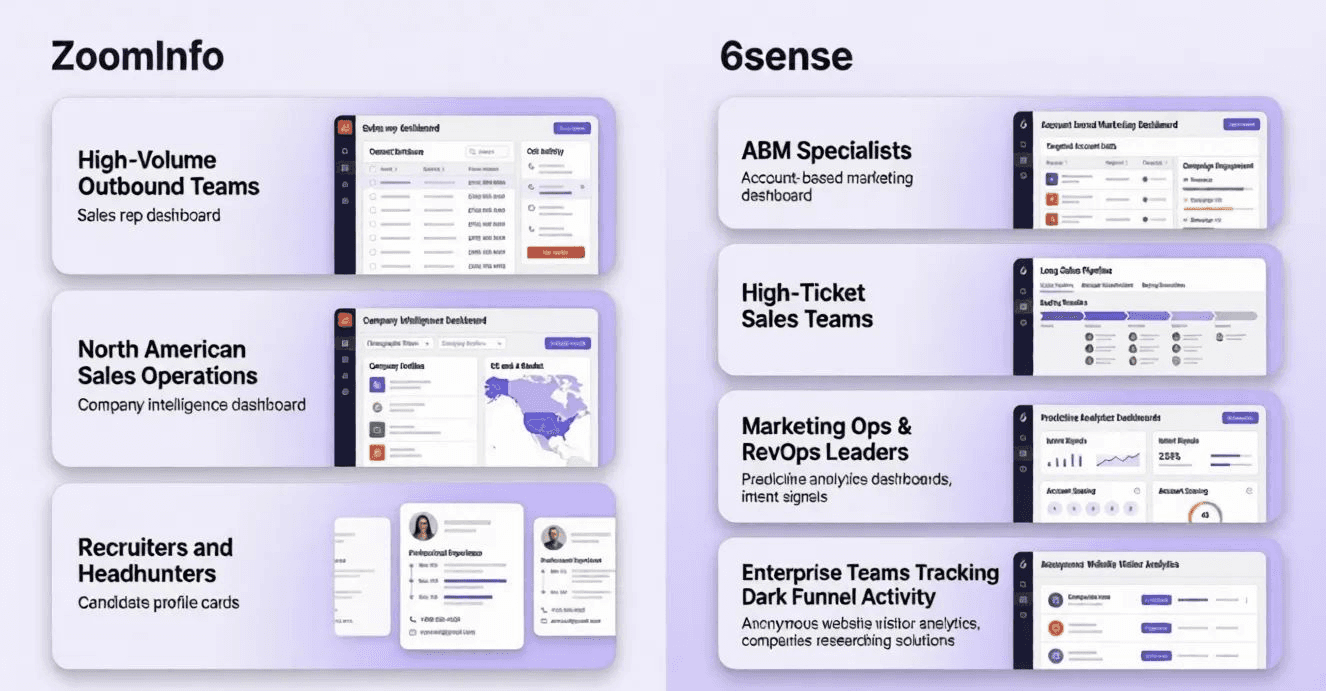
The selection of these platforms depends on whether your priority is to build a list of people to contact immediately or to identify a list of companies already showing interest in your solution. One is a high-volume contact engine, while the other is a strategic radar for buyer intent.
Who Should Use ZoomInfo?
ZoomInfo is the ideal choice for sales organizations that rely on high-velocity outreach and direct prospecting. It is built for teams that need to find the right person and get them on the phone as quickly as possible.
- High-Volume Outbound Teams: If your success depends on SDRs making 50+ dials a day, ZoomInfo is necessary for its massive library of verified mobile numbers and direct emails.
- North American Sales Operations: Organizations focused on growth in the US and Canada will find ZoomInfo’s database depth the most comprehensive in the market.
- Recruiters and Headhunters: Because of its deep professional profiles, it’s a top-tier tool for talent acquisition teams seeking candidates with very specific career histories.
Who Should Use 6sense?
6sense is designed for sophisticated marketing and "Revenue Operations" teams that want to move away from cold calling everyone and move toward "warm" calling the right accounts. It is built for collaboration between sales and marketing.
- Account-Based Marketing (ABM) Specialists: If your strategy involves targeting 100 high-value accounts with personalized ads and content, 6sense provides the orchestration tools to manage that at scale.
- Teams Selling High-Ticket Items: When your sales cycle lasts 6–12 months and involves a large buying committee, 6sense helps you track the entire company's research behavior over time.
- Marketing Ops and RevOps Leaders: Ideal for those who want to use AI to predict which accounts are "in-market" so they can allocate their advertising budget only to companies that are actually looking to buy.
- Enterprise Organizations with Large "Dark Funnels": If you have a lot of anonymous traffic on your site and want to know which major corporations are lurking there without having to fill out forms, 6sense is the best tool to de-anonymize that data.
Pros and Cons of ZoomInfo vs 6sense
Assessing the strengths and limitations of each platform helps teams align capabilities with outreach goals. ZoomInfo emphasizes lead-level enrichment and verified contacts, while 6sense emphasizes predictive account engagement, intent data, and ABM orchestration.
ZoomInfo Pros and Cons
ZoomInfo is most effective for teams that prioritize rapid access to verified contacts and outbound prospecting.
Pros
- Extensive verified database: Millions of emails, direct dials, and company profiles.
- Lead enrichment: Append missing contact and firmographic data.
- CRM integration: Sync data smoothly with Salesforce, HubSpot, and other platforms.
- Alerts and notifications: Track company growth, funding events, or prospect activity.
- Quick onboarding: Minimal setup lets teams start outbound campaigns quickly.
Cons
- Limited predictive account intelligence: Focuses on leads rather than account-level insights.
- Moderate automation: Primarily in enrichment and CRM sync, not multi-channel orchestration.
- Subscription cost: May be high for teams needing multiple user seats or expanded datasets.
6sense Pros and Cons
6sense is most effective for teams that prioritize account-level insights, predictive scoring, and strategic ABM execution.
Pros
- Predictive account scoring: Prioritizes high-value accounts likely to convert.
- Intent-driven engagement: Monitors buying signals across multiple channels.
- Multi-channel campaigns: Align sales and marketing to drive ABM.
- Advanced analytics: Tracks pipeline acceleration and campaign ROI.
- Scalable for enterprises: Supports large ABM programs with predictive insights.
Cons
- Higher setup complexity: Requires integration of intent signals, scoring, and orchestration workflows.
- Custom pricing: Subscription costs depend on the selected accounts and modules.
- Steeper learning curve: Teams need training to manage predictive analytics and ABM campaigns.
Which One Is a Better Option?
If your daily goal is to get your reps on the phone with as many verified decision-makers as possible, ZoomInfo is the right move. It’s built for the "hunt," giving you the direct dials and email addresses needed to fill a CRM and start outbound sequences immediately. It's the standard for North American teams that just need the data available when they search for it.
However, if your strategy is built around Account-Based Marketing (ABM) and you want to stop guessing which companies are interested in you, 6sense is the stronger play. It’s designed to help you catch the "Dark Funnel" signals so you can prioritize your time on the 3% of your market that is actually looking to buy right now.
For teams that want the best of both worlds without the massive enterprise price tag or the rigid annual contracts, FullEnrich offers a smarter way to work. Instead of locking you into one database, we use a "waterfall" approach to pull and verify data from 20+ premium providers in real-time.
Frequently Asked Questions (FAQs)
Which platform is better for lead-level prospecting?
ZoomInfo is well-suited for lead-level prospecting because it provides verified email addresses, direct dials, and company intelligence, enabling SDRs and sales representatives to quickly identify and contact prospects.
Which platform is better for account-based marketing (ABM)?
6sense is designed for ABM, using predictive scoring, intent signals, and multi-channel engagement to prioritize high-value accounts and orchestrate campaigns across email, calls, and digital channels.
Can these platforms integrate with CRM systems?
Yes. Both ZoomInfo and 6sense integrate with CRM platforms such as Salesforce and HubSpot. ZoomInfo focuses on syncing contact and lead data, while 6sense integrates predictive account insights and campaign tracking.
How do ZoomInfo and 6sense handle intent data?
ZoomInfo provides basic intent signals for contacts and companies, useful for outbound prioritization. 6sense provides advanced, AI-driven account intent scoring for ABM campaigns, highlighting accounts most likely to convert.
Which platform is easier for small teams or startups?
ZoomInfo is easier to deploy for small teams because it requires minimal setup and provides immediate access to verified contacts. 6sense is better suited for mid-market or enterprise teams running structured ABM programs.
Which platform delivers faster ROI?
ZoomInfo typically delivers faster short-term ROI for sales outreach due to immediate access to leads. 6sense delivers longer-term ROI by accelerating account-level pipeline conversion through predictive insights.
Is there an alternative that combines lead-level accuracy with multi-provider flexibility?
FullEnrich offers a practical alternative for teams seeking multi-provider verified enrichment. It consolidates data from multiple sources, validates contacts in real time, and supports pay-for-results workflows, providing both lead-level accuracy and operational flexibility.
Which platform is better for international prospecting?
ZoomInfo has strong coverage in the US and EU, but may be limited elsewhere. 6sense focuses on accounts and intent signals globally, though its effectiveness depends on the quality of target account datasets. FullEnrich supports multi-provider enrichment to provide broader international coverage.