An enrichment API is an endpoint you call with a name, a domain, an email or a LinkedIn URL, and it sends back contact and company data. All ten tools here do that. They differ in the details a feature grid hides. Some bill you when they find nothing. Some verify an email before returning it, and some return whatever their database holds. Some answer inside the same request, while others call a webhook later. Some hand you a key at signup, and some start with a demo request.
This list compares ten enrichment APIs on six points: API access, what comes back, billing on a miss, speed and limits, MCP support and price. A comparison table, a pricing breakdown and a 30-minute test follow. One disclosure: FullEnrich is our product and sits at #1, and every other entry says plainly where that tool beats us.
Key Takeaways
- Check how an API bills a miss before you compare price lists. FullEnrich, Hunter and People Data Labs charge only for matches, RocketReach refunds unverified lookups, and Lusha charges a minimum credit per request.
- List price per record found and cost per usable record are different numbers. Misses, verification and coverage on your own list decide the second one.
- Synchronous APIs like People Data Labs, Lusha and Hunter suit instant form enrichment. FullEnrich's Enrich API is asynchronous and returns results by webhook.
- Six of the ten tools list an MCP server for AI agents: FullEnrich, ZoomInfo, Apollo, Cognism, Lusha and Hunter.
- Clay is an orchestration layer that calls other data vendors, FullEnrich included, so it sits beside the other nine instead of competing record for record.
What Is an Enrichment API?
An enrichment API is a programmatic endpoint that turns a partial record into a fuller one, with nobody opening a UI. You send an identifier, such as a name plus company, a work email or a LinkedIn URL. You get back fields like a work email, a mobile number, a job title and company details.
Scope varies a lot between vendors. FullEnrich exposes three APIs: Enrich for contact details, Reverse Email Lookup to turn an email into a profile, and Search to find new people and companies. Hunter's API covers email only. Clay has a public API too, but it triggers other vendors' data instead of serving one dataset of its own. If you want the category basics first, our guide to the data enrichment API covers them.
What Data Does an Enrichment API Return?
Most enrichment APIs return some mix of five data types: work emails, personal emails, mobile numbers, company firmographics and person attributes. None of the ten tools here returns all five at the same depth, and each type carries its own price.
Work Emails
A work email lookup returns an address plus a verification status, and the status tells you how much to trust the address. FullEnrich's DELIVERABLE emails carry about a 2% bounce rate, HIGH_PROBABILITY about 9%, and CATCH_ALL a higher rate still. All three cost 1 credit when found, per FullEnrich's credit documentation. So catch-all emails get billed too, which is why this article says "emails found" when it compares billing.
Personal Emails
Fewer APIs return personal addresses like Gmail or Outlook, and the ones that do price them higher. FullEnrich runs a separate waterfall for personal emails and charges 3 credits per address found, against 1 for a work email. Personal emails suit recruiting outreach to one specific candidate, and they aren't meant for cold prospecting or ad targeting.
Mobile Phone Numbers
A mobile number helps only if it's really a mobile, it's active and it belongs to your contact, which is why phone data costs more everywhere. FullEnrich charges 10 credits per mobile found and nothing for a landline. It checks each phone for landlines and out-of-service status, and matches the owner's name in the US and Canada. Apollo adds 8 credits when a mobile comes back from its own data. Lusha charges 5 credits per phone number.
Company Firmographics
A company enrichment API returns firmographic fields like industry, headcount and location, and most contact enrich calls include them at little or no extra cost. FullEnrich includes the person and company profile free with any enrichment, or charges 0.25 credits for it on its own. Lusha charges 1 credit for company info. ZoomInfo's enrich endpoints return up to 25 contact or company records per call, from a dataset its docs put at 100M+ companies.
Person and Job Attributes
Job title, seniority and similar professional details usually ride along with a contact lookup, and they drive routing and segmentation. Apollo bundles demographics with the email at 1 credit. FullEnrich returns professional details with each contact at no extra charge. If you start from an email and need the person behind it, reverse email lookup runs the other way for 1 credit.
How Do You Evaluate an Enrichment API?
You evaluate an enrichment API on six things: coverage on your list, verification, speed, geographic fit, pricing model and integration depth. Price is one of the six, and it's rarely the one that decides.
Coverage and Match Rate
Match rate depends on your geography and personas more than on any number a vendor publishes. FullEnrich's pricing page puts its email find rate at about 80% on average, and that figure moves with region and seniority. Its work email find rates typically land between 60% and 95%, depending on geography and persona. Treat every published percentage, ours included, as a hypothesis. Your own list is the only benchmark that transfers.
Data Verification Layer
Verification decides whether a bad result ever reaches you, and it's the part of an API you can't see in a demo. FullEnrich runs syntax, SMTP and catch-all checks on every email, deep-checking 80% of catch-all domains. Its API docs say it rejects over 30% of the data providers return before anything reaches you. Deliverability has hard ceilings too. Google's sender guidelines ask senders to keep spam rates reported in Postmaster Tools below 0.3%, and clean lists are part of staying under that line.
Speed and Sync vs Async
Some APIs answer inside the same HTTP request, while others queue the work and call you back, and that difference decides which ones fit a live form. People Data Labs returns a match or an HTTP 404 in the response itself. Lusha and Hunter also answer synchronously. FullEnrich's Search API is synchronous, but its Enrich API is not. FullEnrich's docs put most enrichments at 30 to 90 seconds per contact, averaging 56 seconds, delivered by webhook.
That wait is the waterfall trying and verifying sources in turn. It suits CRM jobs and outbound lists, and it's too slow to hold a signup form open. Apollo's waterfall also delivers by webhook.
Geographic Fit
A vendor that's strong in one region isn't automatically strong in another, and that gap is the reason waterfalls exist. Cognism frames its enrichment around "verified European B2B data" on its own product page. That's a useful signal if your accounts sit in Europe, and something to test if they don't.
Pricing Model
Credit-based and seat-based pricing charge for different things, and the gap shows up when usage is uneven. FullEnrich sells credits with unlimited users, from $29 a month. Apollo charges per seat, from $49 per seat a month billed yearly. Under a seat model, your lightest user costs as much as your heaviest. Under a credit model, the question becomes what a miss costs.
Integration Depth
An API key and a native integration are different jobs: one needs an engineer, and the other is a button inside a tool your team already runs. FullEnrich has a native HubSpot integration plus actions in Zapier, Make, n8n and Clay. It doesn't have a native Salesforce integration today. Clay goes furthest on breadth, with 200+ data vendors reachable from one table.
Is Waterfall Enrichment Better Than a Single Provider API?
For contact coverage, usually yes: a waterfall queries several providers per request and keeps only results that pass verification. A single-provider API can return only what its own database holds. When that one database misses your contact, the call comes back empty.
A waterfall works in order. The first provider gets the request. If it misses, or its answer fails verification, the next provider gets a turn. Providers are strong in different regions, so the chain reaches further than any one of them.
Single-database APIs still have real strengths. ZoomInfo's docs describe 500M+ professionals and 50+ real-time buying and business signals behind one API. That depth of company and signal data is hard for a contact waterfall to match. The trade-off is reach: when a contact sits outside that database, depth doesn't help.
You can build a waterfall yourself by chaining vendors, which Clay makes practical, or buy one that's verified and billed as a single call. Our guide to waterfall enrichment walks through both paths.
What Are the Top 10 Enrichment API Tools for B2B Data Teams?
The top 10 enrichment API tools for B2B data teams are FullEnrich, ZoomInfo, Apollo, Cognism, Clearbit, People Data Labs, Lusha, Hunter, RocketReach and Clay. Each one gets the same six checks, and every price is a list price as of September 2026.
1. FullEnrich
FullEnrich is a waterfall enrichment API that queries many providers per request and charges only when it finds data.
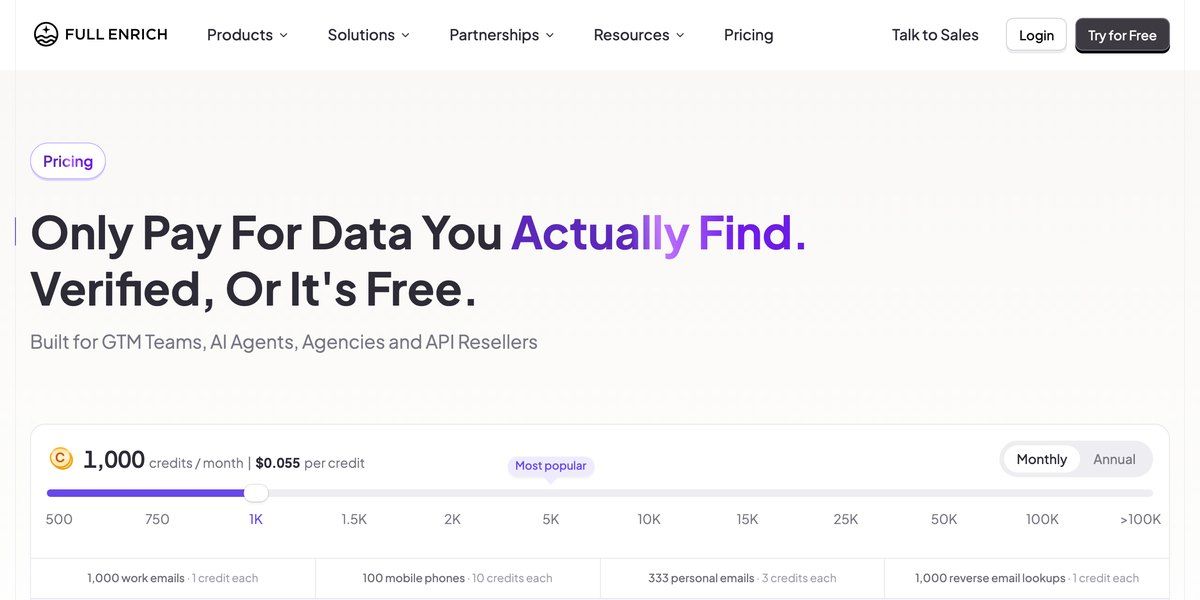
FullEnrich's pricing page. Source: fullenrich.com/pricing.
- API access: Self-serve. You get a key at signup with no sales call, and the free trial includes API and MCP access.
- What it returns: Work email, personal email and mobile phone in one call, plus person details and a light company profile. Reverse Email Lookup and Search are separate APIs.
- Billing on a miss: Nothing. A failed lookup costs 0 credits, and so does a landline found instead of a mobile. Emails cost 1 credit when found, including catch-all.
- Speed and limits: 60 API calls a minute with up to 100 contacts per bulk call, so up to 6,000 contacts a minute, per the rate limit docs. Enrich is async by webhook; Search is synchronous.
- MCP and integrations: A hosted MCP server with OAuth that works in Claude, ChatGPT and Cursor. Native HubSpot, plus Zapier, Make, n8n and Clay.
- Price (September 2026): Free trial with 50 credits and no card. Pro starts at $29 a month for 500 credits, or $26 a month billed yearly. Unlimited users on every plan.
Best for: Teams that want one verified waterfall across regions instead of stacking single-database vendors, and that enrich in batches or background jobs.
Where it falls short: The async Enrich API is the wrong choice for blocking a live form. There's no Salesforce integration today. Catch-all emails are billed like any other email found. At list price, an email plus a mobile costs more than a comparable record from Apollo, People Data Labs or RocketReach.
2. ZoomInfo
ZoomInfo is a single-database sales intelligence platform with deep company and signal data, sold through an account team.
ZoomInfo's Data-as-a-Service page. Source: zoominfo.com/products/data-as-a-service.
- API access: Sales-led. The product page leads with a demo request, and auth runs on OAuth 2.0.
- What it returns: Up to 25 contact or company records per enrich call. ZoomInfo describes 100M+ companies, 500M+ professionals and 50+ buying and business signals.
- Billing on a miss: Nothing. The enrich contact docs say no credit is charged on a "No match" or an error code. Each returned record costs a credit unless it's already under management.
- Speed and limits: Limits vary by package (Builder, Standard, Scaling), with webhooks for long-running jobs.
- MCP and integrations: An official ZoomInfo MCP server for AI agents, plus a CLI.
- Price (September 2026): No public price list. Access is quote-based.
Best for: Enterprise teams that want firmographics, buying signals and contacts from one vendor and are fine with a sales-led purchase.
Where it beats FullEnrich: Company and signal depth. FullEnrich focuses on contact data, and ZoomInfo's 50+ signal types cover ground a contact waterfall doesn't.
3. Apollo
Apollo is a self-serve sales platform with an API on every plan, and the lowest list price per record here when the contact sits in its own data.
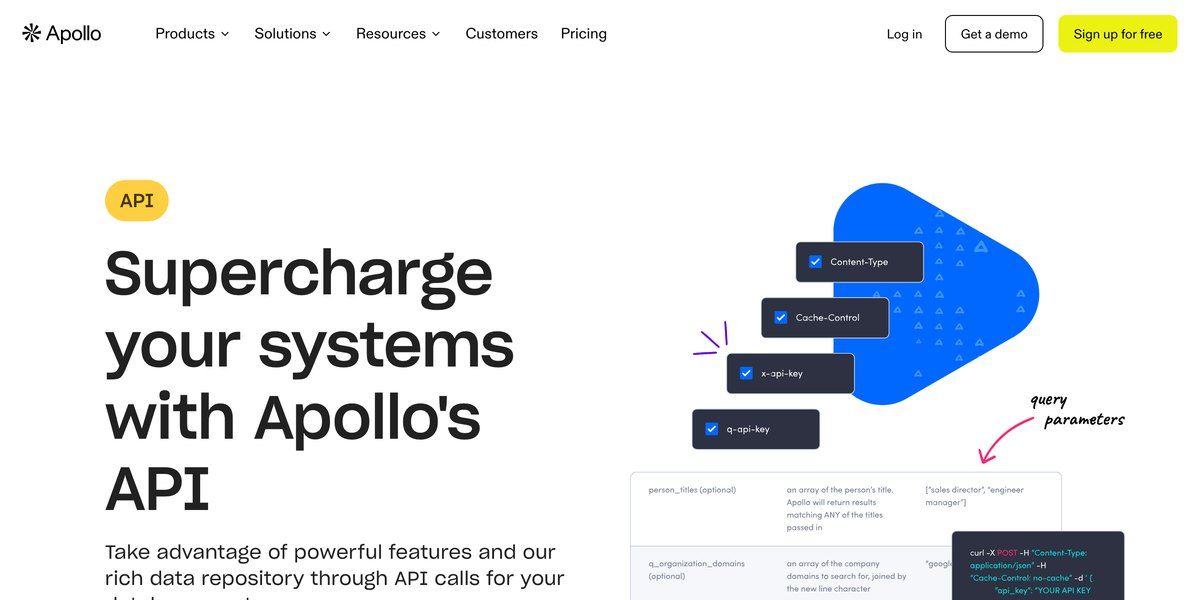
Apollo's API product page. Source: apollo.io/product/api.
- API access: Every plan includes at least basic API access, Free included. More advanced functionality sits on certain paid plans.
- What it returns: Email, mobile, demographics and company data from a database Apollo puts at 240M+ contacts. Bulk enrichment takes up to 10 people per request.
- Billing on a miss: It depends on the source. Apollo's own data charges only when data is found: 1 credit for email or demographics, plus 8 for a mobile. Its API pricing doc warns that some waterfall vendors "consume credits per lookup even when no data is found."
- Speed and limits: Limits apply per team, with 50 requests a minute on Free and 200 on paid plans. Waterfall results arrive by webhook.
- MCP and integrations: A remote MCP server on any plan, including Free.
- Price (September 2026): Free plan available. Basic is $49 per seat a month billed yearly, or $65 monthly. Our breakdown of Apollo's pricing runs the full credit math.
Best for: Teams already prospecting in Apollo who want API enrichment on contacts its database already holds.
Where it beats FullEnrich: Price per record when Apollo has the contact. An email plus a mobile from Apollo's own data works out to about $0.23 on Basic monthly, against $0.64 for the same pair on FullEnrich's entry tier. Once Apollo's waterfall runs, a phone typically costs 8 to 25 credits, or $0.21 to $0.65.
4. Cognism
Cognism is a sales intelligence platform built around European B2B data, with API access sold as part of specific packages.
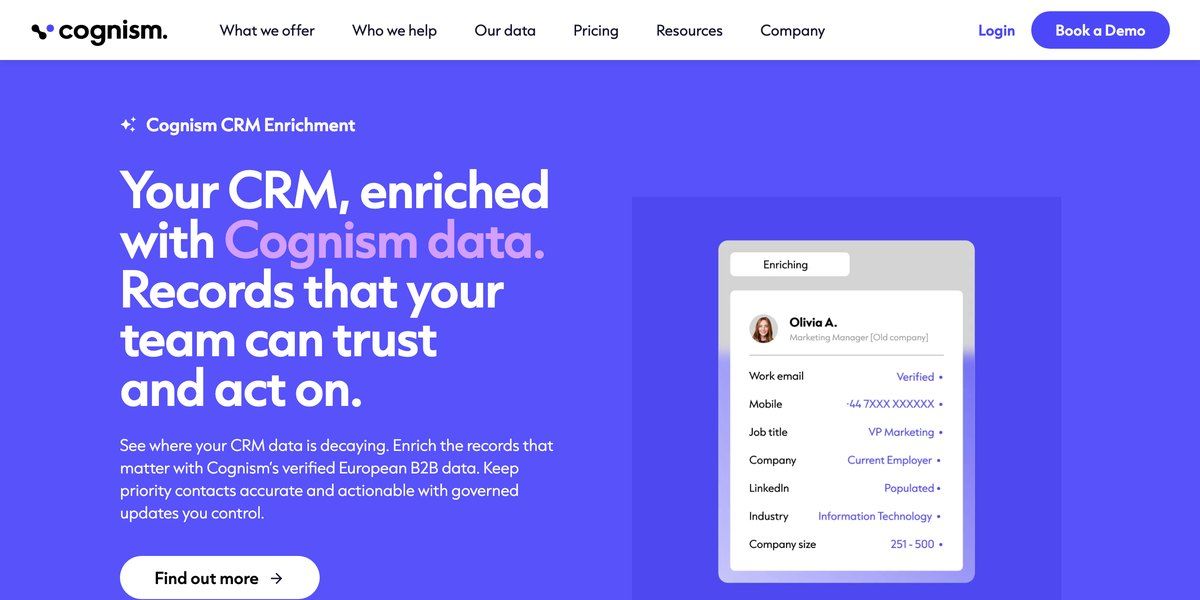
Cognism's Enrich page. Source: cognism.com/enrich.
- API access: You need a package that includes API access. Customers on older packages contact their account team. Auth is OAuth 2.0 client credentials.
- What it returns: People and company records through search, and contact details you reveal. Search tokens count the records you retrieve, and credits count the contact details you reveal.
- Billing on a miss: An empty result page costs no search tokens, and a count call costs one token but no credits, per Cognism's credits documentation.
- Speed and limits: 500 requests a minute on search, count and dictionary endpoints, set per package.
- MCP and integrations: An official MCP server for Claude, ChatGPT and Cursor, available on the new packages.
- Price (September 2026): No public price list and no free trial.
Best for: Teams whose priority accounts sit in Europe and who want one vendor's data there.
Where it beats FullEnrich: Account search, company data and European-focused contact data inside one platform and one contract.
5. Clearbit
Clearbit is now part of HubSpot, and new buyers get its data through HubSpot's data enrichment on paid hubs instead of a standalone API.
Clearbit's home page. Source: clearbit.com.
- API access: No standalone signup. The Clearbit site only offers a customer login.
- What it returns: Firmographic and job fields on HubSpot records, drawn from HubSpot's commercial dataset, third-party providers and public information. HubSpot's enrichment property list has no email or phone field for contacts, only a company phone number.
- Billing on a miss: Not applicable. Data enrichment doesn't consume HubSpot credits, per HubSpot's data enrichment guide.
- Speed and limits: Enrichment runs on HubSpot records inside the CRM, not through a Clearbit endpoint you call.
- MCP and integrations: Enrichment runs inside HubSpot itself, so there's no separate Clearbit connection to set up.
- Price (September 2026): Included on Starter, Professional and Enterprise tiers of HubSpot's Marketing, Sales, Service, Data and Content hubs. The free Clearbit platform was sunset on April 30, 2025.
It stays on this list because people still search for it by name, and it's the right answer only if you already live in HubSpot.
Best for: Teams already paying for a qualifying HubSpot hub who want firmographic enrichment without adding a vendor.
Where it beats FullEnrich: No extra spend and no setup on a paid HubSpot hub, since enrichment ships included.
6. People Data Labs
People Data Labs is a raw person data API built for engineers, with a free tier for testing and billing per match.
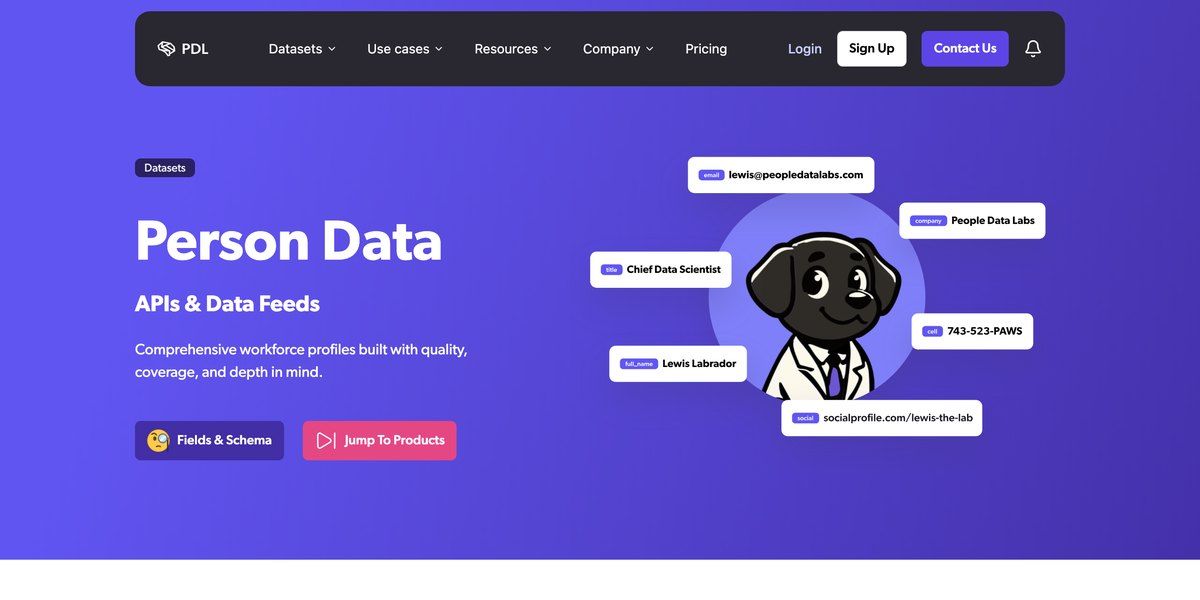
People Data Labs' person data page. Source: peopledatalabs.com/person-data.
- API access: Self-serve signup with an API key.
- What it returns: Person records matched one to one against what PDL describes as nearly three billion profiles. On the free plan, emails, phones and addresses are obfuscated until you move to Pro.
- Billing on a miss: Nothing. A non-match returns HTTP 404, and PDL's pricing and credits page says credits are consumed per successful match.
- Speed and limits: Synchronous, with 100 requests a minute for free customers and 1,000 for paying customers. Bulk calls take up to 100 records.
- MCP and integrations: No first-party MCP server on its site as of September 2026. Integrations include Snowflake, Databricks, Zapier and Make.
- Price (September 2026): Free plan with up to 100 credits a month. Pro starts at $98 a month for as few as 350 credits, at $0.28 per credit on the first monthly tier.
Best for: Engineering teams that want a high-throughput data API and plan to build their own verification and logic on top.
Where it beats FullEnrich: Speed. A synchronous answer at 1,000 requests a minute fits instant form enrichment and in-app lookups, where FullEnrich's async waterfall doesn't.
7. Lusha
Lusha is a self-serve contact data platform that gives every user an API key on every plan, with the strictest miss billing in this list.
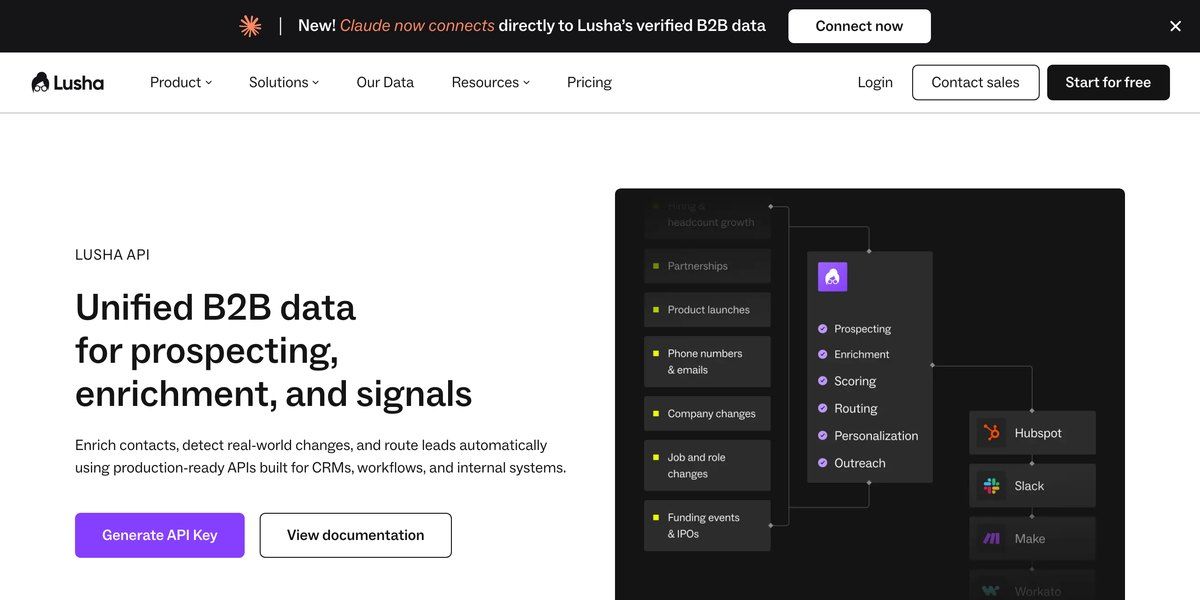
Lusha's API page. Source: lusha.com/lusha-api.
- API access: Every user gets a key by default on every plan, including Free.
- What it returns: Emails at 1 credit, phone numbers at 5 and company info at 1, plus 1 credit per request. An email and phone for one contact costs 7 credits.
- Billing on a miss: At least 1 credit per request even when no data comes back, per Lusha's API documentation. A request takes up to 100 contacts or companies.
- Speed and limits: Synchronous lookups. Per-key limits are 40 a minute on Free and Starter, 50 on Pro and 300 on Premium and Scale, with hourly and daily caps.
- MCP and integrations: A hosted MCP server over OAuth, with guides for Claude, ChatGPT, Codex, Cursor and VS Code. On Pro and above, a data waterfall falls through to third-party providers you enable.
- Price (September 2026): Starter is $49.90 a month for 400 credits, or $37.45 a month billed yearly. Our Lusha pricing analysis goes plan by plan.
Best for: Reps and small teams doing quick lookups where an instant answer counts for more than miss billing.
Where it beats FullEnrich: Instant answers. A synchronous lookup suits a form or a rep's click better than an async job that takes 30 to 90 seconds.
8. Hunter
Hunter is an email finder and verifier with API and MCP access on every plan, including a free one.
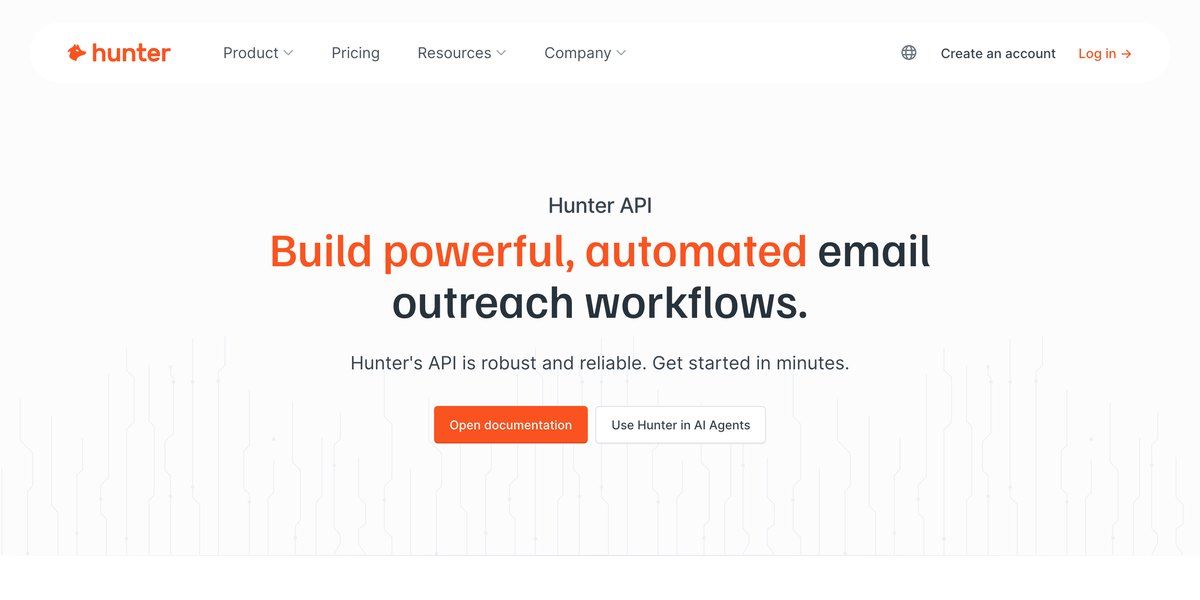
Hunter's API page, archived 12 September 2026. Source: hunter.io/api.
- API access: Self-serve on every plan, Free included, per its plan comparison table.
- What it returns: Email addresses only, through its Discover, Domain Search, Email Finder and Email Verifier APIs. No phone data.
- Billing on a miss: Nothing. Hunter counts 1 credit per email found, and a search that finds nothing is free. Verification costs 0.5 credit, and a failed verification costs nothing.
- Speed and limits: Synchronous calls drawing on a monthly credit pool set by plan.
- MCP and integrations: MCP on every plan, and the API page links straight to using Hunter in AI agents. Unlimited users on all plans.
- Price (September 2026): Free with 50 credits a month. Starter is $49 a month, or $34 billed yearly, for 2,000 credits.
Best for: Teams that only need work emails and want to start free with the API already switched on.
Where it beats FullEnrich: A free plan that keeps API and MCP access on, and cheap email credits once you pay: $0.0245 each on Starter monthly.
9. RocketReach
RocketReach is a contact lookup platform with API access on all three self-serve plans and a refund on lookups that don't return verified data.
RocketReach's home page, archived 21 September 2026. Source: rocketreach.co.
- API access: Included on Essentials, Pro and Ultimate. A free account comes with 5 lookups and no card.
- What it returns: Emails on Essentials, emails and phones on Pro and Ultimate. Its API docs describe 700M+ professionals and 60M+ companies.
- Billing on a miss: Refunded. RocketReach says a lookup is used only if it finds and verifies an email or phone.
- Speed and limits: Yearly export caps of 1,200 on Essentials, 3,600 on Pro and 20,000 on Ultimate. API limits live in its API documentation.
- MCP and integrations: No MCP server listed on its pricing page. HubSpot, Salesforce, Outreach, Salesloft and Bullhorn integrations on Pro and Ultimate.
- Price (September 2026): Essentials is $33 a month billed annually ($399 a year). Pro is $75 a month ($899 a year) and Ultimate $142 a month ($1,699 a year). Enterprise starts at $6K a year.
Best for: Small teams that want a lookup refunded automatically when nothing verified comes back.
Where it beats FullEnrich: A native Salesforce integration on Pro and Ultimate, which FullEnrich doesn't offer today. On Pro billed annually, one export with email and phone also works out to about $0.25.
10. Clay
Clay is an orchestration layer that calls 200+ data vendors, FullEnrich among them, from one table or one API.
Clay's home page. Source: clay.com.
- API access: The developer platform is on every plan, including free and trial plans.
- What it returns: Whatever the vendors you trigger return. Apollo, Hunter, People Data Labs and ZoomInfo (with your own account) are among them, and FullEnrich runs natively with your API key.
- Billing on a miss: Depends on the vendor you call. API calls "consume the same credits and actions as equivalent in-product work," per Clay's API docs.
- Speed and limits: Set by the actions and data credits in your plan. HTTP API integration columns come only with Growth and above.
- MCP and integrations: An Agent Plugin for Claude Code and Codex, plus Claygents.
- Price (September 2026): Free with 6K actions and 1.2K data credits a year. Launch is $167 a month and Growth is $446 a month.
Best for: GTM engineers who want to combine several vendors, FullEnrich included, in one workflow with their own logic.
Where it beats FullEnrich: Breadth and control. Clay can route a record through 200+ vendors and your own rules, and FullEnrich can be one step in that flow.
Enrichment API Comparison Table
The quickest way to compare these ten is by how you get a key, what a miss costs and the entry price.
Tool | API access | Billing on a miss | Entry price (Sept 2026) |
|---|---|---|---|
FullEnrich | Self-serve, key at signup | Free, landlines free too | Free trial (50 credits); Pro $29/mo |
ZoomInfo | Sales-led, demo request | No charge on "No match" | No public price |
Apollo | Self-serve, every plan incl. Free | Own data free; some waterfall vendors charge per lookup | Free plan; Basic $65/seat/mo |
Cognism | Package with API access required | Empty result pages cost no tokens | No public price |
Clearbit | No standalone signup, inside HubSpot | Not applicable | Included on paid HubSpot hubs |
People Data Labs | Self-serve | Charged per match only | Free (100 credits/mo); Pro $98/mo |
Lusha | Self-serve, every plan incl. Free | Minimum 1 credit per request | Free plan; Starter $49.90/mo |
Hunter | Self-serve, every plan incl. Free | Free if no email found | Free (50 credits/mo); Starter $49/mo |
RocketReach | Self-serve on Essentials, Pro, Ultimate | Refunded if nothing verified | 5 free lookups; Essentials $33/mo billed annually |
Clay | Self-serve, every plan incl. free | Depends on the vendor called | Free plan; Launch $167/mo |
Seven of the ten let you start without talking to anyone, and only Lusha charges a guaranteed minimum on an empty request. The entry price tells you what it costs to start, which is a different number from what a usable record costs.
How Do Match Rates Compare Across ICPs and Geographies?
Match rates move with region, seniority and list composition far more than with any vendor claim, so no published figure transfers cleanly to your list. That's why this ranking doesn't score the ten tools on match rate.
FullEnrich's own figure is about 80% on average for emails, varying by region and seniority. Its work email find rates typically run between 60% and 95%, depending on geography and persona. A list of US SaaS founders and a list of German plant managers will produce different numbers on every API here, ours included.
The definition of a match shifts too. FullEnrich counts catch-all emails as found and bills them, and other vendors draw that line in their own place. Two APIs can report the same match rate while handing you very different shares of deliverable addresses.
The structural point holds without competitor numbers. A single database's match rate is capped by what it holds in your segment. A waterfall's rate depends on how many providers cover that segment and how many results survive verification. The rate worth trusting is the one you measure on your own contacts.
How Do Enrichment API Pricing Models Work?
Enrichment APIs are priced per credit or per seat and contract, and the model decides what a miss, an idle user or a volume spike costs you. Most self-serve APIs in this list sell credits. The sales-led ones quote a package.
Per Credit Pricing
Per-credit pricing charges for the data you pull, so seats stop mattering and each field carries its own price. FullEnrich charges 1 credit per work email, 3 per personal email and 10 per mobile, at $0.058 per credit on its entry monthly tier. Lusha charges 1 per email, 5 per phone and 1 per request, at $0.125 per credit on Starter. Hunter works out to $0.0245 per credit on Starter monthly, for emails only. People Data Labs charges $0.28 per match on its first monthly tier.
Here's what the entry paid plan with API contact data costs each vendor per month, as of September 2026. ZoomInfo and Cognism don't publish prices, and Clearbit is sold inside HubSpot subscriptions, so they're left off.
Annual Subscription Pricing
Seat-based and annual pricing shows up at the sales-led end of this list and in tools built around the seat. Apollo's Basic, Professional and Organization plans cost $49, $79 and $119 per seat a month billed yearly. Organization is annual only with a 3-seat minimum, and unused Apollo credits don't roll over. RocketReach lists its self-serve plans at annual prices, from $399 a year.
ZoomInfo and Cognism don't publish prices, so you negotiate a package, and that package also sets your API limits. For contrast, FullEnrich's annual plan starts at $26 a month, and unused credits roll over for 12 months.
Hidden Costs to Watch
The biggest hidden cost in most enrichment plans is what you pay for misses, and it never appears on the price page. Lusha charges at least 1 credit per request even when nothing comes back, which is $0.12 on Starter. A phone through Apollo's waterfall typically costs 8 to 25 credits, and some of its vendors bill per lookup. Clay's HTTP API columns come only with Growth, at $446 a month.
List price per record found looks like this:
Tool | Price per record found | Basis |
|---|---|---|
FullEnrich | $0.64 | Work email + mobile (11 credits), Pro monthly entry tier |
Apollo | $0.23 | Email + mobile from Apollo's own data (9 credits), Basic monthly |
People Data Labs | $0.28 | One person match, Pro first monthly tier |
Lusha | $0.87 | Email + phone for one contact (7 credits incl. request), Starter monthly |
RocketReach | $0.25 | One export with email + phone, Pro billed annually |
List price per found record isn't cost per usable record. Lusha's minimum credit on every empty request adds cost the table can't show, and so do Apollo's waterfall vendors that charge per lookup. Verification changes how many found records you can use, and coverage on your list changes how many you find at all.
The rows aren't identical products either. A PDL match is a person record, while the FullEnrich row is an email plus a verified mobile. FullEnrich charges 0 on a miss and 0 for landlines, so its spend equals what it finds, catch-all emails included. Divide total spend by usable records, and the ranking can change.
Which Enrichment APIs Integrate With HubSpot, Salesforce, and Clay?
HubSpot is well covered among these ten, Salesforce support is uneven, and Clay reaches many of them through its marketplace. FullEnrich pushes enriched contacts to HubSpot natively, checking for existing records first and flagging uncertain matches for review. Clearbit now lives entirely inside HubSpot. RocketReach lists HubSpot and Salesforce integrations on Pro and Ultimate.
Salesforce is where you should check hardest. FullEnrich doesn't offer a native Salesforce integration today, so if Salesforce is your system of record, weigh that before you commit. More on the HubSpot side in our guide to HubSpot enrichment.
Apollo, Hunter, People Data Labs and ZoomInfo (with your own account) are reachable inside Clay, and FullEnrich runs there natively with your API key. Outside Clay, FullEnrich has no-code actions in Zapier, Make and n8n, and People Data Labs lists Zapier and Make.
Which Enrichment APIs Are Built for AI Agents and MCP?
Six of the ten tools list an MCP server as of September 2026: FullEnrich, ZoomInfo, Apollo, Cognism, Lusha and Hunter. Who can use each one differs.
FullEnrich's MCP server is hosted, uses OAuth and works in Claude, ChatGPT, Cursor and any MCP-compatible client, on every plan. Apollo's remote server works on any plan, Free included, and Hunter lists MCP on every plan too. Lusha's server connects over OAuth, with guides for Claude, ChatGPT, Codex, Cursor and VS Code. Cognism's covers Claude, ChatGPT and Cursor, on new packages only. ZoomInfo pairs its server with a CLI.
People Data Labs and RocketReach don't list an MCP server. Clay offers an Agent Plugin for Claude Code and Codex instead, and Clearbit's data reaches agents through HubSpot.
MCP makes the call easy for an agent, and it leaves billing and verification exactly as they were. An agent that retries lookups multiplies whatever the API charges on a miss. Check miss billing before you hand an agent the key.
What Are the Common Use Cases for a B2B Enrichment API?
Most enrichment API traffic falls into five patterns, and each one favors a different kind of API.
Inbound lead enrichment. A form fill or signup triggers a lead enrichment API call before the lead reaches a rep. If the form waits on the answer, a synchronous API like People Data Labs, Lusha or Hunter fits. If routing can wait a minute, an async waterfall can run through Zapier, Make or n8n. Our guide to lead enrichment covers the routing side.
CRM keep-fresh. A scheduled CRM enrichment API job catches records that have gone stale. Validity's State of CRM Data Management in 2025 surveyed 602 CRM users and stakeholders. Among them, 76% said less than half of their organization's CRM data is accurate and complete. FullEnrich doesn't charge to re-enrich a contact within 3 months when you send the exact same inputs, though duplicates inside one bulk call are each enriched and billed. More on the workflow in our guide to CRM enrichment.
Outbound prospecting pipelines. A prospect list gets enriched in bulk before it reaches a sequencer. Throughput counts more than latency here. FullEnrich takes up to 100 contacts per bulk call at 60 calls a minute, and async delivery is fine because nobody's waiting on a screen.
AI agent data access. An LLM calls enrichment as a tool in the middle of a conversation. MCP servers make this easy, and miss billing is where the cost quietly builds up.
Product embedding. A SaaS product offers enrichment to its own users through an API. People Data Labs' throughput suits instant in-app lookups. FullEnrich's Enterprise plan covers resellers and embedded API use with sub API accounts. Clay's public API can trigger workflows from outside Clay.
How Do You Test an Enrichment API in 30 Minutes?
You test an enrichment API by running 100 of your own contacts through each shortlisted vendor and comparing cost per usable record. Once you have keys, that takes about half an hour, and it shows you your list instead of the vendor's best one.
Step 1: Pull a Sample of 100 Real Contacts
Take 100 contacts from your own CRM or target list, messy ones included, because that's what the API will see in production. Mix regions and seniority in the proportions you sell to. Include a few contacts whose real email and mobile you already know, so you can check whether "found" also means right.
Step 2: Run the List Through Each API
Send the same 100 contacts with the same inputs to every API, so the vendor is the only variable. On FullEnrich, the whole sample fits in one bulk call, with results arriving by webhook as each contact finishes. Hard-coded team contacts cost 0 credits there, which helps while you wire things up. Log what each vendor charges per request, misses included.
Step 3: Verify Emails and Phones Independently
Spot-check results outside each vendor's own status labels, because every vendor defines "verified" its own way. Run found emails through a separate verifier, or send a small test campaign and watch the bounces. Call a handful of the mobiles. Note which emails came back as catch-all, since some vendors, FullEnrich included, bill those as found.
Step 4: Compare Match Rate and Cost per Verified Record
Divide what each API cost by the number of records that passed your step 3 checks, and compare that figure. On FullEnrich, spend equals records found, since misses and landlines cost nothing. On Lusha, add the minimum credit on every empty request, and on Apollo, any per-lookup charges from waterfall vendors. Rank by that number first, then weigh speed, integrations and MCP.
Start Enriching With FullEnrich
The fastest way to see FullEnrich's match rate on your data is to run a slice of your own list through the free trial. It gives you 50 credits with no card, plus full API and MCP access. A work email costs 1 credit, so that's up to 50 emails found, and misses cost nothing.
Pro starts at $29 a month with unlimited users and credits that roll over. Every tier, and the waterfall across 25+ sources, is on FullEnrich's pricing page. When you're ready, create a free account to get your API key.
Judge any enrichment API on two numbers: the records it gets right, and what it charges when it finds nothing.
FAQs About Enrichment APIs
What is the difference between an enrichment API and an enrichment tool?
An enrichment API is the endpoint your code calls, and an enrichment tool is the interface people use, often on top of the same data. FullEnrich offers both: a web app for lists and single lookups, and APIs for Enrich, Reverse Email Lookup and Search. Pick the API when enrichment has to run inside another system with no person in the loop.
Is enrichment API data GDPR compliant?
It depends on the vendor's compliance program and data handling, and the API format changes nothing. FullEnrich holds SOC 2 Type II, states GDPR and CCPA compliance, and stores enrichment results for 3 months only. People Data Labs lists ISO and SOC 2 Type 2 compliance. Your own lawful basis for outreach still applies.
Can an enrichment API return personal email addresses?
Some can, usually at a higher price than work emails. FullEnrich returns personal emails from a dedicated waterfall at 3 credits each, against 1 for a work email. Personal emails are meant for recruiting outreach to a specific candidate. They aren't meant for cold prospecting or ad targeting.
How fresh is the data returned by an enrichment API?
It depends on whether the vendor serves a stored record or queries providers at request time. FullEnrich keeps no stored contact database, so each request pulls from its providers live and then verifies. Database vendors refresh on their own schedules, so ask how often records update in your segment.
Is there a free enrichment API?
Yes, several. Hunter's Free plan includes 50 credits a month with API and MCP access. People Data Labs gives 100 free credits a month, with contact fields obfuscated. Apollo, Lusha and Clay include API access on free plans, RocketReach gives 5 free lookups, and FullEnrich's free trial gives 50 credits with no card.
Do enrichment APIs charge when no data is found?
Some do and some don't. FullEnrich, Hunter and People Data Labs charge nothing on a miss, and ZoomInfo doesn't charge on a "No match." RocketReach refunds lookups that don't find verified data. Lusha charges at least 1 credit per request, and some vendors in Apollo's waterfall charge per lookup.
How long does an enrichment API call take?
A synchronous call returns in the same request, and an asynchronous one comes back later by webhook. Most FullEnrich enrichments take 30 to 90 seconds per contact, averaging 56 seconds, while its Search API is synchronous. People Data Labs, Lusha and Hunter answer synchronously.