Apollo waterfall enrichment checks connected third-party data sources in an order your admin sets, after Apollo's own database, until it finds an email or phone number. It runs by default for your entire team, and it consumes credits any time a source returns a result, whether that result is verified or not.
That's the one difference worth understanding before the provider count or the integrations list. A dedicated waterfall has nothing of its own to protect: every provider it queries competes purely on whether it returns a usable result. Apollo's cascade runs behind a database it already owns, and that fact shapes almost everything that follows, from what runs first to what counts as verified to when the credit meter starts.
I build waterfall enrichment for a living at FullEnrich, so take the comparison with that in mind. This guide walks through how Apollo's version works, the way its own documentation describes it, then covers what each credit buys, how verification actually works and where the architecture runs out of coverage. Where FullEnrich enters the comparison, I say so plainly rather than folding it in quietly.
If your team already runs search, sequences and dialing inside Apollo, the waterfall is a legitimate reason to stay: one platform, one contract, no second tool to manage for contact data. What that convenience costs, and when it stops being worth it, is the rest of this guide.
Key Takeaways
- Apollo charges credits the moment a source returns an email or phone number, whether or not that result is verified. Independent checking is a separate, optional add-on.
- Apollo always runs first in the lineup and can't be moved from that spot. Below it sit 20 listed integrations: 17 data providers and 3 validators, and the list is closed to outside providers.
- "Verified" means the source vouches for its own answer. A dedicated validator like ZeroBounce is optional, costs extra credits and only one can run at a time.
- Enrichment runs up to 9 credits per record (1 for an email, 8 for a phone number), and the bulk-record ceiling is plan-scoped: 1,000 on Basic, 2,500 on Professional, 10,000 on Organization. A full 1,000-record run on Basic costs about 9,000 credits, nearly a third of that seat's annual 30,000. A full 10,000-record run on Organization costs about 90,000, 1.25 times the seat's annual 72,000.
- Stay with Apollo if your team already runs sequences and dialing there and your volumes are modest. Move to, or add, a dedicated waterfall once bounce rates, global lists or bulk-credit math become the real complaint.
What Is Apollo Waterfall Enrichment
Apollo waterfall enrichment is a coverage extender bolted onto Apollo's own database, not a neutral cascade.
The mechanism is simple. Apollo searches its own database first.
If it has no match, the request falls through to your connected third-party sources, one at a time, in the order your admin set.
Apollo positions the feature as expanded data coverage in one place. That framing is accurate.
The waterfall exists to fill the gaps Apollo's own database leaves, and Apollo's own help center describes removing the third-party sources as the most credit-efficient option, at the cost of coverage.
Two defaults matter before anything else.
The waterfall is on for your whole team the moment an admin configures it. And it is absent from the free plan.
One more thing to notice early. This is a waterfall you operate yourself: you pick the sources, order them and manage their accounts. The closing section prices that difference against a managed one.
Waterfall enrichment appears as a paid feature starting at Basic, at $49 per seat per month billed annually.
If you are new to Apollo itself, read that first. This guide assumes you know the platform and want to understand this one feature.
How Apollo Waterfall Enrichment Works
Four steps, and the credit meter runs during all of them.
1. Apollo Searches Its Native Database First
Apollo is always the first source in the lineup, and that position cannot be moved. The lineup is drag-and-drop for everything except position one: Apollo's help center is explicit that Apollo acts as your first data source and cannot be moved from the top spot.
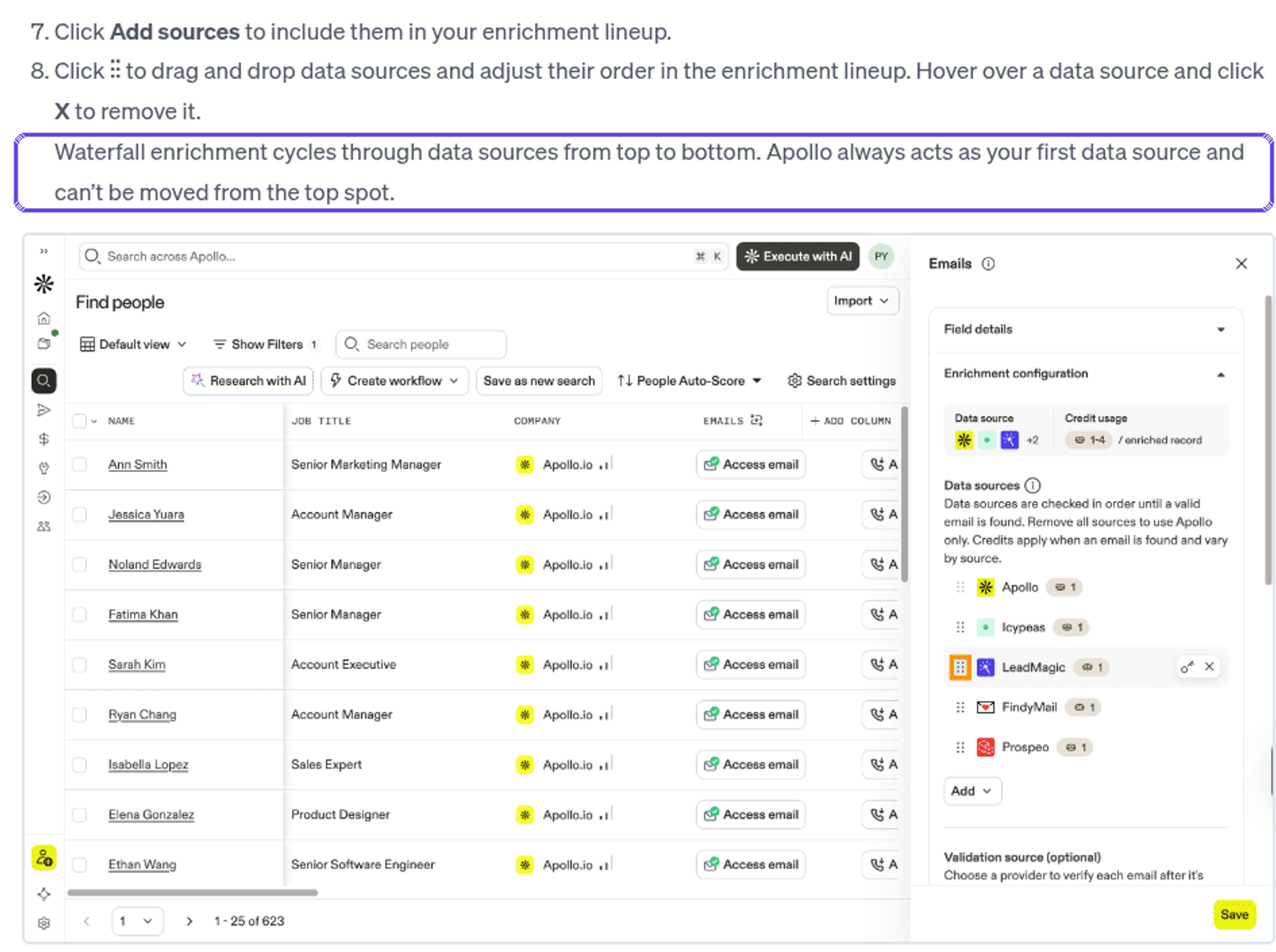
The rule in Apollo's own setup doc, highlighted: the cascade runs top to bottom and Apollo holds position one. Screenshot: knowledge.apollo.io, August 2026.
This is the structural difference between an in-platform waterfall and a dedicated one. Apollo's cascade is built to extend Apollo, not to referee an even competition among sources.
A dedicated waterfall has no home database to favor, so every provider competes on results, which is how a dedicated waterfall works end to end.
2. The Waterfall Queries Third Party Providers in Sequence
Providers run top to bottom until an email or phone number comes back. Your admin picks the sources and the order, and you cannot add providers Apollo has not listed.
Each source connects one of two ways:
- Apollo-integrated. Native connection, no account with the provider needed. Charges Apollo credits.
- External via API key. You bring your own paid subscription with that provider. It bills you directly and consumes no Apollo credits.
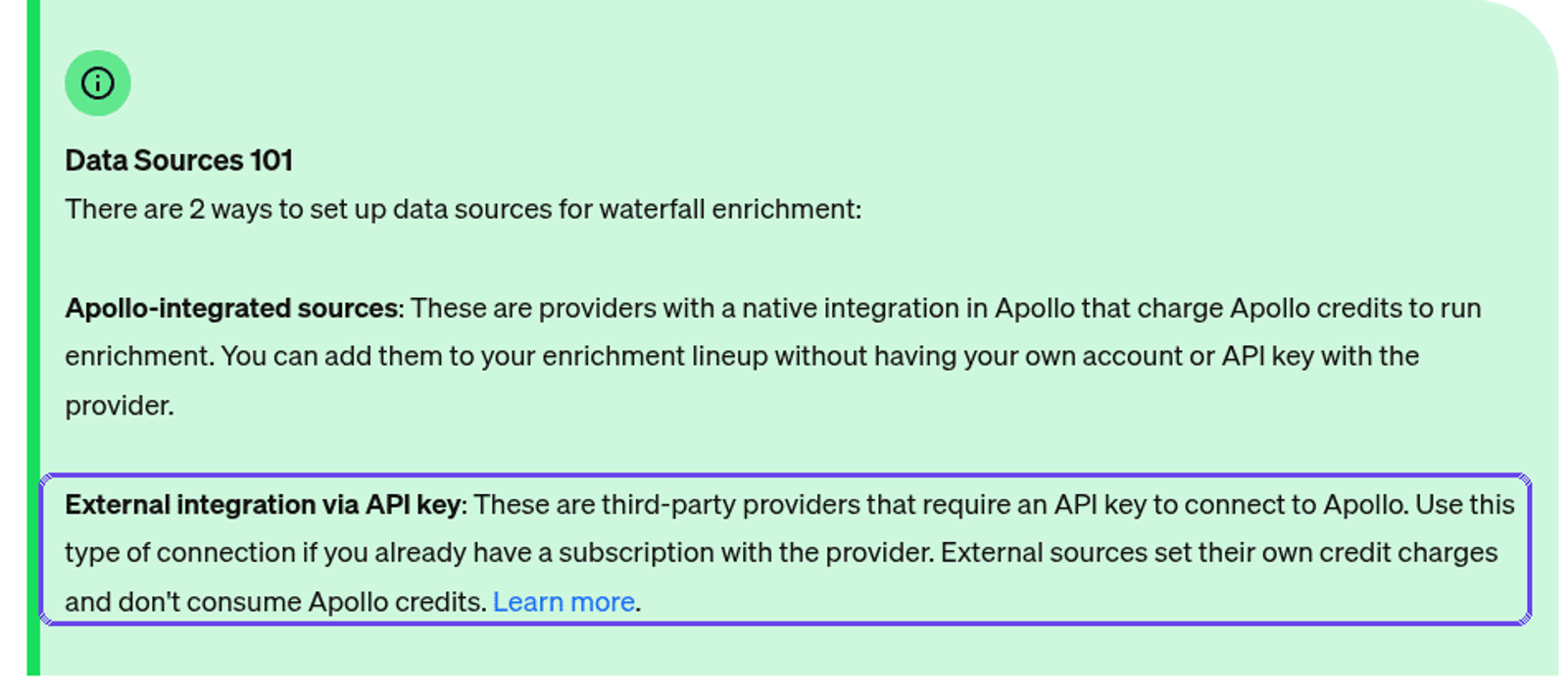
Apollo's help center on the two routes. The highlighted one means your own subscription with that vendor, billed outside Apollo. Screenshot: knowledge.apollo.io, August 2026.
That split matters: it decides who invoices you, and it comes back in the pricing section.
3. Results Are Labeled Verified by the Source That Returned Them
"Verified" in Apollo means the returning source vouches for its own result. Independent validation is a separate, optional layer, easy to miss on a first read of the feature.
Apollo defines three email states. Verified emails are up-to-date results returned by Apollo or a lineup source. Valid emails have passed an extra check through a connected data validator. Catch-all emails are domain-level addresses you can allow or exclude in bulk runs.
The validator is the detail buyers miss. It is optional, it costs additional credits and you can connect only one email or phone validation source at a time. Apollo's own setup flow shows the shape of it: an Apollo + ZeroBounce mode where Apollo enriches and ZeroBounce validates.
So the base waterfall returns provider-claimed data. Independent verification is an add-on you configure and pay for separately.
4. Credits Are Deducted for Every Returned Result, Verified or Not
You pay when a source finds something, not when that something turns out to be good. Apollo's help center states it twice, without hedging: credits are used when a source successfully returns an email or phone number, regardless of whether it is verified. And in verified-email mode, connected providers charge credits for each unverified email found on the way to a verified one.
Call this pay-per-attempt billing: the meter runs on the attempt, not on whether the attempt held up.
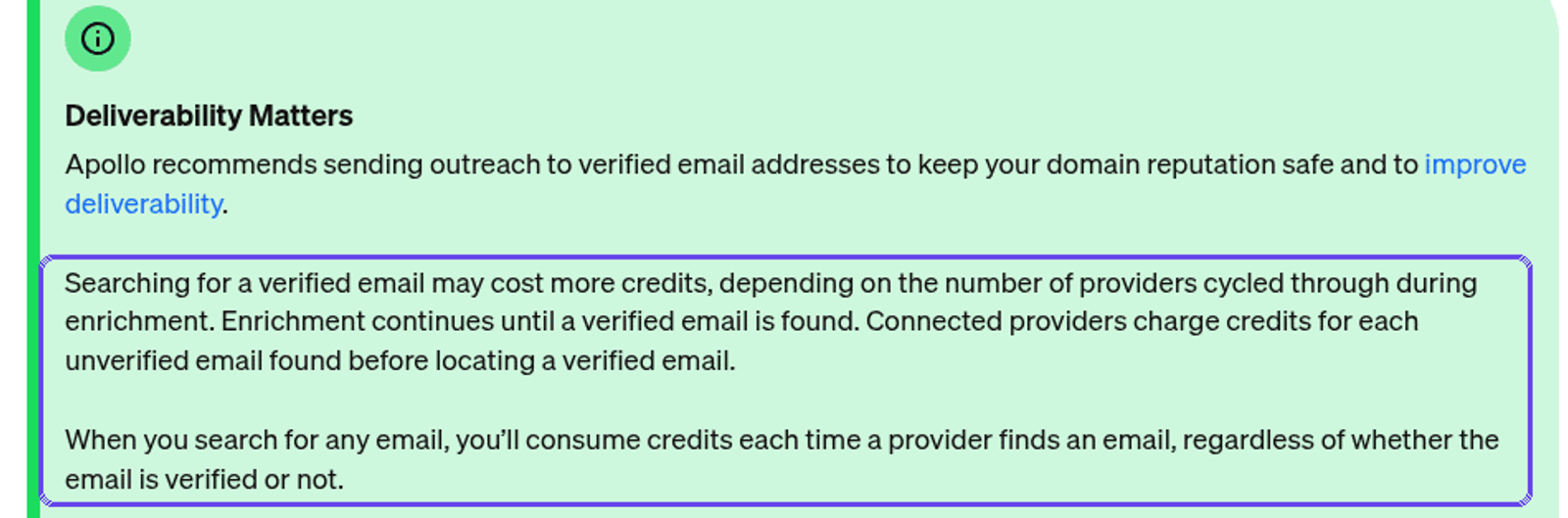
The billing trigger in Apollo's own words. Every found email consumes credits, verified or not. Screenshot: knowledge.apollo.io, August 2026.
A hard contact shows the mechanism clearly. The cascade tries four providers, three return emails that fail the verified bar and the fourth returns one that passes. You paid for all four results, not just the one you can use.
Re-enrichment follows the same logic further down the lineup. A re-run skips the source that succeeded last time and resumes at the next one.
Data Sources Inside the Apollo Waterfall
Apollo lists 20 waterfall integrations. Seventeen supply data and three validate it.
The integrations marketplace names all of them:
- Data providers: Bytemine, ClearoutPhone, ContactOut, Datagma, Dropcontact, Findymail, Global Database, Hunter.io, Icypeas, LeadMagic, Limadata, Prospeo, SMARTe, Swordfish.ai, Trestle, upcell and Wiza
- Validation sources: Bouncer, Enrichley and ZeroBounce
Publishing the roster is a deliberate choice, and it cuts both ways. You can see exactly what you are buying.
You can also see that some of the names are point tools you could subscribe to directly, which matters once you remember the API-key billing route.
The list is closed. Apollo's help center answers the own-provider question with a flat no: you can only connect the data sources or validation sources listed in Apollo.
Where to Run Apollo Waterfall Enrichment
The waterfall reaches every surface of the platform, with different bulk ceilings on each.
Apollo's how-to doc lists the full set: People Search saves and enrichment, job change enrichment, adding contacts to sequences, AI research templates, the Data Health Center, the contact profile page, CSV imports, the Chrome extension, enrichment workflows and the API.
People Search and Saved Lists
This is the default surface, and the biggest one. Saving net-new contacts, enriching saved ones and Access Email or Access Mobile clicks all trigger the waterfall. The bulk ceiling is plan-scoped, not a flat number: Apollo's pricing page puts the record-selection limit at 1,000 on Basic, 2,500 on Professional and 10,000 on Organization.
CSV Imports
Imported lists run through the same cascade on the way in, against the same plan-scoped ceiling described above. The arithmetic is worth checking before importing a big file: the pricing section shows why it matters more on Basic than on Organization.
Data Health Center
Scheduled hygiene runs use the waterfall to fill missing emails and catch job changes. Enrich-missing-emails jobs and job change schedules both cascade through your lineup, and AI research template runs carry a lower ceiling of their own, at 5,000 contacts per run.
Apollo Chrome Extension
Prospects saved from LinkedIn trigger the waterfall one contact at a time. The extension is one of the listed waterfall surfaces, and it can be switched off locally without touching team settings.
Enrichment API and Workflows
The API is waterfall-off by default, and waterfall query parameters ship as false until you set them to true per request. Results arrive asynchronously: firmographic data comes back immediately and the final email or phone lands on your webhook when the cascade finishes.
Bulk via API means something different from bulk in the UI. The bulk endpoint takes up to 10 people per request, against a record-selection limit as high as 10,000 in People Search on the Organization plan.
Teams planning a CRM-scale backfill through the API should do that division first.
Apollo Waterfall Enrichment Credits and Pricing
Waterfall enrichment is a paid feature with a per-result meter, and two of Apollo's own pages disagree about when the meter runs.
Plan access first. The free plan carries 900 credits per seat per year and no waterfall.
The API returns a permission failure for teams whose plan does not include the feature.
Apollo plan | Price | Credits per seat per year | Waterfall |
|---|---|---|---|
Free | $0 | 900, granted monthly | Not listed |
Basic | $49 per seat per month, annual | 30,000 | Included |
Professional | $79 per seat per month, annual | 48,000 | Included |
Organization | $119 per seat per month, 3-seat minimum | 72,000 | Included |
Now the meter. Accessing an email costs 1 credit and a phone number costs 8, with enrichment running up to 9 credits per record.
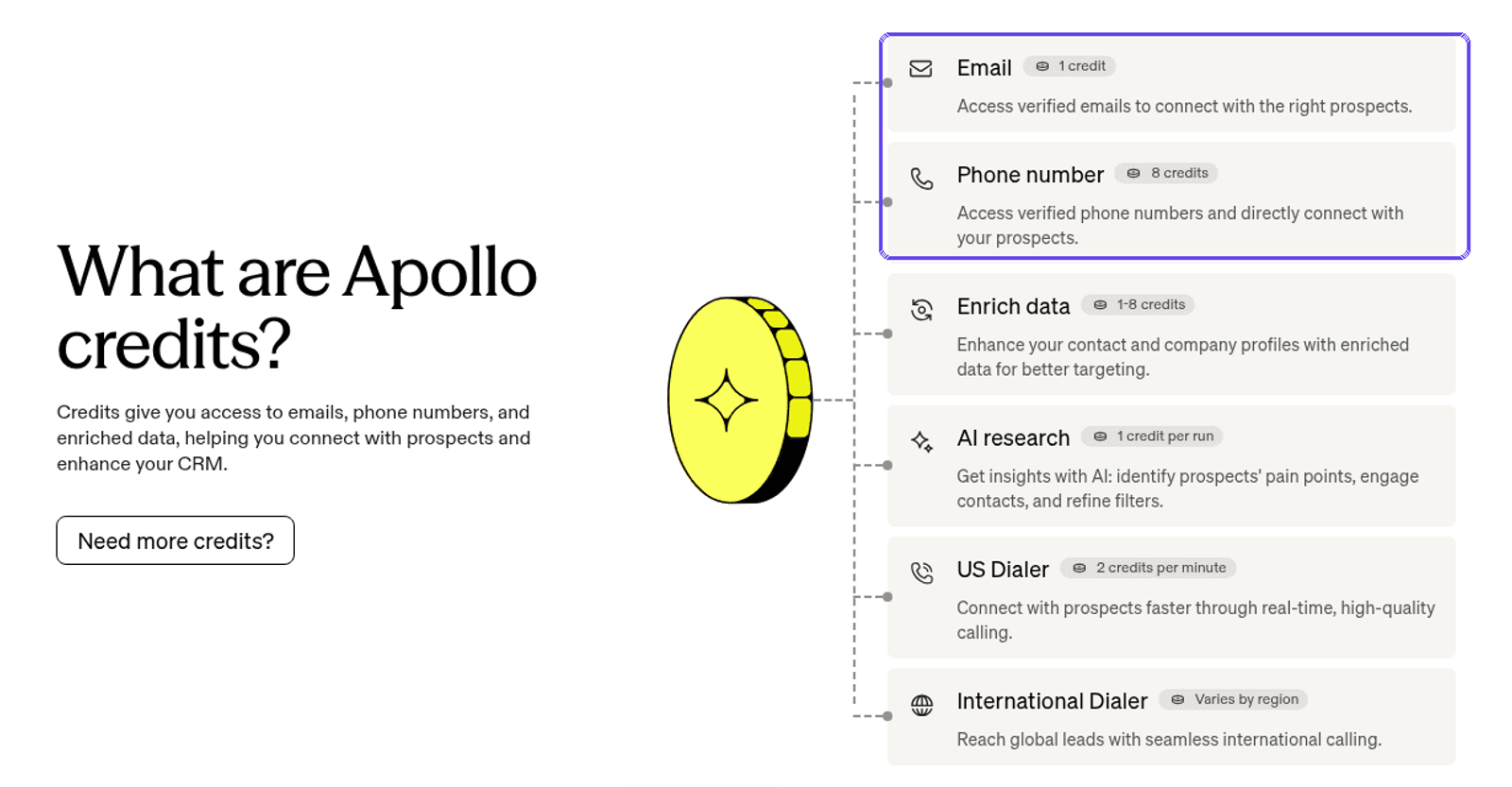
The rates on Apollo's pricing page, highlighted: 1 credit per email, 8 per phone number. The bulk arithmetic below starts from these two numbers. Screenshot: apollo.io/pricing, August 2026.
Apollo's own developer docs show exactly that: 9 credits consumed for one person enriched for email and phone together.
Applied to a real list, the math adds up fast: a 1,000-contact CSV enriched for emails and phones can consume up to nine thousand credits, and 1,000 records is also the most Basic lets you select at once, so a single big import can land right at the credit and record ceiling in the same run. On Basic, that single file is nearly a third of a seat's annual 30,000-credit allowance.
The unverified-results rule from step 4 sits on top: hard contacts can bill several results before one passes.
Two more mechanics decide what you actually spend:
- Two invoices. API-key providers bill you directly, outside Apollo credits. Apollo's reporting shows Apollo credit usage only, so the waterfall's full cost never appears in one place.
- Account-wide limits. Admins can cap credits per user, but the cap covers everything that user does in Apollo, not the waterfall specifically.
And one contradiction worth knowing about. Apollo's help center says no credits are used when nothing is found. Its developer documentation says some data sources may consume credits for a lookup even when they find nothing.
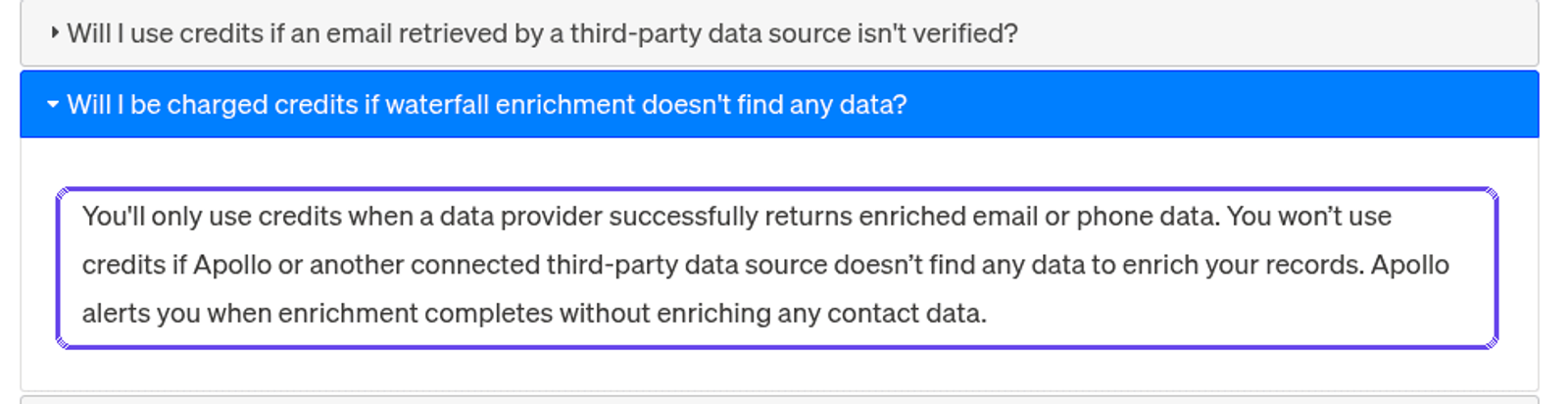
Answer one, from Apollo's help center: no data found means no credits used. Screenshot: knowledge.apollo.io, August 2026.
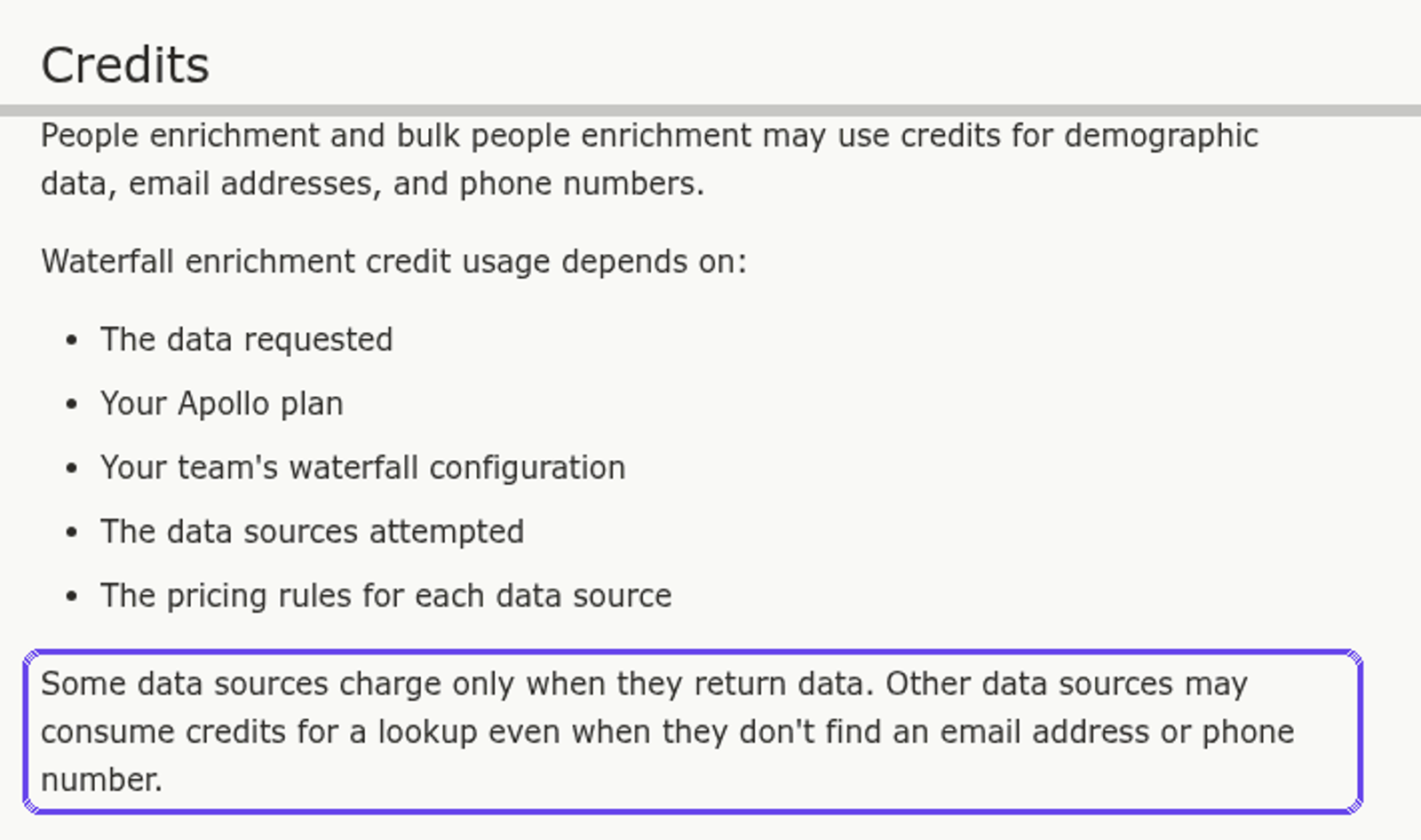
Answer two, from Apollo's developer docs: some sources may charge for the lookup even on a miss. Screenshot: docs.apollo.io, August 2026.
Two Apollo-owned pages, two answers to the question a buyer asks first. At large volumes, a small test batch and a look at what was deducted is worth more than either page.
For what the platform itself costs beyond enrichment, see our breakdown of Apollo's pricing.
Email and Phone Verification in Apollo Data Enrichment
Verification depth is where in-platform and dedicated waterfalls genuinely differ.
Email Verification and Catch All Handling
Base results carry the returning provider's word, and the independent check is optional and metered on top of that. Recall the three states: verified means source-returned, valid means it survived the extra validator, and catch-all means domain-level uncertainty you toggle on or off. One validator connects at a time, at extra credit cost.
Catch-alls are the honest test of any verification story. Apollo's answer is a toggle: allow them into results or exclude them. A dedicated verification layer tries to resolve them instead of sorting them into a bucket.
When you build a waterfall, catch-all domains are the hard case, because a toggle either lets noise through or throws away real contacts along with it. Resolving instead of guessing is slower to build, and it's the reason a toggle feels like the easy answer for a platform whose real job is somewhere else.
FullEnrich runs triple verification on every email: syntax, then MX record, then SMTP handshake. A failed check sends the cascade to the next provider rather than to your CSV. In our data, roughly half of catch-all domains resolve to a definite valid or invalid rather than staying flagged, and about 30% of everything providers return gets discarded before delivery.
We compared the major verifiers head to head in our email verifier comparison if you want that layer on its own.
Mobile Number Verification and Line Type Checks
Apollo publishes no owner-identity check for phone numbers, and that absence is the finding worth sitting with. Phone validation in Apollo's waterfall means connecting a phone validation source such as ClearoutPhone, which validates numbers in real time, but nothing in Apollo's waterfall documentation claims the line's owner is matched to your prospect's name.
Owner matching is the check that decides whether a rep dials the prospect or a stranger. FullEnrich checks every number for line type and active status with the carrier network, then matches line ownership against the lead's name for US and Canada numbers. Landlines and dead lines cost nothing because billing only triggers on a verified mobile.
Coverage Lift You Can Expect From Apollo Enrichment
Apollo's own published lift today is 7% more phone numbers, a 45% lower bounce rate and a 10% conversion rate to sale.
The email-coverage figure that used to sit beside those numbers is gone. As of this writing, there is no percentage for more emails on the page at all.
Those figures come from Apollo's product page, based on two months of usage data from beta customers.
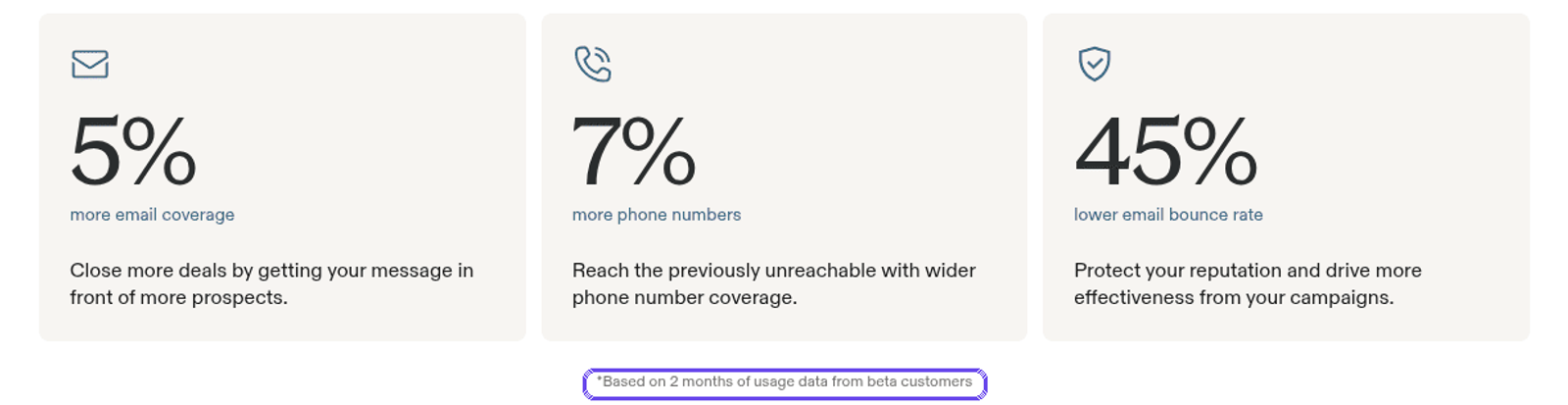
Apollo's published lift as captured in August 2026, beta-data footnote highlighted. The live page now shows 7% more phone numbers, 45% lower bounce rate and 10% conversion rate to sale, with no email-coverage figure. Screenshot: apollo.io/product/waterfall, August 2026.
On a 1,000-contact list, 7% more phone numbers works out to roughly 70 additional numbers over what Apollo's database finds alone. There is no equivalent emails figure to translate anymore.
Be careful comparing that with dedicated-waterfall numbers, because the denominators differ. Apollo measures lift over its own database, which already found most of what it will find.
In our data, FullEnrich customers see 30% to 200% more coverage than any single provider, varying by geography, seniority and list composition, with work email find rates running 60% to 95%.
Clay states waterfalls routinely triple its customers' coverage. Lift over a full platform and lift over one provider are different measurements. Neither is wrong.
Read the baseline before the percentage.
The number that ultimately matters is conversations, not coverage. FullEnrich customers see 20% to 30% connect rates against a 2% to 4% industry average.
On a 500-contact list, that works out to roughly 10 to 20 conversations at the industry average versus 100 to 150 at the rates our customers report, on the same list.
Where Apollo Waterfall Enrichment Falls Short
Five limits, all from Apollo's own published pages. None of them are about data quality.
These read as boundaries, not flaws: each one is a cost of operating the cascade yourself, inside a platform whose real job is outreach.
You Pay Before Verification, Not After
The billing trigger is the single biggest structural gap, and it's the pay-per-attempt billing described earlier working exactly as designed. Credits are consumed on any returned result, verified or not, including each unverified email found on the way to a verified one.
The incentive problem writes itself: the meter runs whether or not the data survives scrutiny. A pay-on-verified model inverts that. FullEnrich deducts credits only when a verified contact comes back, so failed lookups and unverified returns cost nothing.
We built it that way on purpose: when the charge lands on the attempt, the fastest path to a good-looking credit report is more attempts, not better ones. Tying the charge to the verified result instead points the incentive the same direction as the buyer's, toward a contact you can actually use.
Premium Providers Require Your Own Accounts
The published roster hides a procurement exercise. Apollo-integrated sources bill in Apollo credits, and the external ones require your own API key and your own paid subscription with that vendor. That means separate contracts, separate invoices and spend Apollo's reporting cannot show you.
A dedicated waterfall carries one balance across every provider it queries, with 25+ providers behind a single credit price.
No Published International Coverage Story
Apollo makes no geographic claim about its waterfall at all. Across the product page, both help center articles and the developer docs, there is no Apollo-authored statement about international coverage for waterfall enrichment. The only geography on offer comes from partner listing blurbs about their own databases, and a team prospecting into EMEA, LATAM or APAC has nothing from Apollo to evaluate.
That silence is not proof of weakness. It is an absence of evidence where a global buyer needs it, and dedicated waterfalls publish the numbers Apollo does not.
Personal Emails Are Not Part of the Offer
Apollo's waterfall documentation never mentions personal emails. Every Apollo description of waterfall output says emails and phone numbers, with no personal-email claim anywhere in its own copy. The phrase appears only in partner marketing inside the integrations marketplace, and recruiters and teams selling to founders live on personal emails specifically.
FullEnrich returns verified work emails, personal emails and mobile numbers from the same cascade.
Credit Costs Escalate on Bulk Jobs
The per-record math gets expensive at exactly the scale the feature is built for, and it scales differently by plan. Email plus phone runs up to 9 credits per record, and the record-selection ceiling that caps a single bulk run is plan-scoped: 1,000 on Basic, 2,500 on Professional, 10,000 on Organization.
The math looks like this at each end. A 1,000-record file on Basic uses up to 9,000 credits, nearly a third of that seat's annual 30,000. A 10,000-record file on Organization uses up to 90,000 credits, 1.25 times a seat's annual 72,000, which means one big bulk run can outspend a whole seat's yearly allowance before the year is out.
Two rules sit on top of that multiplication. Pay-per-attempt billing means unverified results still bill, and API-key providers invoice you separately, outside Apollo's reporting.
The developer docs say credit usage depends on the sources attempted and each source's pricing rules, so the true cost of a bulk job is knowable only afterward.
Apollo Data Enrichment vs Clay vs Cognism vs FullEnrich
These four are not four flavors of one thing. Two are platforms, one is a single database and one is a dedicated waterfall.
Full disclosure: we build FullEnrich. This is not an anonymous comparison pretending to be neutral. The facts in the table come from each vendor's own published pages, read in August 2026.
Apollo | Clay | Cognism | FullEnrich | |
|---|---|---|---|---|
Architecture | Own database first, 20 listed integrations behind it | Orchestration platform, user-built waterfalls over a 150+ database marketplace | One proprietary database, no waterfall | Dedicated waterfall across 25+ providers |
Who arranges providers | Admin orders the lineup, Apollo stays first | You build and reorder sequences per column | Nobody, single source | Automatic, verification decides what survives |
Billing trigger | Any returned result, verified or not | On result, nothing charged on a null | Per contact revealed, re-charged on job change | Only on a verified result |
Verification | Source-claimed, one optional validator at extra cost | Provider match logic per step | Human phone-verification on Diamond Data | Triple email check plus carrier check, owner-name match in US and Canada, built into the price |
Entry price | Waterfall from Basic, $49 per seat per month annual | Free plan includes waterfalls, Launch at $185 per month | Not published | $55 per month for 1,000 credits, free 50-credit trial |
Built for | Teams that live inside Apollo end to end | Teams building custom GTM workflows | Compliance-first calling into Europe, DNC screening across 15 territories | Coverage and verification depth as the whole job |
Three notes the table cannot carry.
Clay is a different category, and we say that as a provider inside it. Clay describes itself as data infrastructure: one contract over a 200+ vendor marketplace, with waterfalls as one module beside audiences, signals and workflow automation.
Apollo is even one of the providers Clay lists inside its work-email waterfalls.
FullEnrich is a native Clay integration too, with find-work-email and find-mobile actions billable in Clay credits or through your own FullEnrich account.
You add it from any Clay table with Add enrichment.
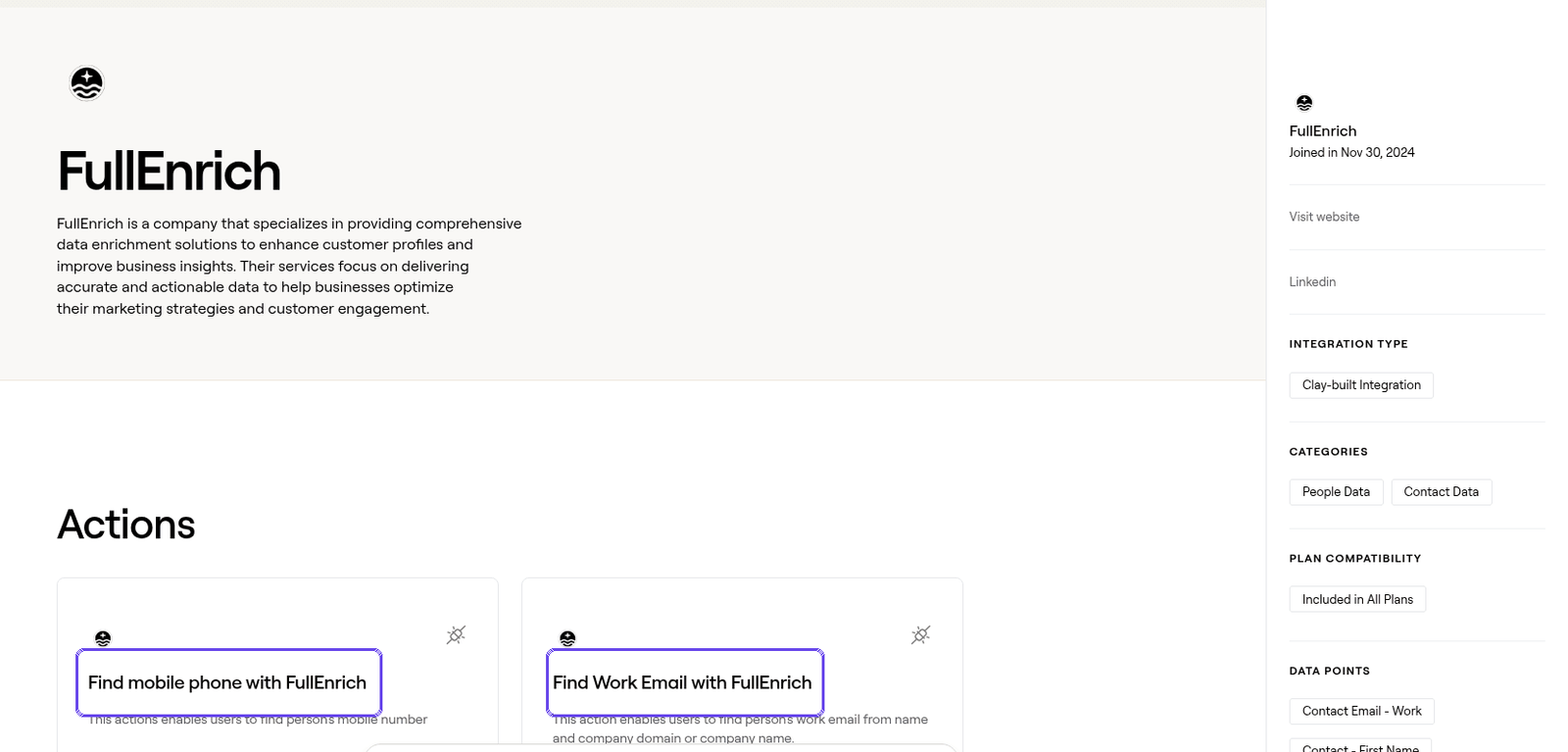
FullEnrich on Clay's own integrations directory: two enrichment actions, Clay-built, included in all Clay plans. Screenshot: clay.com, August 2026.
If Clay runs your GTM workflows, the two compose: Clay orchestrates, FullEnrich supplies verified contacts inside the sequence.
See our Clay pricing breakdown for how its credit model works.
Cognism is the architectural opposite of everything else here. No waterfall, one fused and phone-verified database, credits charged per contact revealed.
Over 10 million contacts are phone-verified by a process that calls the number and confirms who answers, with 95% of director-level contacts refreshed every 30 days.
What it does not publish is pricing. Our Cognism pricing guide covers what is known.
Apollo overlaps with the dedicated tools without replacing them. Its waterfall extends its own database and stops there. Pay-per-attempt billing is part of that boundary: the mechanic that works fine inside outreach-first Apollo is exactly what a dedicated waterfall is built to avoid.
The gaps in the section above are the boundary of that design, not bugs in it.
When to Stick With Apollo and When to Move to a Dedicated Waterfall
Match the tool to the failure you are actually seeing.
Where Apollo wins is real: one platform covers search, sequences, dialing and enrichment, so a team that already lives there gets the waterfall without a second tool or a second contract to manage.
Stick with Apollo's waterfall when all three of these hold. Your team already runs sequences and dialing inside Apollo.
Your lists are modest enough that up to 9 credits per record does not distort the budget.
And provider-claimed verification, with one optional validator, is enough certainty for your send volumes.
Layer or move when any of these describe you:
- Bounce and connect rates are the complaint. The billing trigger is the tell. Pay-per-attempt billing and a tool that only charges on a verified result will hand you different CSVs from the same list.
- Your lists are global. Apollo publishes no international coverage story for its waterfall. Dedicated waterfalls publish find-rate ranges by geography.
- You are enriching in bulk. The 9-credits-per-record math against your list size is worth running before the import, then set beside 1 credit per verified email and 10 per verified mobile, with misses free.
- You already orchestrate in Clay. Clay stays where it is, and FullEnrich becomes one more enrichment step inside your tables. Nothing needs replacing.
- You want Apollo for sequences and something else for data. That split is common and reasonable. Our guide to Apollo alternatives maps who fits which gap.
Apollo Waterfall Enrichment vs a Managed Waterfall
Apollo gives you a waterfall to operate. A managed waterfall operates itself.
Add up the jobs this guide has described Apollo handing you: choosing providers, ordering the lineup, bringing API keys and separate subscriptions for the external sources, picking the one validator you're allowed, then reconciling two sets of invoices against a report that only shows one of them.
That list is the real cost of self-managing a cascade inside a platform whose real job is running your outreach, not the architecture doing anything wrong.
A managed waterfall removes those jobs instead of exposing them. This is what FullEnrich does, and how:
- No assembly. One account, one balance, 25+ providers already behind it.
- Verification is the routing logic, not an add-on. Every email passes syntax, MX and SMTP checks before it reaches you. Mobiles are checked for line type, active status and owner name in the US and Canada. In our data, roughly half of catch-all domains resolve to a definite answer.
- One billing trigger. A verified result costs credits. A miss, a landline or a failed verification costs nothing. This is pay-per-verified, the opposite of the pay-per-attempt billing running underneath Apollo's cascade.
- The output is pre-filtered. About 30% of what providers return never reaches you.
You send a contact in. You get a verified contact back, or you pay nothing. That's the principle the whole design answers to.
The test costs nothing either. Start with 50 free credits, no card required. The fairest test is the contacts Apollo could not finish, the ones that came back empty or bounced, and how many of them return verified.
FAQs About Apollo Waterfall Enrichment
Is Apollo waterfall enrichment the same as CRM enrichment?
No. Apollo's waterfall enriches emails and phone numbers for net-new and saved contacts.
CRM enrichment is a separate Apollo process that updates Salesforce or HubSpot records with firmographic, demographic and technographic data.
Can I use Apollo waterfall enrichment for phone numbers only?
Yes. Access Mobile in People search runs the waterfall for phone numbers alone. Via the API, email and phone are separate parameters you enable independently.
Does Apollo waterfall enrichment support personal emails?
Apollo's own documentation never claims personal email enrichment anywhere. The only personal-email language on Apollo's site sits in partner listing copy about their own databases.
Tools built for personal email return it as a distinct verified field, the way FullEnrich does alongside work emails and mobiles.
Can I connect my own data providers to Apollo's waterfall?
No. Only the data and validation sources Apollo lists can be connected, natively or with your own API key.
The API-key route also moves billing to that vendor and out of Apollo's reporting.
Does Apollo charge credits when no data is found?
Apollo's help center says no, credits are only used on a successful return.
Its developer documentation says some sources may consume credits for a lookup even when nothing is found.
A small batch, checked against what was deducted, answers the question before volume does.
Can admins set credit limits on Apollo waterfall enrichment?
Admins can set per-user credit limits, but the cap applies to everything the user does in Apollo, not to waterfall enrichment specifically.
Sources and Method
The Apollo facts in this guide come from Apollo's public knowledge base articles on waterfall enrichment (https://knowledge.apollo.io/hc/en-us/articles/34071121664781-Use-Waterfall-Enrichment, https://knowledge.apollo.io/hc/en-us/articles/34071089002509-Waterfall-Enrichment-Overview), its waterfall product page, its integrations marketplace, its pricing page and its developer documentation, all read in August 2026.
Clay facts come from clay.com's waterfall, pricing and integration pages, read the same month. Cognism facts come from cognism.com's homepage, pricing and Diamond Data pages.
FullEnrich figures are our own published numbers from fullenrich.com and our internal product documentation.
This is not a hands-on trial. We did not run test lists through Apollo, Clay or Cognism for this piece.
Where two of a vendor's own pages disagree, we say so rather than picking a side.
We did not scrape review sites and no third-party opinion about any vendor's data quality appears here.
Every tool was described from what its maker publishes. The gaps we named are absences and mechanics, checkable in an afternoon.
The provider count was never the question. The question is what you pay for and when.